


Coolant circuit
B3, B6, BP (SOHC)
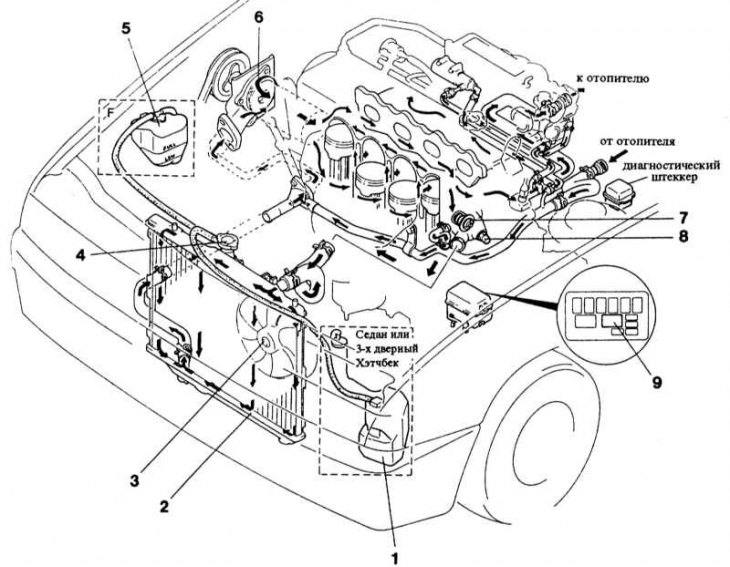
1 - expansion tank; 2 - radiator; 3 - radiator fan; 4 - radiator cap; 5 - expansion tank model F; 6 - water pump; 7 - thermostat; 8 - thermal switch; 9 - fan relay
The cooling system consists of a radiator, water pump, thermostat and electric fan.
The coolant circuit is thermostatically controlled. When the engine is cold, the coolant circulates only in the cylinder block and the heater core. When the coolant heats up, the thermostat opens and the coolant begins to flow through the radiator. The coolant is driven by a water pump, which in turn is driven by a V-belt. The coolant passes through the radiator from top to bottom and is cooled by the air flowing through the fins.
An electric fan provides additional cooling. When the coolant temperature rises to +91°C, the thermal switch switches on the fan via a relay. If the coolant temperature drops below +84°C, the thermal switch automatically switches off the fan.
The coolant reservoir serves as an expansion tank and collects the liquid that expands when heated, and after the engine has cooled, it returns it back to the circuit. Due to this, the circuit is constantly filled and ensures good cooling. Coolant should be added only through the expansion tank.
Warning! The radiator fan may turn on automatically when the engine is off and the ignition is on. This process, caused by the heat in the engine compartment, may be repeated several times. When working in the engine compartment on a hot engine, you should always remember that the fan may turn on unexpectedly. Therefore, if possible, turn off the ignition when working in the engine compartment.
The original article is on: mazbook.ru