


Contents: Removal ⇓ Installation ⇓
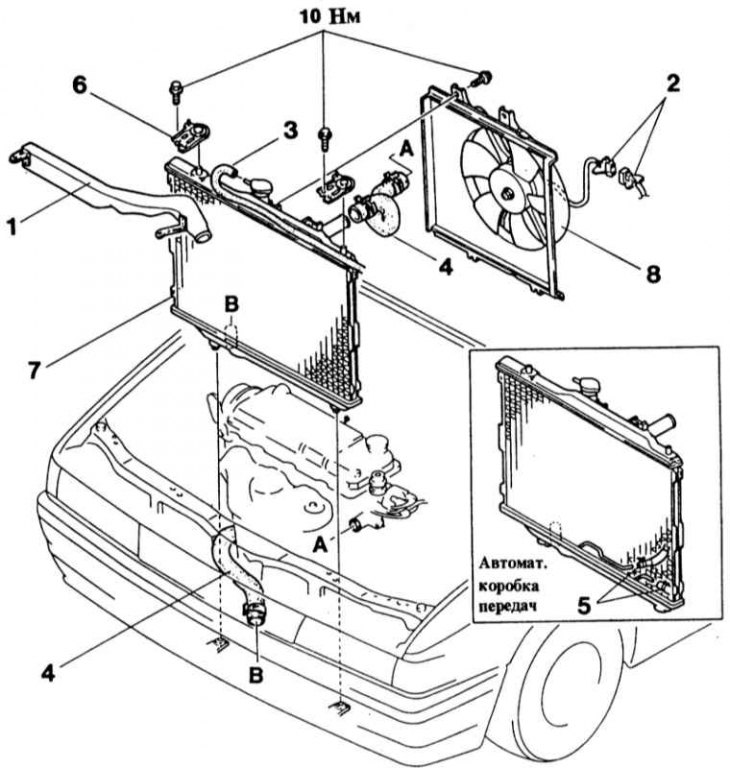
1 - resonance chamber; 2 - plug connection, fan; 3 - hose, expansion tank; 4 - coolant hoses; 5 - oil cooler connection. (Only cars with automatic transmission.); 6 - Upper radiator bracket; 7 - radiator; 8 - Electric radiator fan
After a long period of operation of the car, the thin channels in the radiator can become clogged due to the remaining coolant and lime deposits. This leads to a drop in cooling capacity, the engine overheats. In this case, only a radiator replacement will save the situation.
Removal
1. Disconnect the ground cable from the battery.
Warning! This will erase the engine fault memory or the radio security code. Before disconnecting the battery, read the instructions in Section Removal and installation the battery.
2. If present, unscrew the resonance chamber.
3. Drain the coolant.
4. Disconnect the upper and lower hoses on the radiator, having first loosened and completely moved the clamps.
[The primary source is the website: www.mazbook.ru]
5. Disconnect the hose to the expansion tank from the radiator, having first loosened the clamp.
6. Disconnect the radiator fan cable.
7. Diesel engine: Disconnect the coolant level sensor.
8. Cars with automatic transmission: Disconnect the pipes from the oil cooler, having first loosened and completely moved the clamps. Plug the hoses with clean bolts.
9. Unscrew the bolts securing the upper radiator bracket, tilt the radiator back and remove it together with the fan.
10. If there is not enough space, you can remove the radiator fan.
Attention! The radiator fins have very sharp edges, so it is recommended to wear gloves when removing them.
Warning! If the radiator remains removed for more than 48 hours, it must be washed with clean water, dried with compressed air and the openings must be closed. The radiator can also be stored filled with coolant, with the openings closed. If this is not done, corrosion will occur, which will subsequently lead to leaks.
Installation
1. If necessary, move the fan to the new radiator.
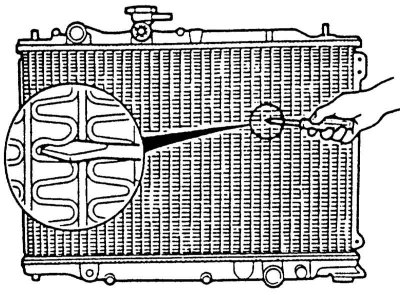
2. If an old radiator is being installed, it should be checked beforehand. Check that there is no damage to the radiator mesh and waterproof casing.
3. If the radiator fins are bent, they must be carefully straightened with a screwdriver.
4. Check all coolant hoses for tears, cracks and other damage, replace if necessary. Check the condition of the rubber radiator mounting tips.
5. Insert the radiator from above so that the radiator mounting pins enter the rubber pads on the bottom of the holder.
6. Tilt the radiator forward, install the upper bracket and tighten the mounting bolts with force 10 Nm.
7. Install the upper and lower radiator hoses and secure them with clamps.
8. Attach the coolant hose to the expansion tank and secure it with a clamp.
9. Connect the cables to the thermal switch and fan.
10. Diesel engine: Connect the cable to the coolant level sensor.
11. Cars with automatic transmission: Remove the bolts from the hoses, place the hoses on the oil cooler and secure with clamps. Check the fluid level in the automatic transmission, see Chapter Maintenance.
12. Fill with coolant, see Section Routine maintenance.
13. Connect the ground cable to the battery.
14. If available, set the time on the clock and set the security code for the radio receiver.
15. Warm up the engine and check the tightness of the hose connections and radiator.
16. Check the coolant level and top up if necessary.