


Before jacking up the car
1. Place the vehicle on a level surface where work can be carried out safely without obstructing traffic.
2. Apply the parking brake.
3. Move the manual transmission shift lever to the "R" position and turn off the engine. Set the transfer case control lever to any position except "N".
4. If necessary, turn on the hazard warning lights and install the emergency stop sign. Unload the passengers from the car and remove the luggage.
5. Remove the jack and jack handle.
Jacking up a car
Attention:
- Never stand under a vehicle that is supported only by a jack. The jack may tilt and move from its mounting position or fall, which could cause an accident.
- Install the jack only in the recommended position. If the jack is installed incorrectly, dents may form in the car body or the jack may fall, injuring you.
- Avoid installing the jack on a slope or unstable surface. Otherwise, the jack may tilt and move from the installation position or fall, which may cause an accident. Always install the jack on a flat, hard surface.
- Before installing the jack, make sure that there is no sand or small stones on the supporting surface.
1. Place a wheel chock under the wheel that is diagonal to the jacking point.
2. Place the jack on a flat, hard surface.
3. Rotate the jack handle clockwise to the installation position.
4. Install the jack in the place specially designated for it.
Make sure the jack is securely installed in the mounting location in the vehicle body.
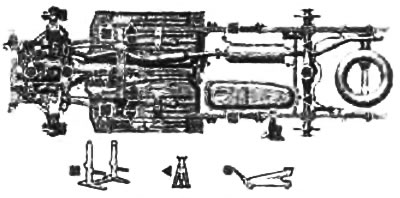
5. Connect the jack handle. Turn the handle clockwise to jack up the vehicle.
6. Lower the vehicle by turning the handle counterclockwise.