


Please note: To perform the test drive, you must select a safe area without heavy traffic.
Note: When performing a road test of an automatic transmission, if the required driving speed exceeds the limit permitted by traffic regulations, use a dynamometer.
Preparing for the test drive
1. Check the engine coolant level.
2. Check the engine oil level.
3. Check the automatic transmission fluid level (see the relevant section below).
4. Gasoline engines: check the ignition timing and idle speed.
5. Make sure that there are no fault codes in the vehicle's memory.
Checking D mode
1. Prepare for the test drive (see above).
2. Warm up the gearbox to operating temperature.
3. Select position D.
4. Check the switching points for position D in normal mode. If any faults are detected, identify the cause and correct the fault.
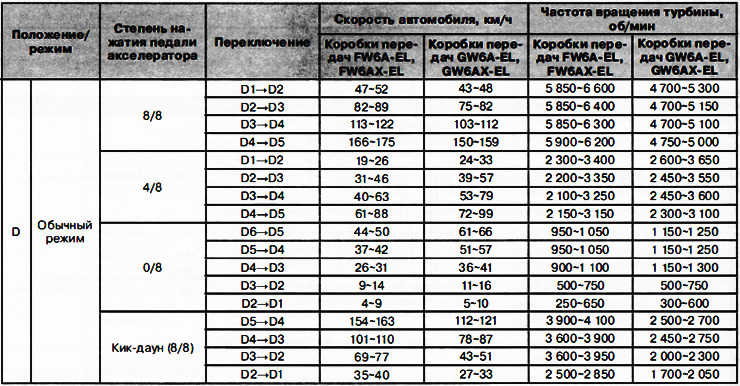
Press the accelerator pedal, start moving the car and make sure that the gears shift from 1 to 2, from 2 to 3, from 3 to 4, from 4 to 5 and from 5 to 6. In addition, it is necessary to make sure that the driving speed corresponds to the gear shift points.
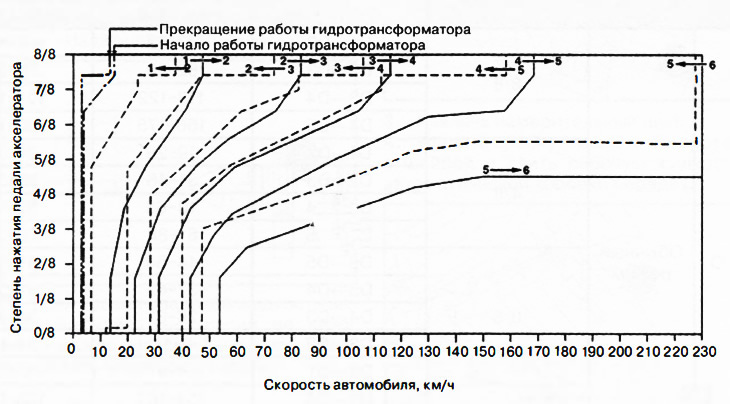
Switching diagram (position D, normal mode) gearboxes FW6A-EL, FW6AX-EL
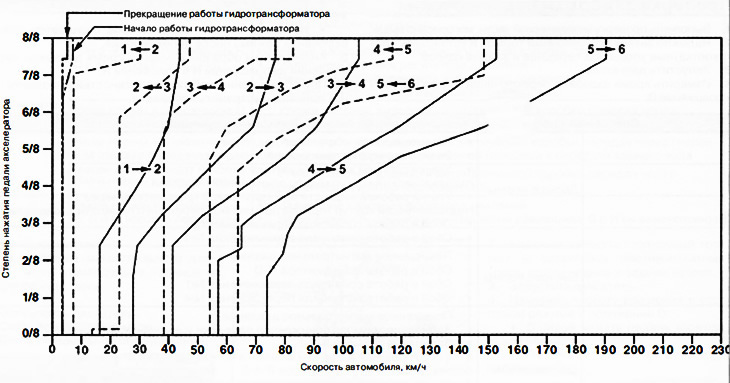
Switching diagram (position D, normal mode) gearboxes GW6A-EL, GW6AX-EL
When driving in sixth gear, release the accelerator pedal and make sure that the gears shift from 6 to 5, from 5 to 4, from 4 to 3, from 3 to 2, from 2 to 1. In addition, it is necessary to make sure that the driving speed corresponds to the gear shift points.
Note.
- If the accelerator pedal is released completely quickly, the gear shift is not performed according to
- the given template, since the current transmission can be saved.
- When reducing speed by pressing the brake pedal hard, the shifting does not occur according to the given pattern, since the downshift point may be at a higher speed.
By sharply pressing the accelerator pedal (kick-down) in 6th, 5th, 4th, 3rd and 2nd gears, make sure that the gears shift from 6th to 5th, from 5th to 4th, from 4th to 3rd, from 3rd to 2nd and from 2nd to 1st. Also, make sure that the maximum speed for kick-down corresponds to the shift point.
Make sure that the shocks from gear shifting are minimal, the shifting is smooth and fast, without extraneous noise or sticking.
Checking M mode
1. Prepare for the test drive (see above).
2. Warm up the gearbox to operating temperature.
3. Select position M.
4. Check the switching points for position M in normal mode. If any faults are detected, identify the cause and correct the fault.
When changing gears while driving the vehicle, make sure that the gears change.
Release the accelerator pedal while driving in sixth gear and make sure that the gears shift from 6 to 5, from 5 to 4, from 4 to 3, from 3 to 2, from 2 to 1. In addition, it is necessary to make sure that the driving speed corresponds to the gear shift points.
When releasing the accelerator pedal while driving, make sure that engine braking occurs in all gears.
Make sure that the shocks from gear shifting are minimal, the shifting is smooth and fast, without extraneous noise or sticking.
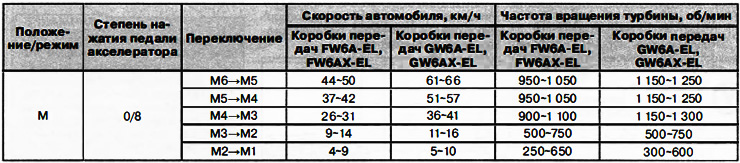
5. Check the second gear of the fixed mode:
With the vehicle stopped or at a speed of 10 km/h or less, move the selector lever toward + to shift into second gear.
Make sure that second gear is engaged.
When releasing the accelerator pedal while driving, make sure that engine braking occurs.
When changing gears while driving the vehicle, make sure that the gears change.
Checking the R mode
1. Stop the vehicle on a gentle slope and move the selector lever to position P.
2. Release the brakes and make sure the car is not moving. If any faults are found, check the parking mechanism in the gearbox.