


Cars with manual transmission
The throttle position sensor should be checked if the engine has poor throttle response, rough idle, and does not achieve maximum power. The throttle position sensor should also be checked as part of maintenance.
Examination
1. Disconnect the plug from the throttle position sensor.
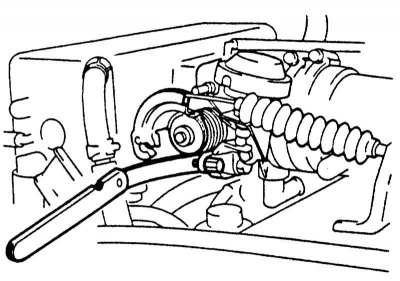
2. Using a flat feeler gauge, adjust the distance between the throttle stop bolt and the stop lever.
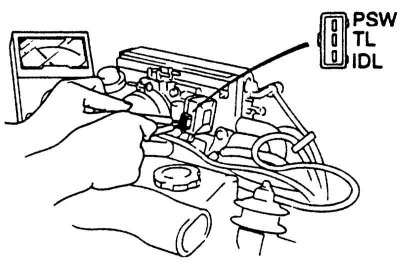
3. Connect an ohmmeter and check the current flow between the terminals.
| Engine | Thickness of the feeler gauge | Between contacts | Current flow | |
| yes | no | |||
| B6 to 9/89 | 0.5 mm | IDL — TL | X | |
| PSW — TL | X | |||
| 0.7 mm | IDL — TL | X | ||
| PSW — TL | X | |||
| VZ, V6 from 10/89 BP | 0.1 mm | IDL — TL | X | |
| PSW — TL | X | |||
| 1.0 mm | IDL — TL | X | ||
| PSW — TL | X | |||
| All | The throttle valve is fully open | IDL — TL | X | |
| PSW — TL | X | |||
4. If the result of one of these measurements does not correspond to the required value, the throttle position sensor must be adjusted.
5. Connect the plug to the sensor.
Adjustment
1. Disconnect the throttle position sensor plug.
2. Connect an ohmmeter between the TL and IDL contacts.
3. Adjust the distance between the throttle stop screw and the stop lever to the required value using a flat feeler gauge.
Required value: up to 9/89: 0.5 mm since 10/89: 0.4 mm
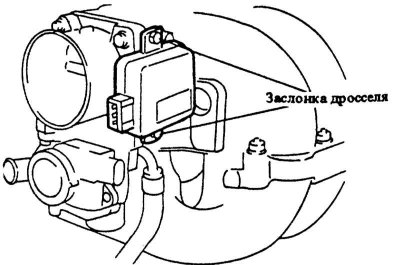
4. Loosen the throttle position sensor mounting bolts.
5. Turn the sensor 30° to the right, then slowly turn it back until the ohmmeter starts to show current flow.
6. Insert a 0.7 mm thick feeler gauge between the throttle stop screw and the stop lever. Now there should be no current flowing at the terminals. If current flows, the adjustment should be repeated.
7. Tighten both mounting bolts with force 2 Nm.
Caution! The throttle position sensor should not rotate when tightening the bolts.
8. Open the throttle valve fully several times using the gas pedal.
9. Check the throttle position sensor adjustment again.