


Warning: A hot engine can cause serious burns.
Caution: Be careful not to get burned when removing and installing engine components.
Make sure the battery is fully charged.
Warm up the engine to normal operating temperature.
Stop the engine and let it cool for approximately 10 minutes to cool the exhaust system.
Remove the fuel pump relay.
Remove the air filter assembly.
Remove the ignition coils.
Remove all spark plugs.
Measure compression as follows.
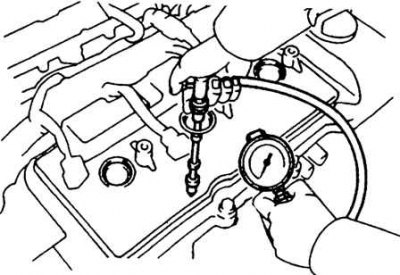
Fig. 2.251. Installing a compression gauge into the spark plug hole
Install the compression gauge into the spark plug hole (fig. 2.251).
Open the throttle fully.
Measure the compression by turning the engine with the starter.
Compression:
- Standard - 1470 kPa (250 min⁻¹);
- Minimum - 1029 kPa (250 min⁻¹);
- The maximum difference between cylinders is 196.1 kPa.
Perform the first three operations for all cylinders.
If the compression reading is less than the minimum value or the compression in one cylinder differs from the compression in the other cylinders by 196.1 kPa or more, perform the first three filling a small amount of engine oil into the spark plug holes.
If the compression has increased after adding engine oil, then the piston ring or cylinder surface may be worn or damaged.
If the compression has not increased, then the valves may be stuck, the valves may not be sealing tightly, or there may be a leak through the cylinder head gasket.
In both cases, engine repair is required.
Install the spark plugs.
Install the ignition coil.
Install the air filter assembly.
Install the fuel pump relay.