


Contents: Petrol engines ⇓ Diesel engine ⇓
Compression testing allows you to draw conclusions about the condition of the engine. In particular, you can determine whether the valves and pistons are in good condition or whether they are worn out. In addition, the results of the test allow you to determine whether the engine can continue to operate or whether it needs a major overhaul. A compression tester is required for testing (compression meter), which is used for most gasoline engines.
Note: A diesel engine requires a compression tester with extended measurement ranges.
The compression pressure value may vary depending on the compression gauge used and the number of starter revolutions. The set value for gasoline engines is 11-13 bar, for diesel engines 20-25 bar compression pressure. More informative is the difference in compression between individual cylinders.
The difference in pressure between individual cylinders must not exceed 3.0 bar (for diesel - 5.0 bar). If the pressure of one or more cylinders differs by more than 3.0 bar compared to others (diesel 5.0 bar), this indicates faulty valves, worn piston rings or cylinder bores. If the wear limit is reached, the engine must be repaired or completely replaced.
To check the compression, the engine oil temperature must be at least 30°C, i.e. the engine must be warm.
The valve clearance must be correct - adjust it if necessary.
Petrol engines
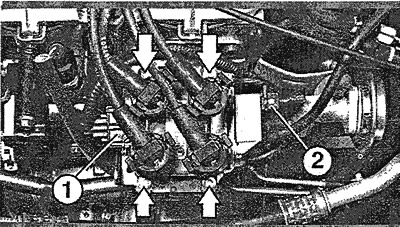
Turn off the ignition.
Remove the fuel pump relay.
Start the engine. It will start and stop when the fuel pump is not delivering fuel and there is no fuel pressure in the system. This measure will prevent unburned fuel from entering the engine and the exhaust system.
Disconnect wires (1) and (2), if present, from the ignition coil.
Remove the spark plugs.
Turn the engine over a little with the starter to remove any deposits and soot.
Caution: The gearbox must be in neutral and the parking brake must be applied.
According to the operating instructions, press the compression tester into the spark plug hole or screw it into the hole.
The assistant must fully depress the gas pedal and hold it in this position during all measurements.
Crank the engine a few revolutions until the compression gauge shows the maximum value.
Check all other cylinders in this way and record the obtained values.
Finally, install the spark plugs.
Install the fuel pump relay.
Caution: When starting the engine with the fuel pump relay/ignition coil plugs removed, the engine management system self-diagnosis unit stores fault codes. The fault codes must be cleared at a workshop. If the fault codes are not cleared, this will not lead to deterioration in engine performance.
Diesel engine
Turn the ignition key to position "0".
Disconnect the electrical wire from the fuel shut-off valve on the high-pressure fuel pump.
(Based on website data: «mazbook.ru»)
Disconnect the glow plug wires and store them separately.
Disconnect the wires from the glow plugs and unscrew the glow plugs.
Screw in a compression gauge instead of the glow plug and turn on the starter until the compression gauge readings stop increasing. Check all cylinders in this way.
Turn the ignition key to position "O".
Install glow plugs.
Connect the wires to the fuel shut-off valve and to the glow plugs.