


Attention.
- Hot engine and oil can cause burns. Be careful not to burn yourself when removing/installing various components.
- Fuel vapors are hazardous and flammable, causing serious injury and equipment damage. Keep sparks and open flames away from fuel.
- Leaks and leaks in fuel lines are dangerous. Fuel can ignite and cause equipment damage, serious injury, or even death. Fuel can cause skin and eye irritation. To prevent this, follow safety precautions when handling fuels and lubricants.
1. Make sure the battery is fully charged. Recharge if necessary.
2. Warm up the engine to normal operating temperature.
3. Perform the procedure for preparing fuel lines for vehicle servicing (see the relevant section of the chapter "Power supply system").
4. Remove the following parts:
- Decorative engine cover (see below in this chapter).
- Ignition coils/ion sensors.
- Spark plugs.
- Fuel pump relay.
- Fuel injector relay.
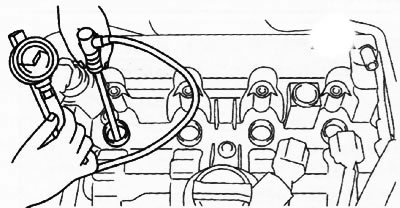
5. Measure the compression in the cylinders:
- Press the compression tester adapter into the spark plug hole.
- Press the accelerator pedal all the way down.
- Rotate the engine crankshaft with the starter and measure the compression in the engine cylinder.
Note:
Since the SKYACTIV-G 2.0 engine has a delayed closing phase of the intake valves, the compression in the cylinders is low.
Compression for European country versions (at 300 rpm):
- Standard: 978 kPa (9.97 kg/cm²).
- Minimum: 783 kPa (7.98 kg/cm²).
- Maximum difference between cylinders: 166 kPa (1.69 kg/cm²).
Compression for versions outside Europe (at 300 rpm):
- Standard: 885 kPa (9.97 kg/cm²).
- Minimum: 7.08 kPa (7.98 kg/cm²).
- Maximum difference between cylinders: 150 kPa (1.69 kg/cm²).
Repeat measurements for all engine cylinders.
6. If the measured values are below the minimum permissible values, or the difference between the cylinders exceeds the permissible norm, pour a small amount of engine oil into the engine cylinder through the spark plug hole and repeat the compression measurement:
- If the compression increases after adding engine oil, this indicates wear or damage to the piston rings or cylinder bore. The appropriate repairs must be performed.
- If the compression remains unchanged after adding engine oil, this indicates wear of the valves or a violation of their seating in the seats, as well as a possible leak in the cylinder head gasket. It is necessary to carry out the appropriate repair operations.
7. Remove the compression gauge.
8. Install the following parts:
- Fuel injector relay.
- Fuel pump relay.
- Spark plugs.
- Ignition coils/ion sensors.
- Decorative engine cover.