


Contents: Description ⇓ Checking the operation and…⇓
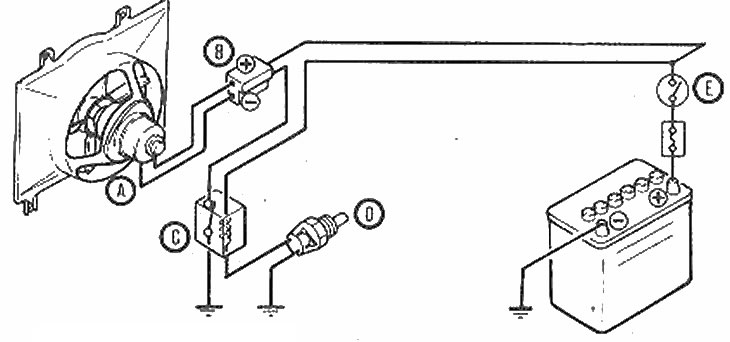
Cooling fan electrical circuit
A - Fan motor; B - Fan connector; C - Relay; D - Thermal switch; E - Ignition switch
Description
1. The system consists of a fan motor, impeller assembly, fan relay mounted on the left wing inner panel, and a thermal switch screwed into the thermostat housing. The impeller is installed in the fan casing, which is bolted to the radiator.
2. When the coolant in the thermostat housing heats up to 97°C, the thermal switch interrupts the circuit through the relay, which turns on the fan motor. When the temperature drops below 90°C, the fan motor turns off.
Checking the operation and replacement
Fan motor
3. Locate the motor wiring connector and disconnect it with a screwdriver.
4. Using an ammeter, measure the current in the motor circuit as shown in the illustration and compare the result with the data given in Specifications.
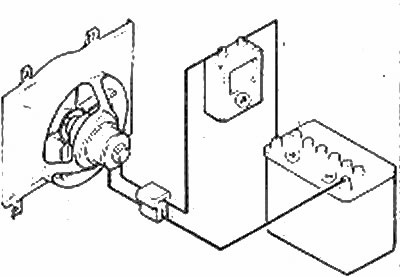
Measure the current
5. If the current that the fan operates on does not match the specified value, replace the motor (Chapter 6).
Fan relay
6. Disconnect the thermal switch connector and check that the fan starts to rotate when the ignition switch is turned to the "ON" position. This means the relay is working properly.
7. If the fan does not rotate, check the reliability of the contacts and the serviceability of the fuse. If the fuse is not blown and the contacts are connected securely, replace the relay. To do this, disconnect the relay connector and remove the mounting screws.
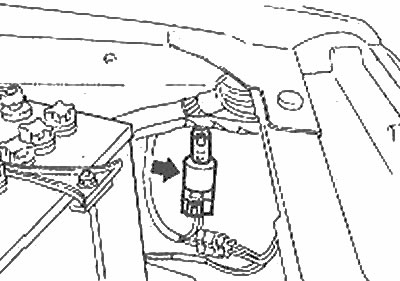
Location of the cooling fan relay (arrow)
Thermal switch
Note: Do not disconnect the brake switch if the ignition switch is in the "ON" position, otherwise the fan will turn on automatically.
8. Drain some fluid from the cooling system so that its level drops below the thermostat housing.
9. Disconnect the connector and remove the thermal switch.
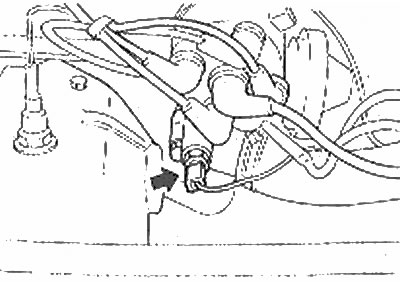
Location of the cooling fan thermal switch (arrow)
The article is reprinted from the portal Mazbook
10. Place the thermal switch in a container of hot water and ensure that its contacts close at temperatures below 90°C. Heat the water and ensure that the switch contacts open before the water boils. If the switch does not operate as described, replace it.
11. When installing the switch, do not forget to install the O-ring.
12. Finally, fill the cooling system.