


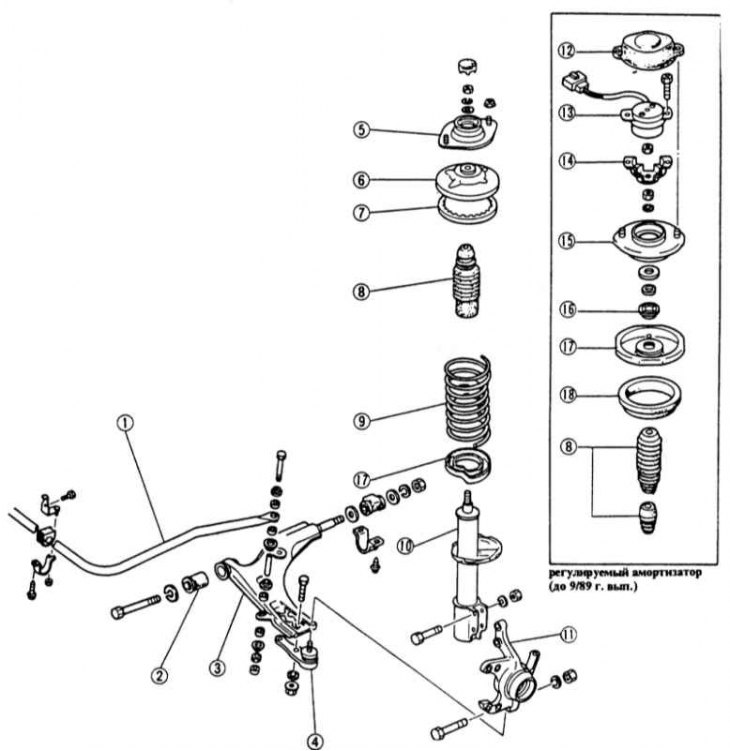
1 - stabilizer; 2 - rubber bushing; 3 - lower arm; 4 - ball joint; 5 - mounting plate; 6 - upper spring cup; 7 - rubber gasket; 8 - shock absorber and casing; 9 - coil spring; 10 - shock absorber; 11 - steering knuckle; 12 - drive cover; 13 - drive; 14 - fastening; 15 - shock absorber support; 16 - bearing; 17 - lower spring cup; 18 - rubber gasket
The front suspension uses two MacPherson shock absorber struts, consisting of a coil spring and a built-in hydraulic shock absorber. They are screwed to the body from above and to the steering knuckles from below. Lateral fastening is carried out by lower L-shaped transverse levers, which are connected to the steering knuckles via replaceable ball joints. The transverse levers are screwed to the body via rubber mounts. Depending on the engine, a stabilizer bar is attached to the bottom, which is connected to the shock absorber struts via connecting rods.
The stabilizer reduces body tilt when cornering.
The engine's drive force is transmitted to the wheels via two drive shafts. On front-wheel drive vehicles, the drive shafts are of different lengths. Each shaft is equipped with two constant velocity joints. The counterweight on the right drive shaft serves to dampen vibrations. Vehicles with a 1.9L DOHC engine and/or all-wheel drive have an intermediate shaft between the gearbox and the right drive shaft, making both drive shafts the same length.