


Contents: Checking the charging system…⇓ Checking the generator voltage ⇓ Checking the generator current ⇓
Caution: Do not apply battery positive voltage to the alternator D terminal, otherwise it may damage the internal components (power transistor) generator.
Checking the charging system indicator
1. Make sure the battery is fully charged.
2. Check the condition of the generator drive belt.
3. Turn on the ignition (engine off) and make sure that the charging system indicator lights up. If the charging system indicator does not light up, but the wiring is normal, check the condition of the engine control unit.
4. Check that the charging system indicator goes out after the engine is started. If the charging system indicator remains on, check for any fault codes, and then troubleshoot the fault.
Checking the generator voltage
1. Make sure the battery is fully charged.
2. Check the condition of the generator drive belt.
3. Turn off the ignition and disconnect all power consumers.
4. Start the engine.
5. Make sure that the generator rotates smoothly without any extraneous noise when the engine is running. If there is extraneous noise, determine its cause and repair or replace the generator.
6. Using a tester, measure the voltage at each connector pin. If the measured value is not within the normal range, determine the cause and repair or replace the faulty parts.
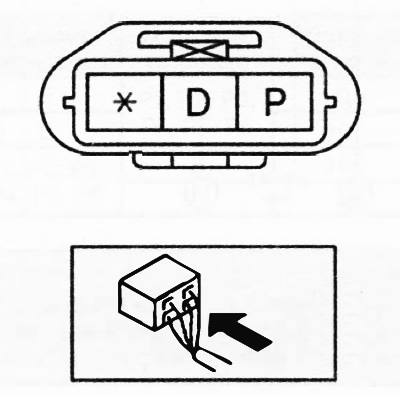
Note:
Generator standard voltage (ignition on):
- Conclusion B: B+
- Output P: about 1V or less
- Pin D: approximately 0V
Generator standard voltage (idle, at 20°C):
- Output B: 13-15V
- Output P: about 3-8V
- Conclusion D: Turn on electrical consumers (headlights, fan motor, rear window heater, brake lights, etc.) and make sure that the voltage value has increased.
Checking the generator current
Note: Since the charging current drops sharply after the engine starts, perform the following procedure quickly and read the maximum current value.
1. Make sure the battery is fully charged.
2. Check the condition of the generator drive belt.
3. Disconnect the negative battery terminal.
4. Connect a tester with a measuring range of at least 120 A between the B terminal of the generator and the wiring.
5. Connect the negative battery terminal.
6. Turn off all power consumers.
7. Start the engine.
8. Cars without i-stop system: increase engine speed to 2,500 rpm.
Note:
- If the electrical load in the vehicle's on-board network is low, the required current cannot be checked even with a normal generator. In this case, it is necessary to increase the electrical load (leave the headlights on for a long time to drain the battery, or use a similar method) and check again.
- If the generator or ambient temperature is too high, the required current cannot be checked either. In this case, it is necessary to let the generator cool down and repeat the check.
9. When the electrical load is on (headlights, fan motor, rear window heater, brake lights, etc.) check for an increase in current. If the current does not increase, check the engine control unit and generator using the M-MDS diagnostic tool (see the operating instructions for the device).
Note: Minimum generator current value (cars without i-stop system): 70% of rated output current (rated output current: 100 A) (ambient temperature 20°C, voltage 13.0-15.0 V, engine and generator warmed up).