

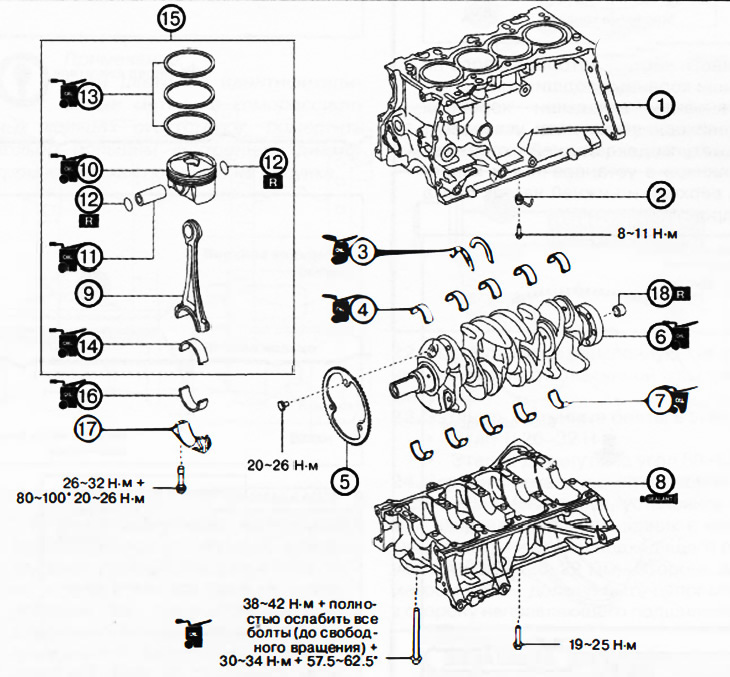
1. Cylinder block.
2. Oil nozzles.
3. Thrust half rings.
4. Upper main bearing shells.
5. Pulse disk.
6. Crankshaft.
7. Lower main bearing shells.
8. Lower part of the cylinder block.
9. Connecting rod.
10. Piston.
11. Piston pin.
12. Retaining rings.
13. Piston rings.
14. Upper connecting rod bearing.
15. Piston with connecting rod assembly.
16. Lower connecting rod bearing.
17. Connecting rod cover.
18. Guide bearing (MCP).
Note:
: replace the part with a new one after each removal.
: apply oil.
: apply sealant.
1. Install oil injectors on the cylinder block.
Attention.
- If thrust washers and main bearing shells are reused, they must be installed in the same positions and in the same direction as they were before removal to prevent damage due to bearing seizure or burning.
- To prevent engine damage during assembly, apply engine oil to the friction surfaces.
2. Apply clean engine oil to the thrust washers.
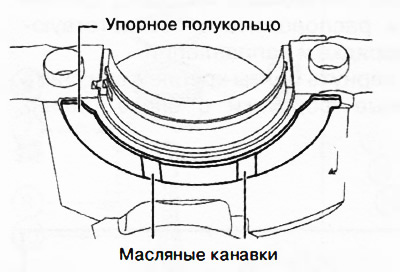
3. Install the thrust half rings with the oil grooves facing the friction surfaces.
4. Apply clean engine oil to the main bearing shells.
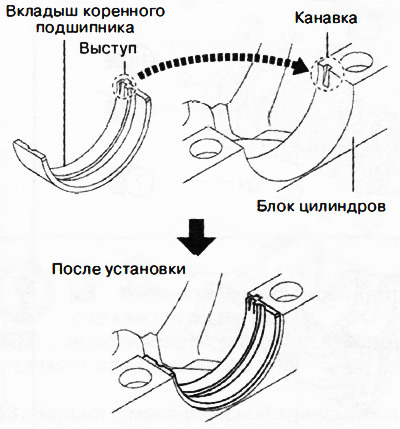
5. Install the main bearing shells, aligning the mounting protrusions of the main bearing shells with the mounting grooves in the upper and lower parts of the cylinder block.
Caution: Do not place the crankshaft on flat surfaces because the diameter of the pulse disk installed on the crankshaft is larger than the size of the crankshaft balancers. Place wooden blocks or other suitable objects under both ends of the crankshaft to prevent the pulse disk from directly touching the flat surface.
6. If removed, install the pulse disk on the crankshaft:
Set the groove of the pulse disk to the position shown in the figure and tighten bolt A.
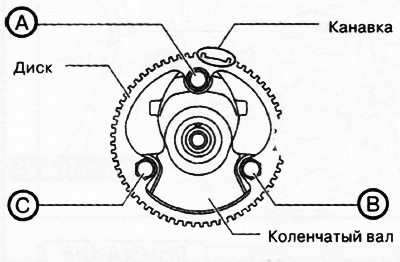
Tighten bolt B.
Install bolt C and tighten all bolts to 20-26 Nm in sequence C, B and A.
7. Install the crankshaft into the top of the cylinder block.
8. Completely clean the contact surfaces of the lower and upper parts of the cylinder block from oil, sealant residue and other contaminants.
9. If the lower cylinder block mounting bolts are reused, remove any remaining sealant from the bolts.
Attention.
- Apply silicone sealant in an even, continuous strip.
- To prevent premature hardening of the silicone sealant, install the front cover on the engine within 10 minutes after applying the sealant. Tighten the mounting bolts immediately.
- Tightening a bolt with cured sealant may cause a crack in the cylinder head or cylinder block.
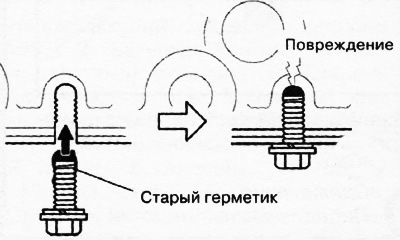
10. Apply silicone sealant to the bottom of the cylinder block as shown in the figure.
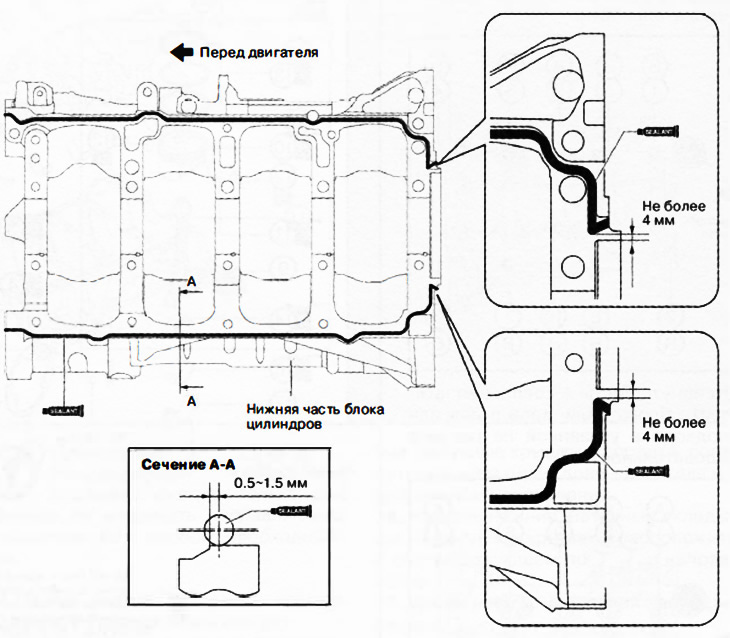
Note: Thickness of sealant bead: 2-6 mm.
11. Install the lower part of the cylinder block.
12. Tighten the lower cylinder block mounting bolts:
Apply clean engine oil to the seating surfaces and threads of the A bolts on the lower part of the cylinder block.
Tighten the bolts A securing the lower part of the cylinder block in the sequence shown in the figure.
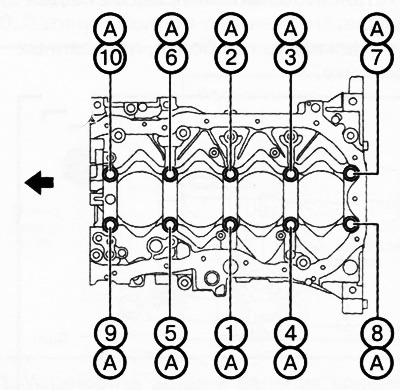
Stage 1: 38-42 Nm
Step 2: Loosen all bolts (to free rotation)
Stage 3: 30-34 Nm
Step 4: Pull to an angle of 57.5-62.5°
Tighten the bolts B securing the lower part of the cylinder block in the sequence shown in the figure to a torque of 19-25 Nm.
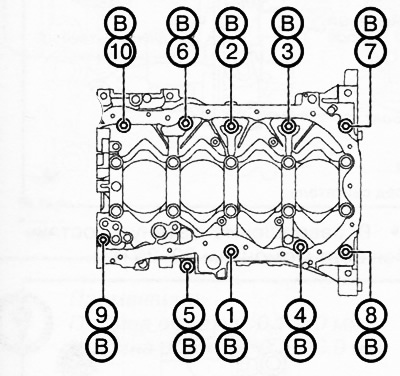
13. After the silicone sealant appears in the crankshaft rear oil seal seat, remove the excess. If the silicone sealant does not appear, remove the lower part of the cylinder block and reapply the sealant.
14. Apply clean engine oil to the piston pin.
15. Insert the connecting rod into the piston and connect them with the piston pin.
Note: Ensure that the connecting rod and piston are correctly oriented relative to each other.
Caution: When installing, do not compress the piston pin retaining ring more than necessary (up to a diameter less than 20.66 mm).
16. Using needle-nose pliers, install new piston pin retaining rings into the piston.
Note: It is not necessary to place the expansion ring lock between the upper and lower oil scraper rings.
17. Install the oil scraper ring so that the oil scraper ring locks do not overlap each other.
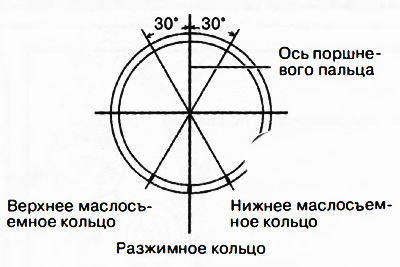
Note: Install piston rings so that the color identification marks on the compression rings are visible on the right side of each piston ring joint.
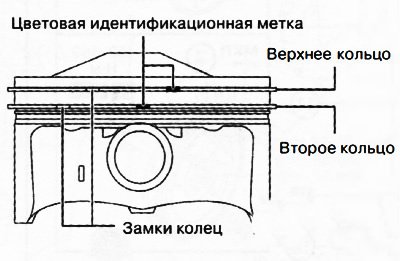
Note: If there are no color identification marks on the compression rings, place the ring with the larger inner diameter facing up as shown in the illustration.
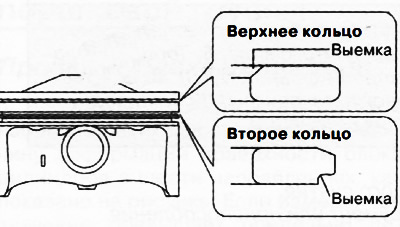
Attention.
- If connecting rod bearings are reused, they must be installed in the same positions and in the same direction as they were removed to prevent damage due to bearing seizure or burning.
- To prevent engine damage during assembly, apply engine oil to the friction surfaces.
18. Apply clean engine oil to the connecting rod bearings.
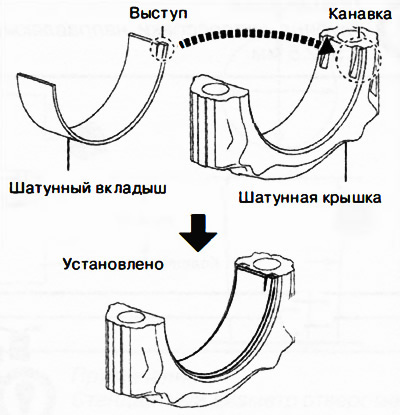
19. Install the connecting rod bearings, aligning the mounting protrusion of the bearing with the mounting groove of the connecting rod or connecting rod cap.
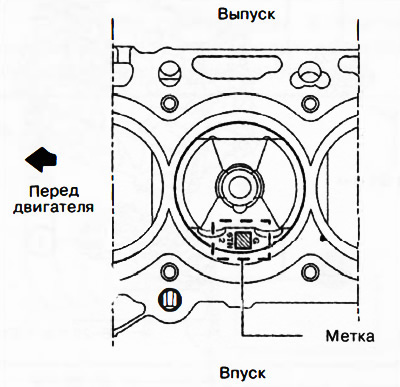
20. Insert the piston into the cylinder so that the mark on the piston bottom is on the intake side.
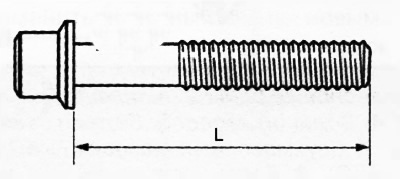
21. Check the length of the connecting rod bolts (see the relevant section below).
22. Align the broken, uneven surface of the connecting rod cap with the connecting rod
23. Tighten the connecting rod bolts in the following steps:
- Stage 1: 26-32 Nm.
- Step 2: Pull to an angle of 80-100°.
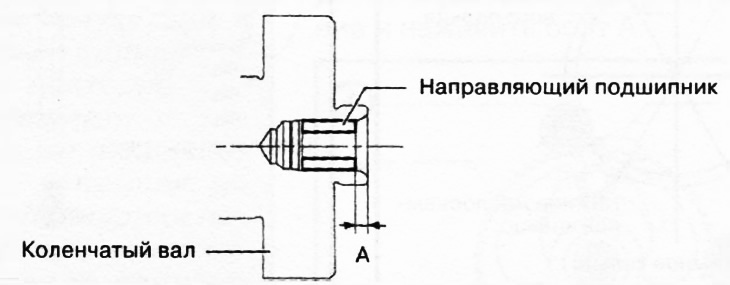
24. Versions with manual transmission: if removed, install a new pilot bearing using a hammer and a bushing of the appropriate size A160M7 (20-22 mm). The side with a diameter of 20 mm should be directed towards the pilot bearing.
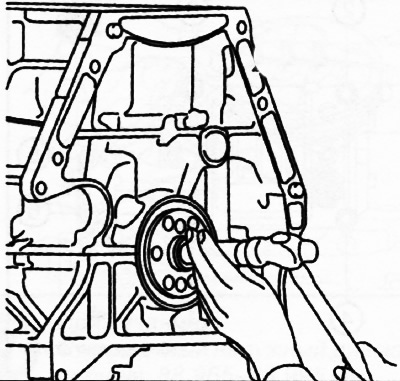
Note: The depth of pressing the guide bearing into the crankshaft (A): 1.5-2.5 mm.
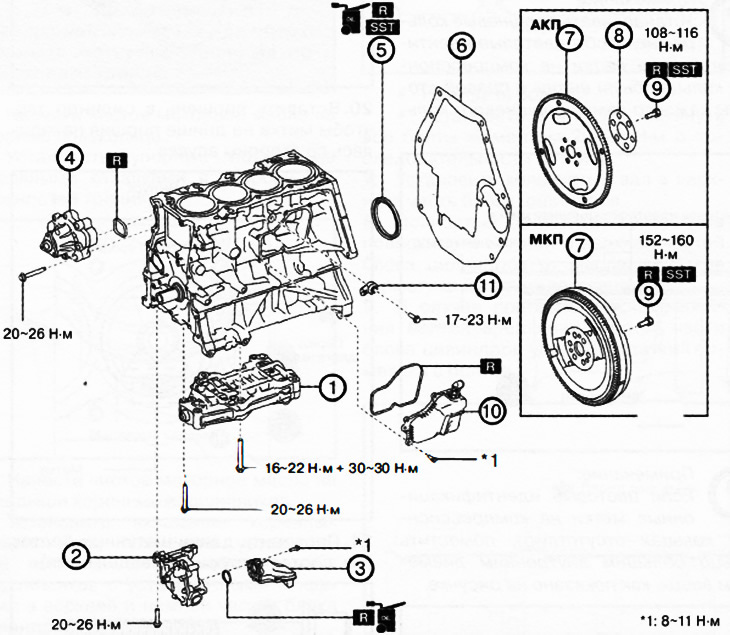
1. Balancing block.
2. Oil pump.
3. Oil intake with mesh filter.
4. Water pump.
5. Rear crankshaft oil seal.
6. End plate.
7. Dual mass flywheel (manual transmission)/drive flange (automatic transmission).
8. Support disk (automatic transmission).
9. Dual mass flywheel (manual transmission)/drive flange (automatic transmission) mounting bolts.
10. Oil separator.
11. Knock sensor.
Note:
: replace the part with a new one after each removal.
: use a special tool or device.
: apply oil.
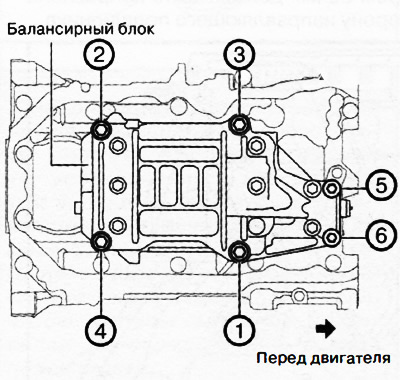
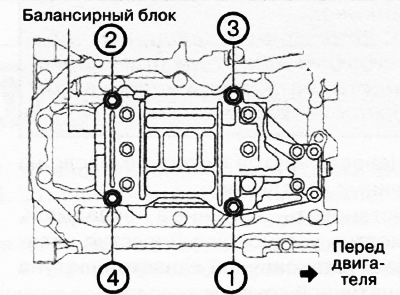
25. Install the balance block on the engine:
Tighten the bolts in the sequence shown in the figure.
 |
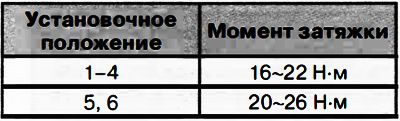 |
Re-tighten the bolts in the sequence shown in the figure to a torque of 30-36 Nm.
26. Install the oil pump on the engine:
Tighten the three bolts shown in the figure.
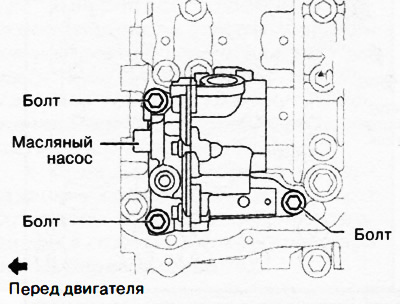
Tighten the two bolts shown in the figure to a torque of 20-26 Nm. The tightening sequence does not matter.
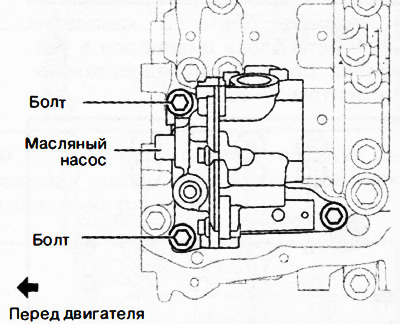
Finally, tighten the remaining bolt to a torque of 20-26 Nm.
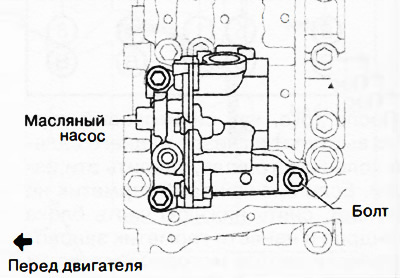
27. Install the oil intake with a mesh filter.
28. Insert a new gasket into the water pump groove.
Information copied from the portal mazbook.ru
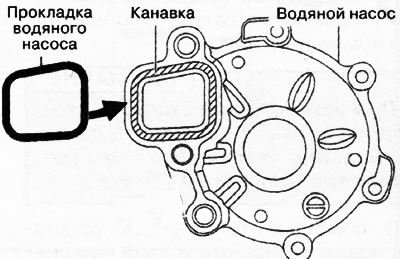
Caution: Install the water pump gasket in the correct position as shown in the figure. Otherwise, coolant leakage and various engine damages may occur.
29. Install the water pump.
30. Tighten the bolts in the sequence shown in the figure to a torque of 20-26 Nm.
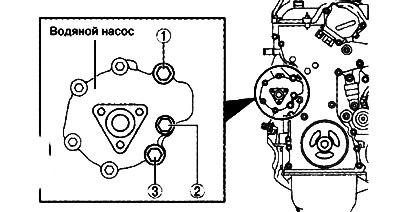
31. Install the rear crankshaft oil seal (see the relevant section of this chapter).
32. After installing the end plate, crimp parts A and B as shown in the figure.
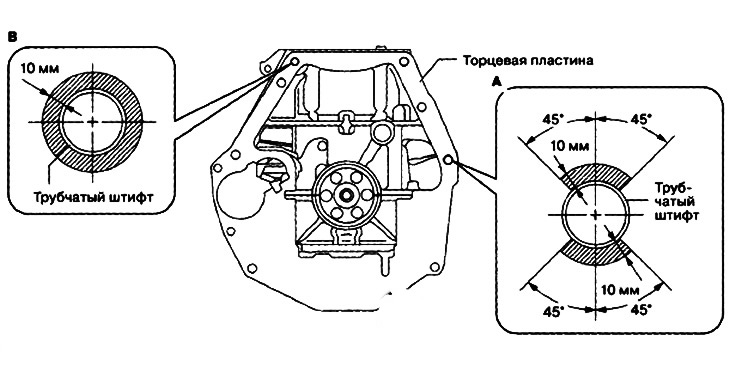
Note:
- Compression depth: 0.1-1.0 mm.
- Compression width: 0.5-10.0 mm.
33. After crimping, make sure there is no damage to the end plate.
34. Install the flywheel (manual gearbox) (see chapter "Clutch") or a drive flange with a support disk (AKP).
35. Install the oil separator on the engine.
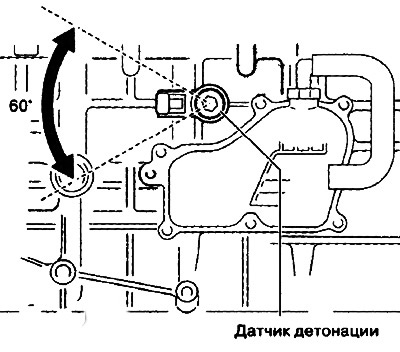
36. Install the knock sensor.
Note:
- Make sure there is no foreign material between the knock sensor and the cylinder block.
- The knock sensor connector must be located within the range shown in the figure.