


Contents: Maintenance techniques ⇓ Fasteners ⇓ Fastener dimensions ⇓ Approximate values of tightening…⇓ Procedure for tightening threaded…⇓ Disassembling the units ⇓ Surfaces for gaskets ⇓ How to remove the old hose ⇓ Repairing damaged threads ⇓ Workplace ⇓
Maintenance techniques
When servicing and repairing a car, there are typical situations that require certain techniques to perform them. In this book, such situations will be repeated often. Knowing these techniques will allow the home mechanic to properly organize the work and complete it thoroughly and completely.
Fasteners
Fasteners are bolts, screws, nuts and studs that are used to connect two or more parts together. When working with fasteners, there are several things to remember. Almost all fasteners are equipped with means to prevent self-loosening. This could be a lock nut, a bending or spring washer, or an anti-loosening compound that is applied to the threads before assembly. Before assembly, fasteners must be clean and in good condition - not deformed, with undamaged threads and head edges for the key. Make it a rule to replace all damaged fasteners during assembly. Special self-locking nuts with nylon or fiber insert can be tightened only once. When unscrewed, they lose their stopping properties and must be replaced.
When loosening rusted bolts and nuts, use a liquid with high wetting ability that can penetrate the threaded connection and make loosening easier. Some mechanics use turpentine for this purpose, which is quite justified in its application. After wetting the joint with liquid, let it work for a few minutes so that it has time to penetrate the rusty joint. If the liquid does not help, then sometimes such a connection has to be sawed off or cut off with a chisel. There is a device that splits the nut lengthwise.
If the pin breaks and remains in the body of the part (for example, in the cylinder block), it must be drilled and removed with a special tool that can be purchased at hardware stores. Most service stations can also fix this type of breakdown.
Flat spring washers should be replaced with the same ones. Do not use spring washers on soft surfaces such as aluminum, plastic, or on thin parts.
Fastener dimensions
Manufacturers are increasingly using fasteners with metric threads. However, vehicles manufactured in the US or intended for the US market may have fasteners with inch threads. Let's consider the main differences between these types of fasteners.
Bolt designations, regardless of thread type, include the thread's outside diameter, thread pitch, and bolt length. For example, an M12x1.75x25 bolt has a 12mm metric thread with a 1.75mm pitch and is 25mm long. A 1/2-13x1 bolt has a 1/2-inch imperial thread with 13 threads per inch and is 1 inch long. Both bolts are nearly identical in appearance and can be easily confused, but they are not interchangeable (figure 0.4).
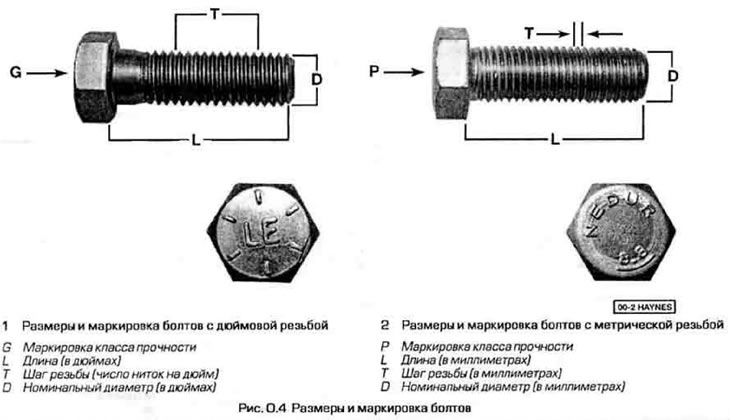
In addition to the outside diameter and thread pitch, inch and metric bolts also differ in their heads. Inch bolts have a spanner size (i.e. the distance between the opposite and the edges) is measured in inches, while metric ones are measured in millimeters. The same applies to nuts. Because of this, wrenches for metric and inch bolts and nuts differ in size. A metric wrench cannot be used on an inch wrench, and vice versa.
Another difference is that the heads of inch bolts usually have several radial slots, the number of which indicates the strength class of the bolt, which can be used to judge the torque that can be applied to tighten the bolt. The more slots, the stronger the bolt. Automobiles use Q bolts with strength classes from 0 to 5 (figure 0.5).
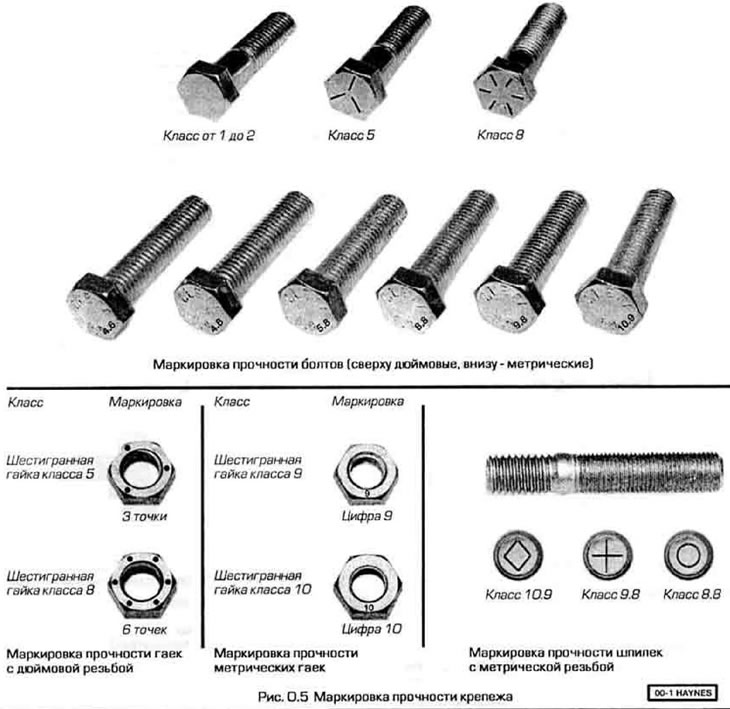
Metric bolts also have a strength class marking, but this marking is indicated by two numbers separated by a dot, stamped on the end of the head. The first number, multiplied by 10, determines the tensile strength in kg/mm². The second number, multiplied by 10, determines the ratio of the yield strength to the tensile strength in %. The product of the numbers determines the yield strength of the bolt material in kg/mm². Therefore, the higher the number, the higher the strength of the bolt. The bolts most commonly used in automobiles have strength classes 8.8, 9.8 and 10.9.
Metric and inch nuts are also distinguished by strength class markings. The strength class on nuts with inch threads is indicated by the number of dots on the end of the nut, while on nuts with metric threads the strength class is indicated by a number. The more dots or the number, the higher the strength of the nut, (The strength class multiplied by 10 gives the test stress value in kg/mm²).
Metric studs also have a strength class marking on the top end. Large studs have the same markings as metric bolts. Small size hairpins are marked with geometric shapes.
It is worth noting that a large number of fasteners, especially those of low strength classes (consumer goods), are not marked. In such a case, the only way to distinguish an inch bolt from a metric one is to carefully measure the thread. There are special templates - thread gauges - for measuring metric and inch threads.
Since fasteners of the same size may differ in strength class, make sure that when reassembling, the bolts and nuts are returned to a different location than they were in before disassembly. If you need to replace fasteners when overhauling a unit, make sure that the new bolts and nuts have a strength class no lower than those being replaced.
Approximate values of tightening torques for threaded connections
Procedure for tightening threaded connections
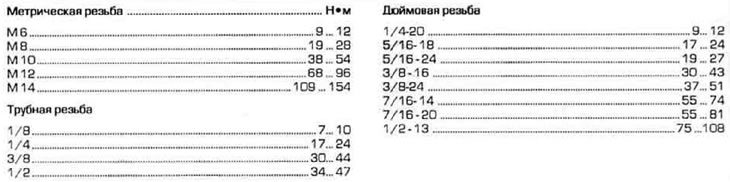
Most fasteners (bolts and nuts) requires tightening to a certain torque. Overtightening a connection can weaken or even break a bolt, while an undertightened connection will not perform its intended function (for example, it will allow gas or liquid to pass through), and will quickly weaken. Depending on the material and size of the bolt, the torque required to tighten the connection is calculated by the designers and indicated in the Technical Data at the beginning of each chapter. Carefully follow the tightening torque recommendations for connections. For less critical connections for which the tightening torque is not regulated, you can follow the recommendations given in the table below. The torque values given in the table are calculated for dry screwing (not lubricated) bolt into a steel or cast iron part (not in aluminum). As stated above, the torque that can be applied to a bolt or nut depends on its strength class. The moment values given in the table are calculated for fasteners of strength classes 2 and 3. For fasteners of higher strength classes, the moment values may be increased.
When disconnecting and connecting parts. having a large mating surface, such as a cylinder head. engine oil pan, differential cover, etc. it is necessary to follow a certain sequence of loosening and tightening the fasteners connecting them in order to avoid deformation of the mating parts. This is the sequence. if necessary. will be indicated in the relevant chapters of the manual. This sequence must be followed. If the tightening sequence is not specified, then you can follow the following recommendations.
First, screw in the bolts or tighten the nuts only by hand. Then turn them one by one with a key one turn in a zigzag or diagonal sequence from the middle to the ends of the parts being connected. Then go back to the first bolt (nut) and tighten all the fasteners in the same diagonal sequence another half turn. Go through all the bolts (nuts) again and tighten another quarter turn. Continue this process until the fasteners are tightened to the specified torque. When releasing and unscrewing the fastener, the order should be reversed.
Disassembling the units
The units should be disassembled carefully. so that they can be reassembled. Always remember or write down the disassembly sequence. Make marks on parts that can be installed in different ways. for example, a convex washer on a bolt. sprocket on shaft, etc. If possible. lay out the parts of the assembly on a clean surface in the order in which they were removed. Before disassembling a unit, it is useful to make a sketch or photograph of it.
When unscrewing fasteners, remember their location. After removing the part, screw the bolts back into place with the washers and screw the nuts back into place where they were before disassembly. This will help preserve the fasteners and prevent them from getting mixed up during reassembly. If it is not possible to return the bolts and nuts to their original places, then at least store them in separate boxes. Tin cans are well suited for this purpose. You can take a large box and divide it into compartments using partitions. This container is very convenient when disassembling units consisting of a large number of small parts, for example, a carburetor. valves. generator. dashboard, etc. The cells can be marked with paint or labels can be attached to them with tape.
When disconnecting electrical connectors, it is recommended to mark the connector halves with numbers or tape so that they can be reconnected without error.
Surfaces for gaskets
Gaskets are widely used in all vehicles to seal two flat surfaces against gas, liquid or vacuum leaks.
Many times during rebuilds these gaskets are coated with liquid or paste sealants. Over time, heat and pressure cause the sealing surfaces to become so bonded to each other that they become difficult to separate. In such cases, tapping the mating parts along the joint surface with a soft-faced hammer helps. You can also use a regular hammer if you don't hit the parts directly. and through a wooden block. Avoid hammering cast parts, especially those made of cast iron, or parts made of soft materials such as aluminum. If the part does not come off, check first. have you unscrewed all the bolts?.
Do not use a screwdriver or pry bar to separate the surfaces, as the surfaces can be easily damaged. If the surfaces still cannot be separated without force, use a wooden wedge, but keep in mind that you will need to clear the joint of splinters and wood fibers later.
After separating the surfaces, carefully scrape off any remaining adhering gasket and rinse the surfaces. A dried gasket can be soaked with some liquid with good penetrating ability or a suitable solvent. It is better to make a scraper for removing the gasket from copper, for example, from a copper tube, if you saw it lengthwise, turn it into a flat surface and straighten it with a hammer. Copper is recommended because it is generally softer than the surfaces being treated, but harder than the gasket that needs to be scraped off. Some gaskets can be removed with a wire brush. But regardless of the method used, the surface must remain intact, flat and clean. If scratches still remain on the surfaces under the gasket, then during assembly the gasket should be covered with a layer of sealant, which will fill the scratches and ensure a tight connection
Information copied from the portal MAZBOOK.ru
How to remove the old hose
Caution: If the vehicle is equipped with an air conditioning system, do not disconnect the system lines unless the refrigerant has been removed from the system first. This operation must be performed by a service station specialist.
The precautions for disconnecting hoses are approximately the same. the same as when removing the gaskets. Be careful not to dent or scratch the surfaces where the hose meets, otherwise the connection may leak. Be especially careful with radiator hoses. Due to chemical reactions, high temperature and pressure, the hoses become stuck to the fittings and can be very difficult to remove.
Before you begin removing the hose, loosen its clamps. Then grab the end of the hose and try to rotate it relative to the nozzle. Turn it back and forth until you feel it turn freely and can be pulled off the hose.
If the hose is so stuck to the pipe that it is impossible to remove it, there is one last option: cut the hose along the pipe with a sharp knife, after which it will be easy to remove. Naturally, such a hose will have to be replaced with a new one. Try not to scratch the pipe while doing this.
If the hose clamp is damaged or broken, replace it. The most reliable clamp is the worm type.
Repairing damaged threads
Sometimes the internal threads of nuts or bolt holes become stripped or crushed. Most often this occurs due to excessive force when tightening. It is easiest to strip threads in aluminum parts, since aluminum is a soft material and cannot withstand heavy loads.
Typically, the internal and external threads are only partially stripped or crushed. If you cut the thread with a die or tap, it becomes quite suitable for further use. But sometimes the thread is damaged so badly that it cannot be restored in this way. In this case, you have three options.
1. Drill the hole to the next thread size and tap the new thread.
2. Drill and tap the hole to a size that will allow the threaded plug to be screwed into it. Screw in the plug, drill it out and cut a thread of the same size as before. Sometimes you can buy a plug with a ready-made threaded hole. In this case, drill and cut a hole for the plug. Then screw a bolt with a lock nut into the plug and screw the plug into the hole using this bolt, then unscrew the lock nut and unscrew the bolt.
3. The third method involves using patented repair kits for blind and through holes, such as Heli-Coil or Slimset. If you have managed to obtain such a kit, follow the instructions included with it.
Regardless of the method used, do this work slowly and carefully. Any mistake can ruin all your work and completely destroy the part being repaired.
Workplace
When talking about tools, we shouldn't forget about the workplace. If the work being performed goes beyond normal maintenance, a good work station is essential.
We understand that many car owners, due to circumstances, are forced to remove the engine or similar components from the vehicle in conditions that are not as favorable as those available in a repair shop. Such work should always be carried out under a roof.
Wherever possible, any disassembly should be carried out on a clean, flat workbench or table of suitable height.
The workbench should be equipped with a vice with a jaw opening of less than 100 mm, which is suitable for most jobs. As mentioned above, it is necessary to allocate a dry and clean place for storing tools, as well as all kinds of lubricants, liquids, touch-up paint, etc.
One of the most common tools in the garage is a power drill with a chuck for a drill bit of at least 8 mm in diameter, which can be used for a wide variety of jobs. Such a drill, as well as a large set of drill bits, are absolutely necessary when installing various auxiliary equipment.
Last but not least, always keep a certain amount of old newspapers, paper towels, and clean cloths in the workplace that do not leave threads or lint, and keep the workplace clean.