


Contents: Tachometer ⇓ Odometer and trip meter ⇓ Fuel quantity indicator ⇓ Coolant temperature gauge ⇓ Instrument cluster indicators ⇓
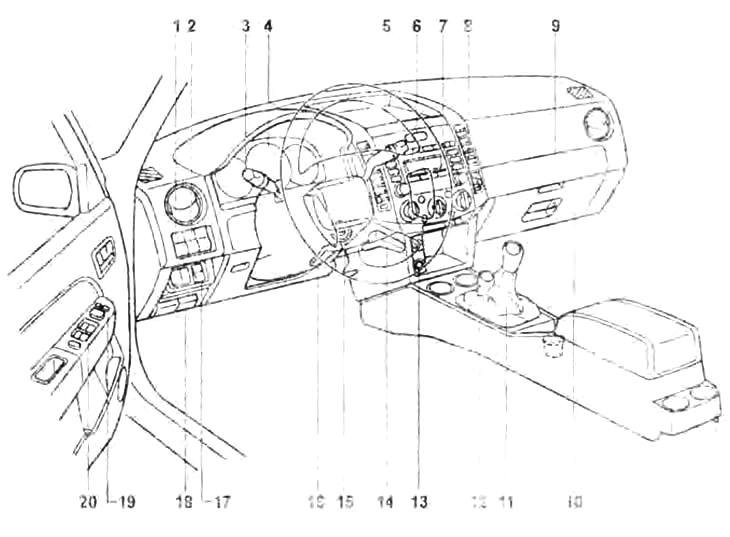
Instrument panel.
1 - headlight range correction system regulator.
2 - instrument cluster backlight brightness control,
3 - headlight and turn signal switch,
4 - instrument cluster,
5 - windshield wiper and washer control switch,
6 - hazard warning switch,
7 - audio system,
8 - air conditioning and heating control panel,
9 - stand,
10 - storage box,
11 - manual transmission lever,
12 - transfer case control lever,
13 - connector for connecting additional devices,
14 - parking brake lever,
15 - ignition switch,
16 - steering wheel lock lever,
17 - fuel filler flap lock actuator button,
18 - hood lock drive lever,
19 - mirror position control panel,
20 - window lifter control panel.
For the location of the instruments and indicators, see the figure "Instrument cluster".
Tachometer
The tachometer shows the number of revolutions of the engine crankshaft per minute (rpm).
Note: While driving, watch the tachometer readings. Its needle, which shows the engine shaft speed, should not enter the red zone (high engine speed zone).
Odometer and trip meter
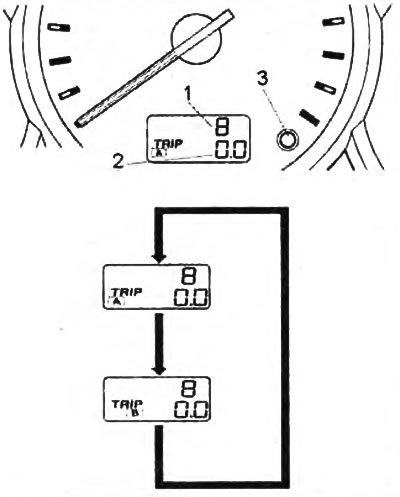
1 - odometer,
2 - mileage counters,
3 - button for switching/resetting the mileage counter readings to zero.
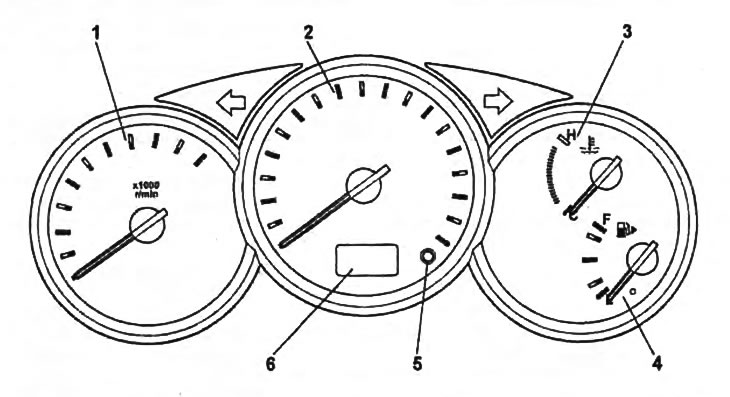
Instrument cluster.
1 - tachometer,
2 - speedometer,
3 - coolant temperature indicator,
4 - fuel quantity indicator,
5 - odometer and trip counter display,
6 - button for switching/resetting the mileage counter readings to zero.
The odometer (1) shows the total mileage of the vehicle.
The trip meters (2) show the distance traveled since the last time the counter was set to zero.
Button (3) is used to switch modes and to reset the odometer readings to zero. A short press on the button switches between the indication modes odometer "A" → odometer "B". The corresponding indicator lights up for each mode. "TRIP A", "TRIP B". The odometer is reset by a longer press on button (3).
Fuel quantity indicator
Warning: Do not drive with too little fuel in the tank. Running out of fuel can cause damage to the catalytic converter.
The indicator shows the fuel level in the fuel tank (F - full tank. E - empty tank) when the ignition key is set to the "ON" position. If the pointer is near the "E" mark, it is recommended to refuel as soon as possible. When the fuel level in the tank is low, the indicator on the instrument panel starts flashing (see the table "Instrument cluster indicators").
Note: The arrow (if present) next to the gas pump symbol indicates which side of the vehicle the gas cap is located on.
- Fuel tank capacity - 70 l
Coolant temperature gauge
The gauge shows the temperature of the engine coolant when the ignition key is in the "ON" position.
If the pointer of the indicator enters the red zone of the "H" scale while the engine is running, this indicates engine overheating. In this case, immediately stop the vehicle in a safe place and perform the procedures described in the "Engine Overheating" subsection of this chapter. Eliminate the cause of overheating.
Instrument cluster indicators
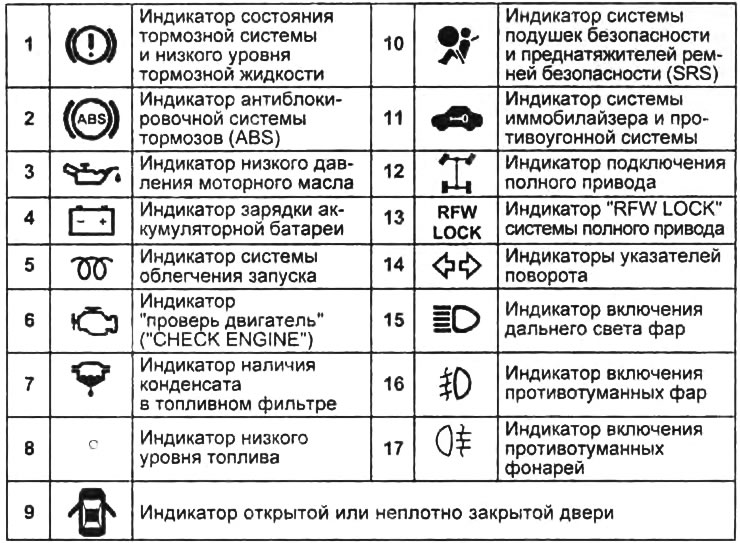
Note: The indicator number in the "Instrument cluster indicators" table corresponds to the item number.
1. Indicator of the brake system condition and low brake fluid level.
The indicator lights up when you turn the ignition key to the "ON" position and should go out after a few seconds.
a) The indicator lights up if:
- parking brake engaged;
- low brake fluid level or brake booster leak;
- the electrical circuit of the indicator is faulty.
Note: When the pressure in the brake booster system decreases, the indicator lights up.
Table. Instrument cluster indicators.
b) If the indicator lights up while driving, you must slow down, pull off the road and carefully stop the car. You can slow down by braking with the engine and using the parking brake, but do not forget to press the brake pedal to turn on the brake lights to warn drivers behind you about braking.
Check the parking brake, it may be engaged. If the parking brake is disengaged and the indicator is on or the indicator remains on after the brake is released, there is a fault in the brake system.
Check the brake fluid level in the reservoir.
If the brake fluid level is low, add fluid and check the vehicle's braking efficiency in a safe location. If you think the brakes are still working well enough, carefully drive the vehicle to the nearest repair facility. If the brakes do not work, the vehicle must be towed or removed for repair.
Warning: Driving a vehicle with low brake fluid is dangerous.
If the brake fluid level is normal, then there may be a malfunction in one of the brake circuits.
2. Anti-lock braking system (ABS) indicator.
The indicator comes on when you turn the ignition key to the "ON" position and should go out after a few seconds. If the indicator does not go out or comes on while driving, this indicates a malfunction of the anti-lock braking system (for more information, see the "Anti-lock braking system (ABS)" section).
In this case, only the brake system works on the car and the anti-lock system does not work. Move to the repair site.
Caution: Pressing the brake pedal repeatedly may cause the indicator to come on for a few seconds.
3. Low engine oil pressure indicator
a) The indicator lights up when the ignition key is turned to the "ON" position and should go out after the engine starts.
b) The indicator lights up if the engine oil pressure is too low.
c) If the indicator flashes or lights up while driving, you must pull over to the side of the road and turn off the ignition.
- The indicator may flash after sudden braking or when the engine is idling. There is no malfunction if the indicator goes out with a slight increase in engine speed.
- The light may come on when the engine oil level is too low. However, this light is not intended to indicate low oil levels, so check the level periodically with the dipstick.
4. Battery charge indicator.
a) The indicator lights up when the ignition key is turned to the "ON" position and should go out after the engine starts.
b) If the indicator lights up while driving, the charging system is faulty or the alternator drive belt is loose (broken). However, the engine will continue to run until the battery is completely discharged.
Turn off additional equipment (air conditioning, radio, etc.) and move to the repair site.
5. Start assist system indicator.
The indicator informs the driver that the starting aid system has started to operate (turning on the glow plugs).
The system starts working after the ignition is turned on. It is recommended to start the engine only after the indicator goes out.
If the indicator lights up while driving or flashes, this indicates a malfunction in the engine starting assistance system.
6. Indicator "check engine" ("CHECK ENGINE").
The indicator lights up when the ignition key is turned to the "ON" position for a few seconds and then goes out, informing the driver that the engine management system is being checked.
If the indicator continues to light or lights up while driving, this indicates that there are faults in the electronic engine management system and the emission control system. In this case, you need to go to the repair shop and diagnose the engine management system.
7. Indicator of the presence of condensate in the fuel filter.
If the indicator lights up while the engine is running, this indicates that condensation has accumulated in the fuel filter or water separator.
If this occurs, remove condensation from the fuel filter or water separator (see the subsection "Removing Air and Condensation from the Fuel System" in the chapter "Maintenance and General Checking and Adjusting Procedures").
8. Low fuel indicator. The indicator lights up when the fuel level in the tank is low. On slopes or when turning, the indicator may light up due to fluctuations in the fuel in the tank.
9. Indicator of open or not tightly closed door.
The indicator remains on until all doors are completely closed.
10. Airbag and seat belt pretensioner system (SRS) indicator.
The indicator lights up when you turn the ignition key to the "ON" position. After a few seconds, the indicator goes out. If the indicator does not light up or lights up (flashes) while driving, there is a malfunction in the SRS components. Contact a service center for diagnostics and repair of the passive safety system components.
11. Immobilizer and anti-theft system indicator.
The heads of the main and additional keys may have built-in microcircuits that perform the function of an immobilizer. This function is used to block the engine (preventing car theft). There is a transmitter in the key head that sends a signal to the receiver. If the signal does not match the registered one, the engine start is blocked.
The indicator starts to flash at intervals of 2 when the ignition key is turned from the "ON" position to the "ACC" position and informs about the activation of the anti-theft system. The indicator stops flashing when the ignition key is turned to the "ON" position, lights up for 3 seconds and then, if the signal matches the registered one, goes out. In this case, the engine start is unlocked. If the indicator flashes, this indicates a malfunction in the immobilizer system. Contact the service center for diagnostics and repair.
12. All-wheel drive connection indicator.
Lights up when the all-wheel drive is engaged. For more details, see the section "Features of the transmission of 4WD models".
13. "RFW LOCK" indicator of the all-wheel drive system.
Based on website data MAZbook.ru
Lights up when the all-wheel drive is engaged and goes out when the front axle is disengaged using the switch. For more details, see the section "Features of the transmission of 4WD models".
14. Turn signal indicators. The indicators flash when the turn signals are turned on. Excessive flashing of the indicator lamps indicates a poor connection in the turn signal circuit or a failure of the turn signal lamp.
15. High beam headlight indicator.
Lights up when the high beam headlights are turned on.
16. Fog light indicator.
Lights up when the fog lights are turned on.
17. Fog light indicator.
Lights up when the fog lights are turned on.