
MazBook.ru
English Русский
Български
Беларускі
Український
Српски
Hrvatski
Română
Polski
Slovenský
Magyar
• Bookmark • Sitemap • Contacts •   
Cars Opel Cars Ford Cars Volkswagen Cars Audi Cars Kia Cars Renault Cars Peugeot


Familia Capella Mazda3 Mazda6 CX-? Others Articles
Capella 3 (1982-1992, petrol) Capella 3 and 4 (1982-1992) Capella 4 (1987-1992) Capella 5 (1991-1997) Capella 6 (1997-2005, petrol)

Fuses — basic information (Mazda Capella GF)

  • Home
  • Mazda Capella
  • Capella GF (1997-2005)
  • Electrical equipment
  • Equipment and devices
  • Fuses — basic information
0
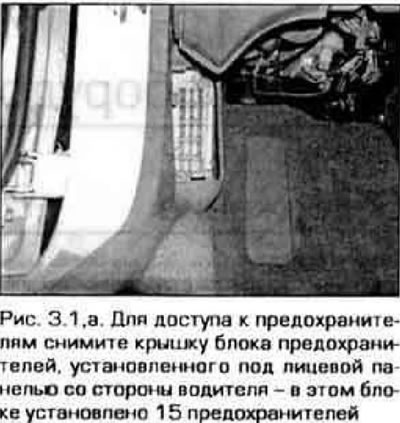
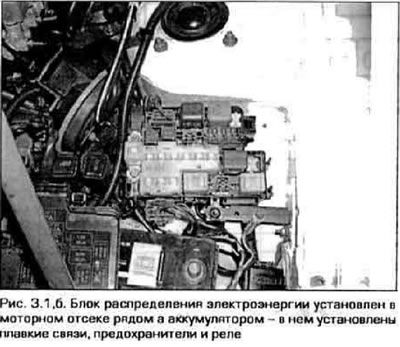
1. The electrical circuits of the vehicle are protected by fuses and circuit breakers. There are two fuse boxes installed on the vehicle; under the dashboard and in the engine compartment, on the left side (figure 3.1, a, b).

1. The electrical circuits of the vehicle are protected by fuses and circuit breakers. There are…

2. Each fuse protects a specific target (or several chains). These circuits are marked on the fuse box housing.

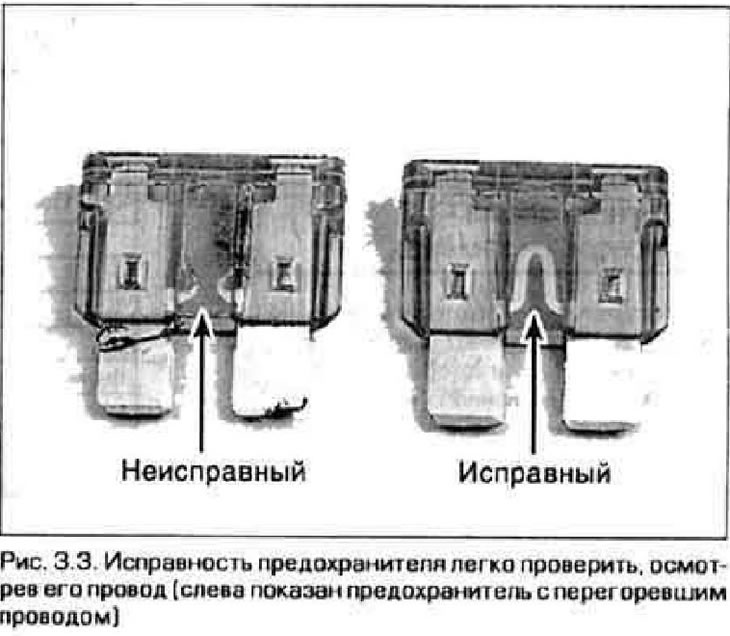
3. The fuse box contains miniature blade-type fuses that are easy to insert and remove without any special tools. If a circuit malfunction occurs in your vehicle, first check the corresponding fuse. To check the fuses, turn on the ignition and check the voltage at one terminal of the fuse, then at the second terminal. If voltage is present in both cases, then the fuse is good. If voltage is present at only one terminal of the fuse, the fuse is faulty. The fuse is easy to check for proper operation after removing it, as the fuse has a transparent housing. Inspect the wire running inside the fuse box to make sure it is. that it is not melted (figure 3.3).


3. The fuse box contains miniature blade-type fuses that are easy to insert and remove without any…


4. Make sure the spare fuse has the same rating. Fuses of different ratings are interchangeable. however, fuses that have failed should only be replaced with fuses of the same rating. It is not recommended to install fuses with a lower or higher rating. Each electrical circuit is rated for a specific maximum current. The rating of each fuse is indicated on the fuse box cover.

5. If the blown fuse immediately blows, this indicates a more serious circuit fault. Do not replace the fuse again until the problem has been corrected. In most cases, the fault is due to a short circuit due to worn wire insulation or a faulty component.

6. All vehicle models have a main fuse rated at 100A which protects all circuits between the battery and the appropriate purpose fuse. When too much current is drawn, the main fuse will blow, protecting the vehicle's electrical system. The main fuse has a fusible metal strip that melts when overloaded. Before replacing the main fuse (which can be purchased from a dealer) disconnect the battery.

Warning. Your car's radio has an anti-theft system. Before disconnecting the battery, please read the information at the beginning of this manual.


The main fuse is located in the engine compartment fuse box. It is similar to other fuses and is replaced in a similar manner. Install a new fuse of the same rating as the old one. In other words, if your vehicle came with an 80A fuse, install an 80A fuse; if a 100 A fuse was installed, install a fuse with a rating of 100 A. Do not change the rating of the main fuse!

[The article is reprinted from the portal: mazbook]
This article is available at: russian, bulgarian, belarusian, ukrainian, serbian, croatian, romanian, polish, slovak, hungarian
This text was checked by: German Vorobyov
Share with friends on social networks:

Previous
Capella 6 » Equipment and devices
Next

Electrical Circuit Troubleshooting — basics
Basic information about on-board electrical equipment
Circuit Breakers — basic information
Relays — basic information and testing
Turn signal and hazard warning relay — testing and replacement
Steering Column Switch Combination — checking and replacing
Ignition Switch and Lock Cylinder — checking and replacing
More articles on repairing other Mazda models
Basic special tool Mazda Familia 5 (1985-1989)
Seat belts — general information Mazda3 BK (2003-2009)
Information display Mazda6 GG (2002-2008)
Replacing fuses Mazda CX-5KE (2012-2017)
Coolant — Basic Information Mazda 121 (3) (1996-2003)
Link in different formats to this article
Comments and feedback from visitors
No comments yet


How much will 12 + 48 ?


Capella 6 (1997-2005, petrol) 
  • General information
  • Introduction to guide
  • User manual
  • Troubleshooting
  • Maintenance
  • Power unit
  • 4-cylinder engines
  • 6-cylinder engines
  • Engine overhaul
  • Cooling and ventilation
  • Power and exhaust systems
  • Engine electrics
  • Control system
  • Transmission
  • Mechanical gearbox
  • Automatic gearbox
  • Clutch and drive shafts
  • Chassis
  • Brake system
  • Car suspension
  • Steering
  • Body
  • Exterior (external elements)
  • Interior (internal elements)
  • Doors, windows and locks
  • Electrical equipment
  • Equipment and devices
  • Electrical circuits
Capella 5 (1991-1997) 
  • General information
  • User manual
  • Maintenance
  • Helpful hints
  • Power unit
  • Petrol engines 1.6 and 1.8
  • Petrol engines 2.0
  • 2.5 petrol engines
  • Overhaul engines 1.6 and 1.8
  • Overhaul engines 2.0 and 2.5
  • Diesel engine 2.0
  • Engine electrics
  • Cooling system
  • Air conditioner
  • Carburetor Nikki 30/34
  • Power system (1.6 and 1.8)
  • Power system (2.0 and 2.5)
  • Control system
  • Transmission
  • Mechanical gearbox
  • Automatic gearbox
  • Clutch and axles
  • Chassis
  • Brake system
  • Suspension and wheels
  • Steering
  • Body
  • Exterior (external elements)
  • Interior (internal elements)
  • Doors and windows
  • Electrical equipment
  • Equipment and devices
  • Electrical circuits
Capella 4 (1987-1992) 
  • General information
  • Introduction to manual
  • Vehicle specifications
  • Power unit
  • Engine repair
  • Lubrication system
  • Cooling system
  • Fuel system (carburetor)
  • Fuel injection (FE)
  • Fuel injection (DOHC)
  • Fuel system (diesel)
  • Ignition system
  • Transmission
  • Clutch
  • Gearbox
  • Drive shafts
  • Chassis
  • Front suspension
  • Rear suspension
  • Steering system
  • Brake system
  • Electrical equipment
  • Equipment and devices
  • Electrical circuits
Capella 3 and 4 (1982-1992) 
  • General information
  • User manual
  • Maintenance
  • Power unit
  • Gasoline engine
  • Engine overhaul (gasoline)
  • Diesel engine
  • Cooling and heating
  • Supply system
  • Ignition system
  • Emission reduction
  • Transmission
  • Clutch
  • Mechanical gearbox
  • Automatic gearbox
  • Drive shafts
  • Chassis
  • Brake system
  • Suspension and wheels
  • Steering
  • Body
  • Exterior (external elements)
  • Interior (internal elements)
  • Electrical equipment
  • Equipment and devices
  • Power devices
  • Electrical circuits
Capella 3 (1982-1992, petrol) 
  • General information
  • User manual
  • Maintenance
  • Troubleshooting
  • Late models
  • Power unit
  • Engine in car
  • Engine overhaul
  • Cooling and heating system
  • Fuel and exhaust system
  • Engine electrical system
  • Emission control system
  • Transmission
  • Mechanical gearbox
  • Automatic gearbox
  • Clutch and drive shafts
  • Chassis
  • Brake system
  • Suspension and wheels
  • Steering
  • Body
  • Exterior (external elements)
  • Interior (internal elements)
  • Electrical equipment
  • Equipment and devices
  • Lighting and lamps
  • Electrical circuits
MazBook.ru © 2018–2026 · Mobile version · Articles and news · Sitemap: EN BG BY UA RS HR RO PL SK HU · Feedback · Site search · Add to bookmarks Familia 5 (BF) · Familia 6 (BG) · Capella 3 (GC) · Capella 3 and 4 (GC) · Capella 4 (GD) · Capella 5 (GE) · Capella 6 (GF) · Mazda3 BK · Mazda6 GG · CX-5KE · Mazda 121 (3) · Mazda BT-50 (1) ·
By continuing to use the site, you agree to the use of cookies 🔐