


Contents: Basic information ⇓ Examination ⇓
Basic information
1. Many vehicle components have relays installed to transmit power to the component (these targets include: fuel injection system, sound signals, starter, cooling fan, fog lights, etc). The relay uses two circuits: one low current circuit (control chain), which switches the second circuit with a large load on or off (power circuit). If the relay is faulty, the component it controls will not work. Some relays are installed in the engine compartment fuse box, while some relays are installed individually. To check the relay, it must be removed and checked in the manner described below or contact a service station. The faulty relay must be replaced entirely.
Examination
2. Most relays have two terminals for the control circuit (these terminals are connected to the relay electromagnet, which, when turned on, closes the contacts of the power circuit). The remaining terminals relate to the power circuit controlled by the relay.
3. Some turntables have markings that make it easier to identify the terminals. If the relay is not labeled, refer to the appropriate wiring diagram at the end of this chapter and identify the relay terminals by the color of the connected wires.
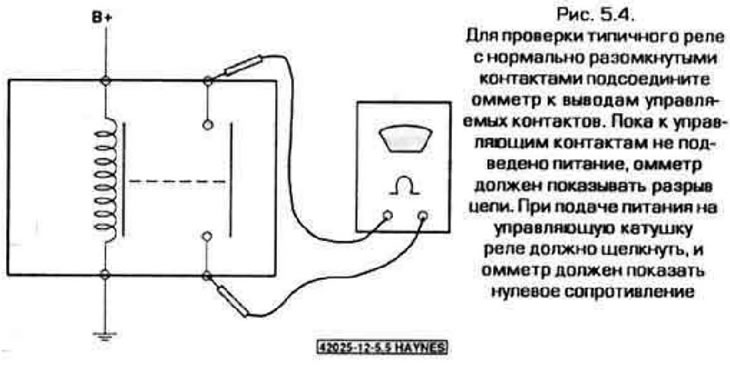
4. To check the relay, connect an ohmmeter to the terminals of the controlled circuit. The ohmmeter should show infinite resistance (figure 5.4). Now connect the positive battery terminal to the control winding terminal of the relay using a wire with a fuse. Connect the second terminal of the control winding to the vehicle ground. The relay should turn on (a click will be heard), and the ohmmeter readings should become zero. In some relays, the polarity of its connection matters. If you do not hear a click, change the brightness of the control circuit terminal connections.
5. If the relay is faulty, replace it.
(Content based on information from: MazBook)