


Note:
- During bleeding, the brake fluid level in the reservoir should not fall below 3/4 of the set level.
- Whenever the brake pipes are disconnected, the entire system must be bled. If the brake pipe was disconnected from the master cylinder, start bleeding from the wheel cylinder farthest from the master, then move to the next farthest wheel cylinder, and so bleed all four wheel cylinders. If the brake pipe was disconnected in another place, start bleeding from the wheel cylinder closest to the place where the pipe was disconnected, move to the next wheel cylinder closest to the place where it was disconnected, and so bleed all four wheel cylinders.
1. Jack up the car and place it on stands.
2. Remove the cap from the bleed nipple and place a clear vinyl hose over the nipple.
3. Place the other end of the hose into a clear container to collect the brake fluid.
4. One worker must press the brake pedal several times and hold the pedal down.
5. Another worker, using a special device, loosens the bleed nipple, and after the fluid has passed into the brake fluid drain tank, tightens the nipple.
- Tightening torque: 6 - 9 Nm
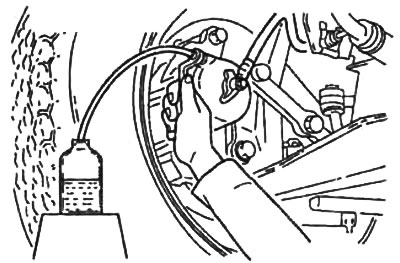
Front disc brakes.
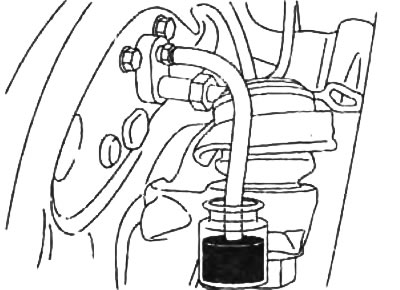
Rear drum brakes.
6. Repeat steps "4" and "5" until no more air bubbles appear in the escaping brake fluid.
7. Check that the brakes are working properly.
8. Check for brake fluid leaks.
Caution: If brake fluid leaks, remove it immediately.
[The article is copied from the resource: MAZBOOK.ru]
9. After bleeding the brake system, bring the brake fluid level to the maximum.
- Brake fluid - SAE J1703, FMVSS 116 DOT-3