


Contents: Removal ⇓ Installation ⇓
Attention.
- A hot engine can cause burns. Before starting work, turn off the engine and wait until it cools down.
- If the camshaft is rotated after the drive chain is removed, the valves may hit the piston crown when the piston is at top dead center, causing engine damage. When rotating the camshaft with the drive chain removed, all pistons in the engine must be set to the middle position.
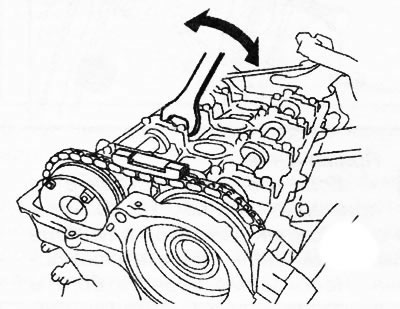
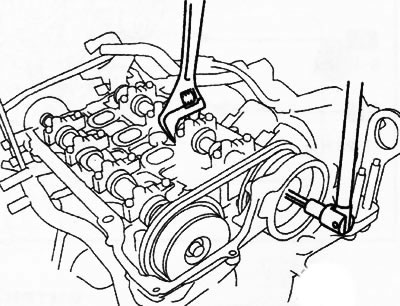
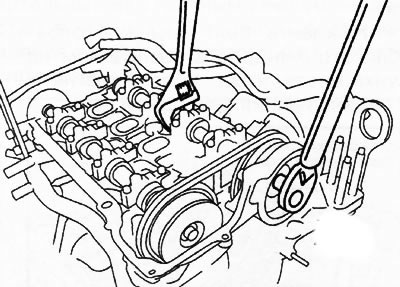
- When turning the camshaft with a wrench on the hexagonal part, the wrench may hit the rocker arm and damage it. To prevent damage to the rocker arm, when holding the camshaft by the hexagonal part, place the wrench closer to the rear of the engine, as shown in the figure, to ensure a safe gap between the wrench and the camshaft lobe.
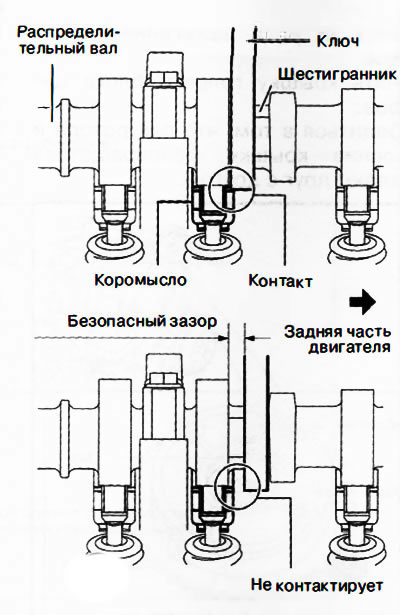
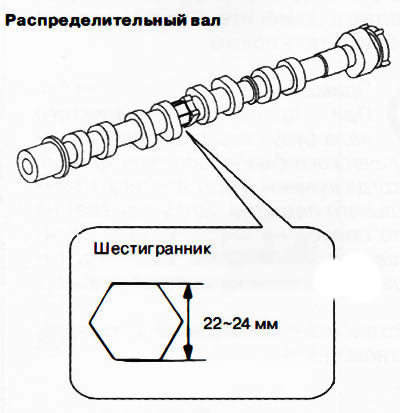
Note: The width of the hexagonal part of the camshaft is 22-24mm.
Removal
1. Disconnect the negative battery terminal.
2. Remove the decorative engine cover.
3. Remove the ignition coils/ion sensors.
4. Remove the cylinder head cover (see section "Gas distribution mechanism drive chain" above in this chapter).
5. Remove the front protective pan No.2 of the engine.
6. Remove the electric drive of the valve timing regulator.
7. Remove the vacuum pump.
8. Remove the high pressure fuel pump with the rear casing.
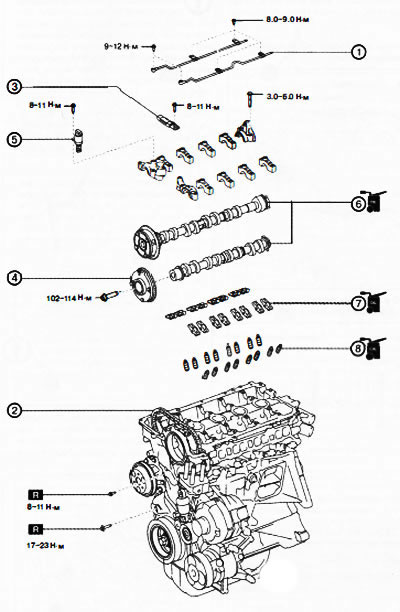
1. Oil spray tubes.
2. Gas distribution mechanism drive chain.
3. Chain tensioner No.1.
4. Electric valve timing controller.
5. Oil supply control valve.
6. Camshafts.
7. Rocker arms.
8. Hydraulic compensators.
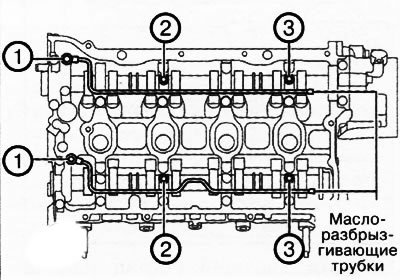
9. Loosen the mounting bolts and remove the oil spray tubes.
10. Remove the timing chain with damper No.1:
Note: Loosen the drive chain tension by securing the tensioner shoe through the service hole in the front engine cover.
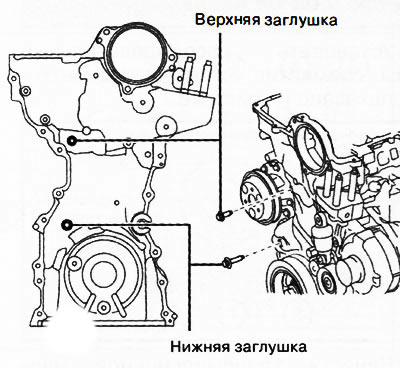
Remove the plugs (upper and lower) from the service holes of the front engine cover.
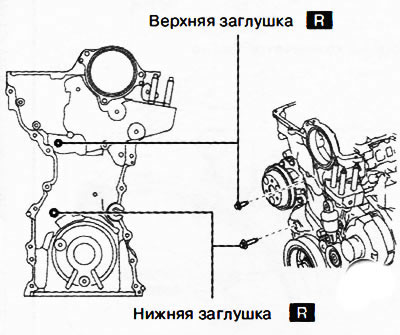
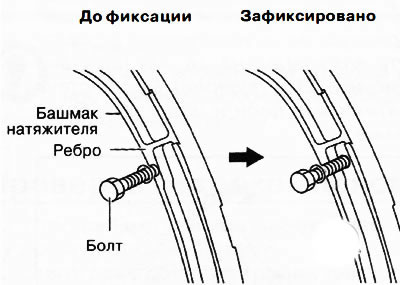
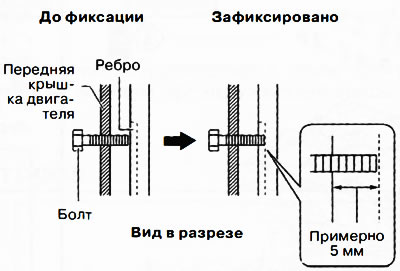
Insert M6 bolt (35-60 mm long with threads all the way to the head) into the upper service hole and screw it in until it contacts the tensioner shoe, then loosen it by about 180° (the bolt should rest slightly against the front of the tensioner shoe).
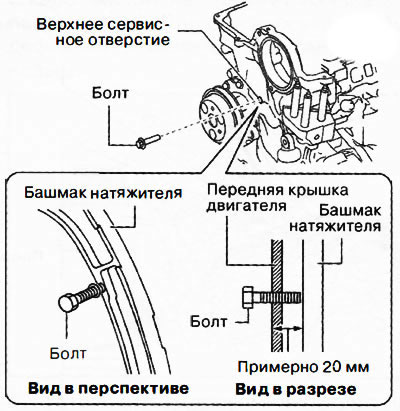
Note:
- The bolt will contact the tensioner shoe after being screwed in to a depth of approximately 20mm.
- Hold the exhaust camshaft with a wrench by the hexagonal part and move it back and forth several times as shown in the figure. This will allow the oil to drain from the chain tensioner and make servicing easier.
Insert a suitable screwdriver into the lower service hole.
While moving the exhaust camshaft back and forth with a wrench mounted on the hexagonal portion, press down on the tensioner plate with a screwdriver and release the tensioner lock.
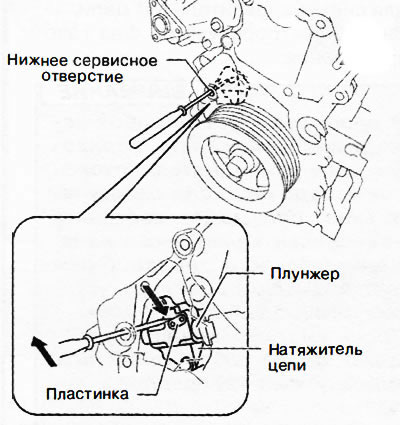
Note: As the exhaust camshaft moves back and forth, the drive chain depresses the tensioner plunger, making it easier to turn the lock plate.
After releasing the plunger lock, turn the exhaust camshaft clockwise until the drive chain is loose.
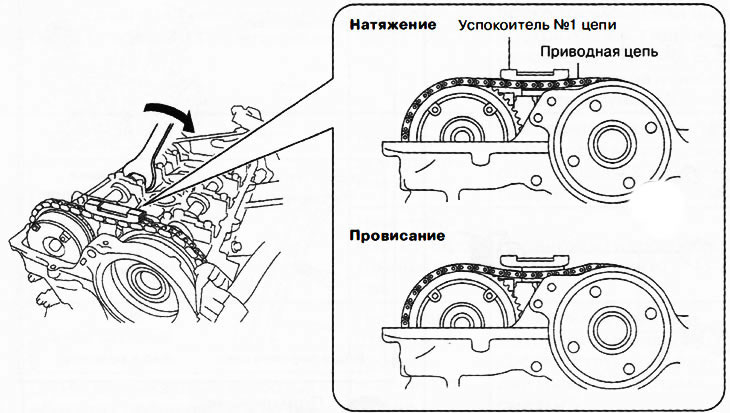
After loosening the chain, tighten the M6 bolt in the upper service hole until it goes in about 5 mm more to secure the tensioner shoe.
 |
 |
Note:
- If the bolt does not go in about 5 mm, the tensioner plunger lock may not be released or the chain may not be loose enough. The bolt must be returned to its original position and the procedure repeated.
- When the exhaust camshaft is turned clockwise, the drive chain pushes the tensioner shoe, changing the position of its rib. The entire tensioner shoe is fixed by hooking the bolt onto the rib.
After fixing the tensioner shoe, remove chain guide No.1.
11. Remove the valve timing control unit:
Attention.
- During and after the work, it is necessary to keep the drive chain raised away from the sprockets. If the chain falls down, it can jump off the crankshaft sprocket, as a result of which it will be necessary to perform the entire valve timing procedure.
- After completing the work, it is necessary to check the valve timing.
Turn the crankshaft clockwise so that the piston of the first cylinder is set almost to the top dead center (TDC) position, as shown in the figure.
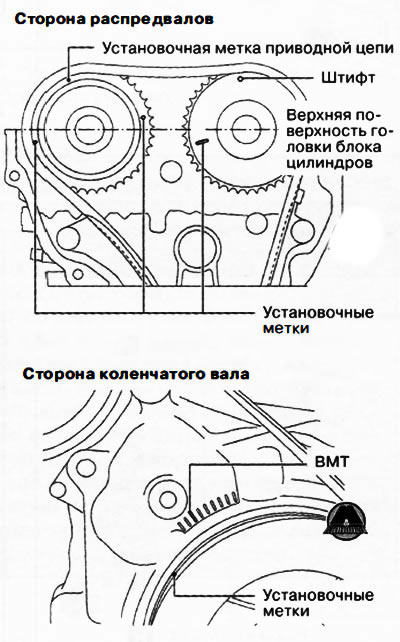
Note: When the piston of the first cylinder of the engine is set to the position of almost the top dead center (TDC), there is no large movement (rotation) of the exhaust camshaft with the drive chain removed. In this regard, the installation of the electric valve timing adjuster is simplified. If there is a large movement of the exhaust camshaft, the installation of the electric valve timing adjuster on the camshaft should be carried out with the chain loosened by rotating the exhaust camshaft.
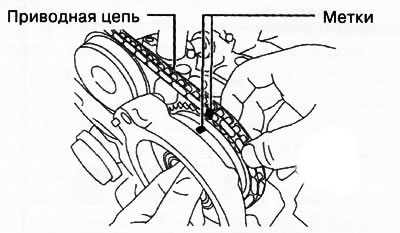
Mark the relative positions of the drive chain and phase shifters so that they are in the same position after reinstallation.
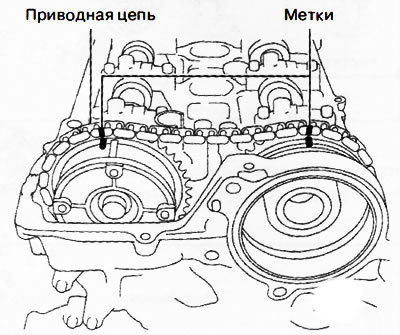
Holding the intake camshaft with a wrench by the hexagonal part, unscrew the valve timing control valve mounting bolt.
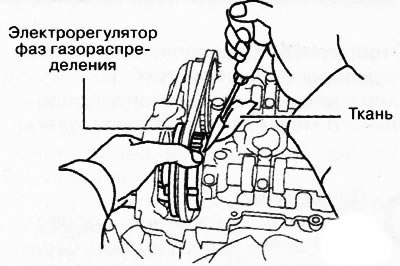
Using a screwdriver wrapped in a clean cloth, gently push the phase adjuster forward to disconnect it from the camshaft.
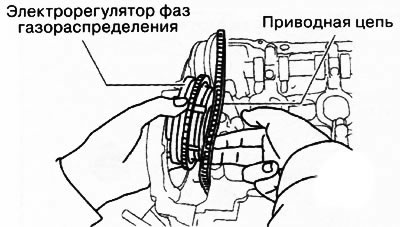
Remove the timing chain from the exhaust and intake camshaft sprockets and set it aside, then remove the electric phase regulator.
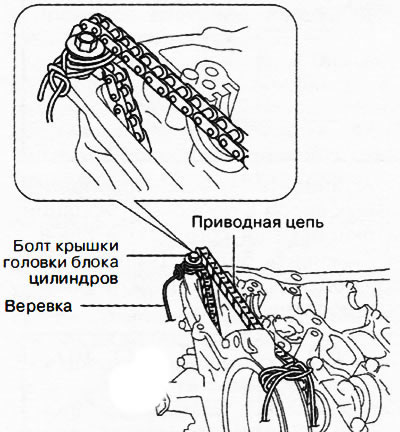
Return the drive chain to the exhaust camshaft sprocket and, pulling the chain up, hang it on the rope as shown in the figure.
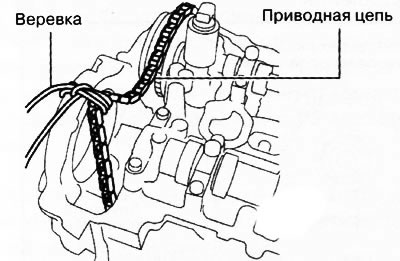
12. Unscrew the oil supply control valve.
13. Remove the camshafts:
Note: The exhaust camshaft and hydraulic phase shifter are removed as one unit.
Leave the drive chain as is - suspended after removing the electric valve timing controller.
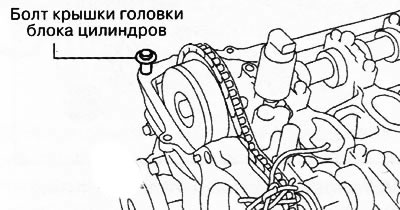
Install the cylinder head cover bolt in the location shown in the figure to use them to hang the drive chain.
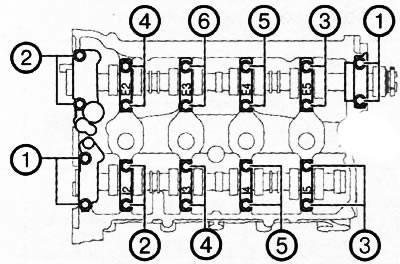
Loosen the camshaft cover bolts in two or three steps in the sequence shown in the figure, then remove the covers.
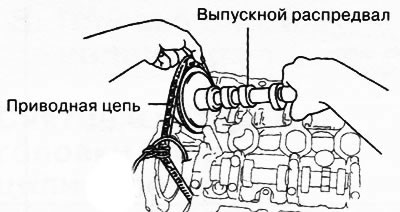
Remove the intake camshaft.
Having moved the timing chain to the side, remove the exhaust camshaft with the hydraulic phase shifter as one unit.
Pull the drive chain up and hang it with a rope as shown in the figure.
14. Remove the rocker arms from the cylinder head and arrange them in the order corresponding to the cylinders so that they can be installed in their proper places during assembly.
15. Remove the hydraulic lifters and arrange them in the order corresponding to the cylinders so that they can be installed in their places during assembly.
Installation
1. Bleed air from hydraulic compensators:
Place the hydraulic compensator in a reservoir with engine oil.
Caution: Do not insert the rounded rod with great force, as the check valve ball spring is extremely weak.
By lightly pressing on the check valve ball with a rounded rod (diameter approximately 1.0 mm), remove air by moving the plunger up and down.
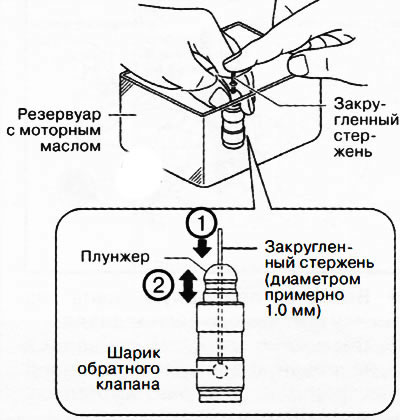
Press the end of the plunger into the oil and make sure there is no feeling of pushing out. Otherwise, it is necessary to replace the hydraulic compensator with a new one.
2. Visually inspect the surface of the hydraulic compensator that contacts the rocker arm for wear or damage. If any defects are found, replace the gyro compensator with a new one.
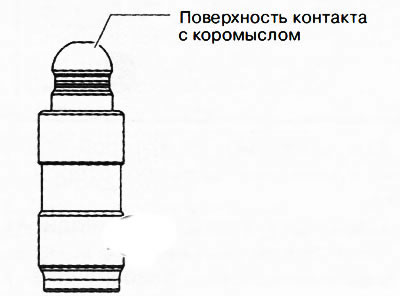
3. Install the hydraulic compensator in its original position in the cylinder head.
4. Apply engine oil to the hydraulic lifters and the ends of the valve stems, then install the rocker arms in the original positions they occupied before removal.
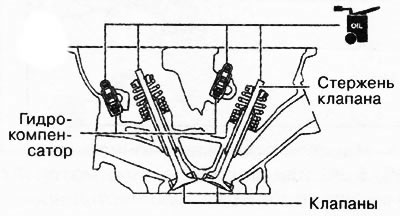
5. Install the camshafts:
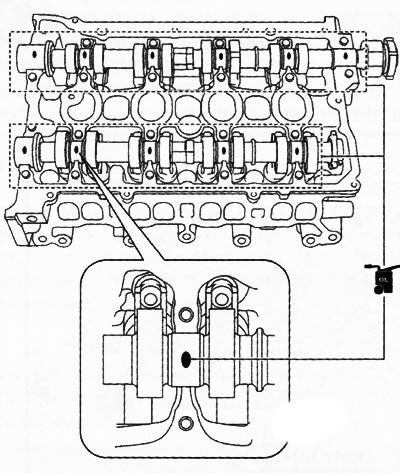
Apply transmission oil (SAE 90 or similar) or engine oil to the center of each bearing in the cylinder head as shown in the figure.
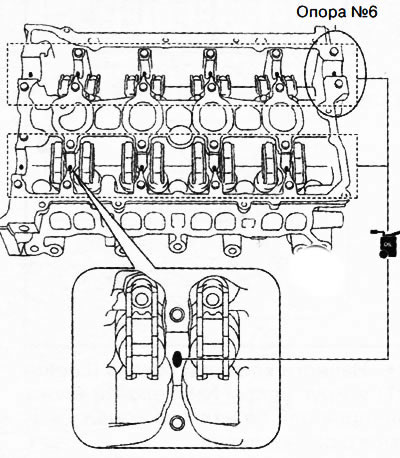
Attention: No more than 0.05 ml of oil should be applied to support #6.
Aligning the position of the camshaft cam with the position of the near top dead center of the piston of the first cylinder (TDC), as shown in the figure, install the intake camshaft into the cylinder head.
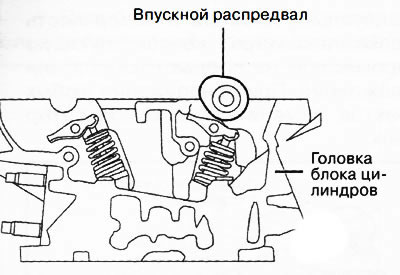
Remove the rope that holds the drive chain on the release side.
Aligning the mark on the drive chain, made during removal, with the mark on the hydraulic phase shifter, install the exhaust camshaft into the cylinder head.
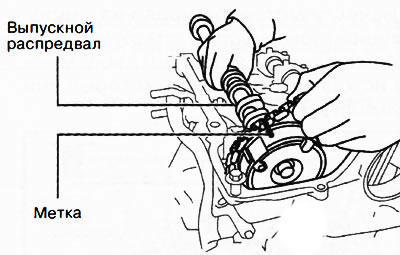
Apply transmission oil (SAE 90 or similar) or engine oil to the center of each camshaft journal as shown in the figure.
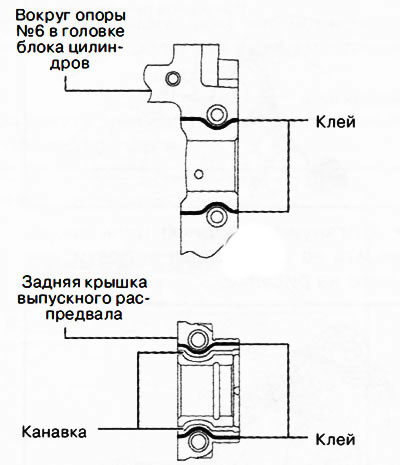
Apply adhesive (Loctite 962T) around support No.6 of the cylinder head or on the rear cover of the exhaust camshaft.
Caution: Make sure that no adhesive comes into contact with the camshaft journal.
Note: Adhesive bead width: 0.5-1.5 mm.
Install the camshaft caps in numbered order (according to the markings on the lids) and evenly tighten the cap bolts in two or three steps in the sequence shown in the figure.
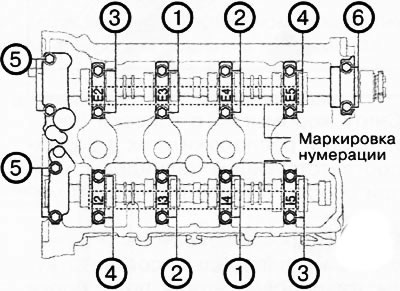
Tighten the camshaft cover bolts in two stages in the sequence shown in the figure: first to 3.0-6.0 Nm, then to 8-11 Nm.
6. Screw in the oil supply control valve.
7. Install the electric valve timing controller:
Remove the rope that holds the drive chain on the intake side.
Remove the drive chain from the sprockets of the exhaust and intake camshafts and put it back, then insert the electric valve timing adjuster between the front engine cover and the cylinder head.
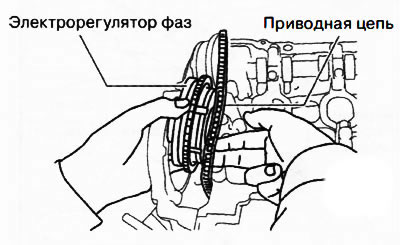
Return the drive chain to the exhaust camshaft sprocket.
Align the mark on the drive chain, applied during removal, with the mark on the electric phase regulator, and install the chain on the sprocket.
Align the installation pin on the end of the intake camshaft with the groove on the side of the phase regulator, and install the electric valve timing regulator.
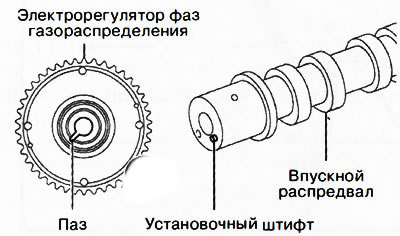
Note: Adjust the relative position of the dowel pin and groove by rotating the camshaft.
Holding the intake camshaft with a wrench by the hexagonal part, tighten the electric phase regulator mounting bolt to a torque of 102-114 Nm.
8. Install the drive chain damper No.1.
9. Loosen the tensioner shoe fixing bolt to tighten the drive chain.
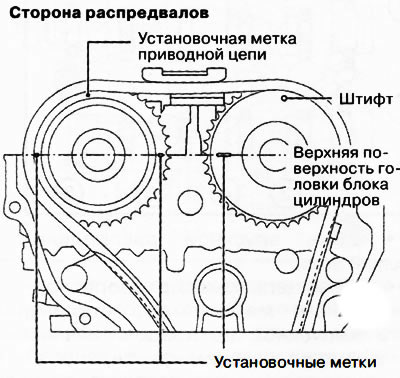
10. Turn the crankshaft two turns clockwise to ensure that the valve timing marks are correctly set.
 |
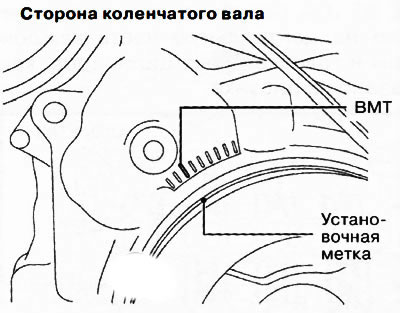 |
Note: If the timing marks are incorrect, remove the front engine cover and reinstall the drive chain on each sprocket.
11. Install plugs (upper and lower) into the service holes of the front engine cover.
Note:
Tightening torques for plugs:
- top: 8-11 Nm;
- lower: 17-23 Nm.
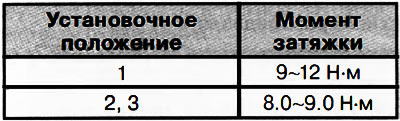
12. Install the oil spray tubes and tighten the mounting bolts in the sequence shown in the figure.
 |
 |
13. Install all remaining parts in the reverse order of removal.
14. Start the engine and check its operation.