MazBook.ru
English Русский
Български
Беларускі
Український
Српски
Hrvatski
Română
Polski
Slovenský
Magyar
• Bookmark • Sitemap • Contacts •   
Cars Opel Cars Ford Cars Volkswagen Cars Audi Cars Kia Cars Renault Cars Peugeot


Familia Capella Mazda3 Mazda6 CX-? Others Articles
Mazda 121 (3) (1996-2003) Mazda BT-50 (1) (2006-2011)

Checking the battery (Mazda 121 (3))

  • Home
  • Mazda
  • 121 JASM (1996-2003)
  • Electrical equipment
  • Power devices
  • Checking the battery
0
Contents: Checking the electrolyte level ⇓ Checking voltage ⇓ Checking the battery under load ⇓ Checking the density of the…⇓

Checking the electrolyte level


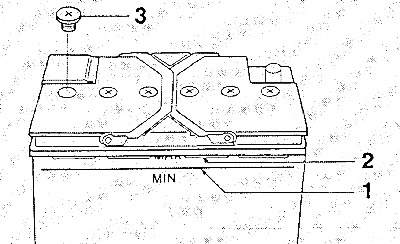
The electrolyte level in individual cans should be between the "MIN" (1) and "MAX" (2) marks. If necessary, unscrew the plugs (3) and add distilled water.

Checking voltage


Checking voltage


The condition of the battery is checked by measuring the voltage between the battery terminals using a voltmeter.

Clean the outside of the battery.

To check, the battery should not be charged for at least 6 hours, including with the engine running. Otherwise, turn on the headlights for 30 seconds before charging.

The original article is available on MAZBOOK.ru

Turn off the headlights and all other current consumers and wait 5 minutes.
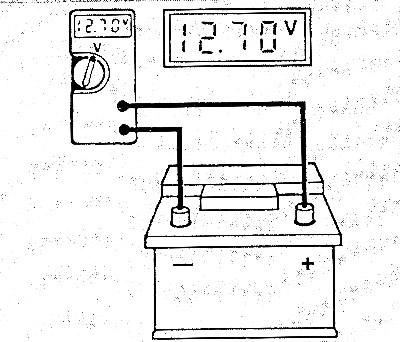
Connect a voltmeter to the battery terminals and measure the voltage.


Connect a voltmeter to the battery terminals and measure the voltage.


Evaluation of measurement results:

12.7V or higherThe battery is in good condition
12.6 VThe battery is normal
12.4V or belowThe battery is in bad condition, charge or replace it

Checking the battery under load


Connect the voltmeter to the battery terminals.

Start the engine and measure the voltage.

When starting the engine with a fully charged battery, the voltage should not drop below 10 V (at a temperature of +20°C).

If the voltage drops sharply and the electrolyte density in the battery banks is different, this indicates a malfunction.

Checking the density of the electrolyte


The density of the electrolyte in combination with the voltage gives an accurate conclusion about…


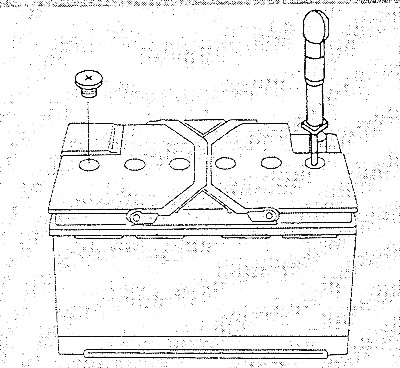
The density of the electrolyte in combination with the voltage gives an accurate conclusion about the state of charge of the battery. Remove the caps from the cans. A density meter (hydrometer) is required for checking. The density of the electrolyte is measured in g/ml (g/cm³) or in degrees Baume (+°Be'). The following values should be obtained:

State of charge+°Ve'g/ml
Discharged161,15
Half discharged241,22
Well charged30-1,26

Check all the battery jars one by one - they should have the same density of electrolyte (permissible difference - 0.04 g/ml). If this is not the case, the battery is faulty.
This article is available at: russian, bulgarian, belarusian, ukrainian, serbian, croatian, romanian, polish, slovak, hungarian
This text was checked by: Evgeny Mereshnikov
Share with friends on social networks:

Previous
Mazda 121 (3) » Power devices
Next

Battery charge
Instructions for use of maintenance-free battery
Removal and installation the battery
Storage of the battery
Trouble diagnosis of the battery pack
General information about the generator
Precautions when working with a generator
Checking the generator charging voltage
More articles on repairing other Mazda models
Checking the battery Mazda Familia 6 (1989-1994)
Battery Connection Cables — checking and replacing Mazda Capella 3 (1982-1992, petrol)
Checking the battery charge level Mazda3 BK (2003-2009)
Checking the battery charge indicator Mazda6 GG (2002-2008)
Checking the oil Mazda CX-5KE (2012-2017)
Link in different formats to this article
Comments and feedback from visitors
No comments yet


How much will 25 + 32 ?


Mazda BT-50 (1) (2006-2011) 
  • General information
  • Introduction to guide
  • User manual
  • Maintenance
  • Power unit
  • Engine repair (diesel)
  • Cooling and lubrication system
  • Fuel injection system
  • Intake and exhaust system
  • Engine electrical equipment
  • Transmission
  • Clutch
  • Mechanical gearbox
  • All-wheel drive system
  • Transfer case and gearboxes
  • Chassis
  • Front suspension
  • Rear suspension
  • Steering
  • Brake system
  • Body
  • Exterior (external elements)
  • Interior (internal elements)
  • Heating and air conditioning
  • Security system SRS
  • Electrical equipment
  • Equipment and devices
  • Electrical circuits
Mazda 121 (3) (1996-2003) 
  • General information
  • User manual
  • Maintenance
  • Power unit
  • Petrol engine 1.3 l
  • Petrol engine 1.25/1.4 l
  • Diesel engine
  • Lubrication system
  • Cooling system
  • Ignition system
  • Supply system
  • Fuel injection (gasoline)
  • Fuel injection (diesel)
  • Exhaust system
  • Transmission
  • Clutch
  • Car gearbox
  • Chassis
  • Front suspension
  • Rear suspension
  • Steering
  • Brake system
  • Wheels and tires
  • Body
  • Exterior (external elements)
  • Interior (internal elements)
  • Doors, windows and locks
  • Heating system
  • Electrical equipment
  • Troubleshooting
  • Equipment and devices
  • Lighting system
  • Power devices
  • Electrical circuits
MazBook.ru © 2018–2026 · Mobile version · Articles and news · Sitemap: EN BG BY UA RS HR RO PL SK HU · Feedback · Site search · Add to bookmarks Familia 5 (BF) · Familia 6 (BG) · Capella 3 (GC) · Capella 3 and 4 (GC) · Capella 4 (GD) · Capella 5 (GE) · Capella 6 (GF) · Mazda3 BK · Mazda6 GG · CX-5KE · Mazda 121 (3) · Mazda BT-50 (1) ·
By continuing to use the site, you agree to the use of cookies 🔐