
MazBook.ru
English Русский
Български
Беларускі
Український
Српски
Hrvatski
Română
Polski
Slovenský
Magyar
• Bookmark • Sitemap • Contacts •   
Cars Opel Cars Ford Cars Volkswagen Cars Audi Cars Kia Cars Renault Cars Peugeot


Familia Capella Mazda3 Mazda6 CX-? Others Articles
Mazda 121 (3) (1996-2003) Mazda BT-50 (1) (2006-2011)

Storage of the battery (Mazda 121 (3))

  • Home
  • Mazda
  • 121 JASM (1996-2003)
  • Electrical equipment
  • Power devices
  • Storage of the battery
0
To prevent aging, the battery removed from the car should be recharged every two months. Batteries that have not been used for a long time are subject to self-discharge and therefore can become sulfated. When such batteries are charged with a fast charger, they do not accept the charge or they undergo a shallow charge, which is quite fast and is mistaken for a full charge.

Before concluding that the battery is faulty, the following must be checked:

Check the density of the electrolyte. If the density values in different cans differ from each other by no more than 0.04 g/ml, then the battery needs to be charged with a normal current.

After charging, check the battery under load. If the control values are not reached, the battery is faulty.

If the density of the electrolyte in one or two adjacent cans is noticeably lower than in others (for example, in 5 cans 1.16 g/ml, and in one - 1.08 g/ml), then there is an internal short circuit in the battery and it is faulty.

The battery is self-discharging


Depending on the vehicle configuration, the natural self-discharge of the battery is supplemented by current leakage in various control units when the vehicle is idle. Therefore, the battery in a vehicle that is not moving should be charged every six weeks. If there is a suspicion of leakage currents, check the electrical system as follows:

Use a charged battery for testing.
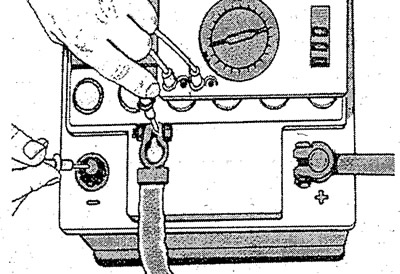
Set the ammeter with measurement ranges of 0-5 mA and 0-5 A to the maximum measurement limit.…


Set the ammeter with measurement ranges of 0-5 mA and 0-5 A to the maximum measurement limit. Disconnect the negative cable from the battery.


Caution: This will erase the data from the injection control unit, the radio safety codes and the settings. See the instructions in the relevant section of this chapter.


Connect the ammeter between the negative terminal of the battery and the negative wire disconnected from the battery. Connect the "plus" of the ammeter to the wire, and the "minus" of the ammeter to the negative terminal of the battery.

Note: The test can be done with a test lamp. If the lamp between the negative wire and the battery terminal does not light, then in any case you should use an ammeter.


Turn off all power consumers, disconnect the clock (and other non-disconnectable consumers), close the doors.

Reduce the ammeter's range until a readable current value is obtained.

Disconnect different circuits one by one by pulling out the fuses. If the current drops to zero when one of the circuits is broken, then you need to look for the source of the malfunction in it. The malfunctions may be as follows: corroded and dirty contacts, frayed wires, internal short circuit in the consumer itself.

If no faults are found in the fuse-protected circuits, disconnect the wires from unfused units such as the generator and starter.

The article is copied from the resource: MAZbook.ru

If the current drops to zero when disconnecting wires from unprotected units, repair or replace the corresponding unit. If there are current leaks in the starter or ignition system, the ignition and starter switch must also be checked.

Connect the negative cable to the battery.

Set the clock, enter the radio receiver safety codes.
This article is available at: russian, bulgarian, belarusian, ukrainian, serbian, croatian, romanian, polish, slovak, hungarian
This text was checked by: Evgeny Mereshnikov
Share with friends on social networks:

Previous
Mazda 121 (3) » Power devices
Next

Checking the battery
Battery charge
Instructions for use of maintenance-free battery
Removal and installation the battery
Trouble diagnosis of the battery pack
General information about the generator
Precautions when working with a generator
Checking the generator charging voltage
Removal and installation the generator
More articles on repairing other Mazda models
Storage of the battery Mazda Familia 6 (1989-1994)
Jump starting with a spare battery Mazda Capella 3 (1982-1992, petrol)
Storage of the battery Mazda3 BK (2003-2009)
Replacing the remote control battery Mazda6 GG (2002-2008)
Tire storage Mazda CX-5KE (2012-2017)
Link in different formats to this article
Comments and feedback from visitors
No comments yet


How much will 48 + 21 ?


Mazda BT-50 (1) (2006-2011) 
  • General information
  • Introduction to guide
  • User manual
  • Maintenance
  • Power unit
  • Engine repair (diesel)
  • Cooling and lubrication system
  • Fuel injection system
  • Intake and exhaust system
  • Engine electrical equipment
  • Transmission
  • Clutch
  • Mechanical gearbox
  • All-wheel drive system
  • Transfer case and gearboxes
  • Chassis
  • Front suspension
  • Rear suspension
  • Steering
  • Brake system
  • Body
  • Exterior (external elements)
  • Interior (internal elements)
  • Heating and air conditioning
  • Security system SRS
  • Electrical equipment
  • Equipment and devices
  • Electrical circuits
Mazda 121 (3) (1996-2003) 
  • General information
  • User manual
  • Maintenance
  • Power unit
  • Petrol engine 1.3 l
  • Petrol engine 1.25/1.4 l
  • Diesel engine
  • Lubrication system
  • Cooling system
  • Ignition system
  • Supply system
  • Fuel injection (gasoline)
  • Fuel injection (diesel)
  • Exhaust system
  • Transmission
  • Clutch
  • Car gearbox
  • Chassis
  • Front suspension
  • Rear suspension
  • Steering
  • Brake system
  • Wheels and tires
  • Body
  • Exterior (external elements)
  • Interior (internal elements)
  • Doors, windows and locks
  • Heating system
  • Electrical equipment
  • Troubleshooting
  • Equipment and devices
  • Lighting system
  • Power devices
  • Electrical circuits
MazBook.ru © 2018–2026 · Mobile version · Articles and news · Sitemap: EN BG BY UA RS HR RO PL SK HU · Feedback · Site search · Add to bookmarks Familia 5 (BF) · Familia 6 (BG) · Capella 3 (GC) · Capella 3 and 4 (GC) · Capella 4 (GD) · Capella 5 (GE) · Capella 6 (GF) · Mazda3 BK · Mazda6 GG · CX-5KE · Mazda 121 (3) · Mazda BT-50 (1) ·
By continuing to use the site, you agree to the use of cookies 🔐