


Examination
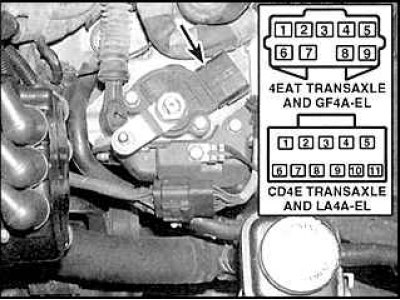
1. Disconnect the sensor wire (the corner shows the location of the contacts in the sensor's contact socket).
2. Move the gear shift lever to each position in turn. Take measurements and compare the results with the data in the tables Checking the gearbox sensor (4ET and GF4A-EL) and Checking the gearbox sensor (CD4E and LA4A-EL).
Checking the gearbox sensor (4ET and GF4A-EL)
| Position of the sensor switch | The circuit is closed (contacts) |
| P | 1 and 5; 6 and 9 |
| R | 1 and 4 |
| N | 1 and 8; 6 and 9 |
| D | 1 and 2 |
| 1 | 1 and 7 |
| 2 | 1 and 3 |
Checking the gearbox sensor (CD4E and LA4A-EL)
| Position of the sensor switch | The circuit is closed (contacts) |
| P | 1 and 7 (3770 – 4607 Ohm); 8 and 2 |
| R | 1 and 7 (1304 – 1593 Ohm); 5 and 3 |
| N | 1 and 7 (660 – 807 Ohm); 8 and 2 |
| D | 1 and 7 (361 – 442 Ohm) |
| 1 | 1 and 7 (190 – 232 Ohm) |
| 2 | 1 and 7 (78 – 95 Ohm) |
Adjustment (4EAT and GF4F-EL)
1. Place the gear shift lever in neutral position. Disconnect the gear shift lever cable from the shift lever on the transmission.
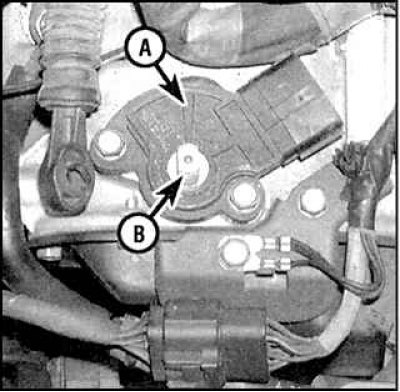
2. Loosen the switch bolts and turn the switch to align the neutral position mark (A) with the switch rod (B).
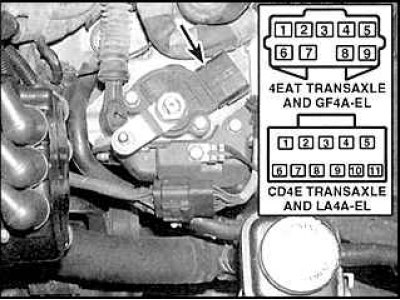
3. Disconnect the sensor wire and connect an ohmmeter to the contacts responsible for the neutral position. The circuit between the contacts must be closed.
4. Tighten the shifter bolts and install the lever and cable.
Replacement
1. Raise and support the front of the vehicle.
2. Disconnect the wire from the sensor.
3. Place the gear shift lever in neutral position.
4. Remove the sensor bolts.
5. Install the new switch and adjust the sensor.