

2. It is recommended to periodically check the tightness and efficiency of the air conditioning system.
3. Use caution when working with the air conditioning system. Before working with the air conditioning system, read the section "Safety precautions when working with refrigerant".
4. When removing and installing some components in the air conditioning system, it is necessary to add a certain amount of compressor oil. The need to add oil is indicated in the text in the installation procedures for such components.
5. After performing work that requires disconnecting the tubes or hoses of the system, it is necessary to:
- air conditioning system refill;
- vacuuming the system;
- leak test.
Refueling the air conditioning system is the procedure for filling the system with refrigerant. When refueling the system, it is necessary to strictly follow the recommendations for the volume of refrigerant. Insufficient refrigerant reduces the efficiency of the air conditioning system and can lead to compressor failure. Overcharging the system leads to insufficient cooling, excessive fuel consumption, engine overheating, etc.
Evacuation is a procedure to remove air from the air conditioning system. The presence of air in the air conditioning system can lead to a decrease in efficiency or failure of the air conditioner.
Leak testing is a procedure designed to detect leaks in the air conditioning system. Leaks in the system will lead to a lack of refrigerant in the system, which in turn can cause a decrease in the efficiency of the air conditioning system or lead to compressor failure.
If you have special equipment, perform refueling (vacuuming, leak testing) air conditioning systems. When performing the procedure, follow the instructions for the devices and the data in the "Specifications" table. If you do not have special equipment, contact a specialized service to carry out refueling procedures (vacuuming, leak testing) air conditioning systems.
Specifications

6. Location of fittings for connecting the pressure gauge block and/or equipment for filling the system.
Note:
- The air conditioning system fittings are located in the engine compartment and are covered with caps.
- High and low pressure fittings differ in diameter.
The high pressure fitting is usually located on the high pressure line between the compressor and the condenser, or between the condenser and the air conditioning unit in the cabin.
The low pressure fitting is usually located on the low pressure line between the air conditioning unit (in the cabin) and the air conditioning compressor.
Note: The location of the fittings can be determined from the "Cooling Lines" drawing in this chapter.
Checking the refrigerant pressure
1. Install the pressure gauge block
2. Set the idle speed to 1500 rpm.
3. Set the heater fan speed to maximum.
4. Turn on the air conditioner.
5. Set the mode "RECIRCULATE".
6. Switch the temperature control lever to the "MAX COLD" position.
7. Set the "VENT" mode.
8. Close all doors and windows.
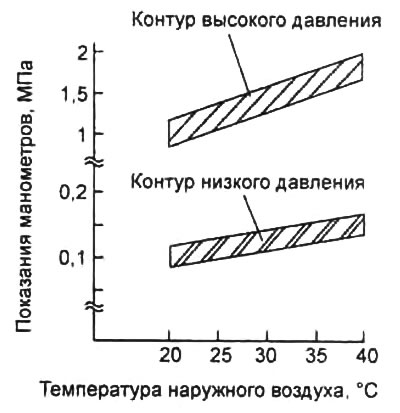
9. Measure the outside temperature and the readings of the pressure gauges connected to the low-pressure circuit and to the high-pressure circuit.
10. Make sure that the outside air temperature and pressure gauge readings are within the shaded area of the graphs.
Checking the efficiency of the refrigerant circulation system
1. Perform the steps described in the subsection - "Checking the refrigerant pressure".
If the pressure is not correct, troubleshoot the air conditioning system.
If the pressure is correct, proceed to the next step
2. Install the thermometer in the center air vent on the driver's side.
3. Set the idle speed to 1500 rpm.
4. Set the heater fan speed switch to the "MAX HI" position.
5. Turn on the air conditioner.
6. Set the mode "RECIRCULATE".
7. Switch the temperature control lever to the "MAX COLD" position.
8. Set the "VENT" mode.
9. Close all doors and windows.
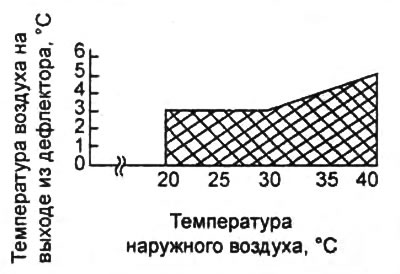
10. Wait until the temperature of the air coming out of the deflector stabilizes. The temperature of the air coming out should be constant and the compressor should turn on and off at regular intervals.
11. Measure the temperature of the air coming out of the deflector.
12. Measure the outside air temperature.
13. Make sure that the temperature of the air coming out of the deflector falls within the center zone of the diagram in accordance with the outside air temperature.