


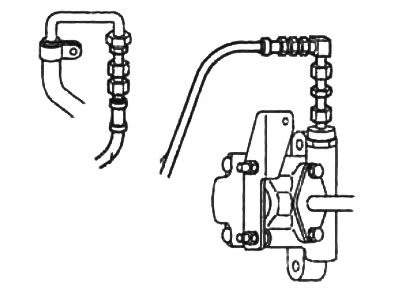
2. Disconnect the discharge hose.
Note: Make alignment marks before disconnecting the hose.
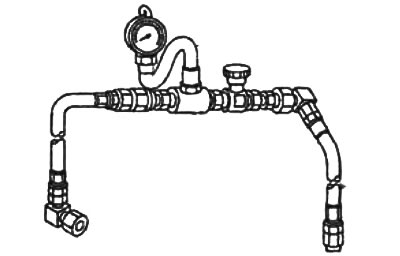
3. Connect the pressure gauge as shown in the figure.
- Tightening torque - 29-44 Nm
4. To remove air, bleed the system (see section "Bleeding the power steering system").
5. Open the pressure gauge valve completely.
6. Start the engine, to warm up the fluid to 50-60°C, turn the steering wheel right and left several times until it stops.
Caution: If you hold the steering wheel in the extreme position for more than 5 seconds, this will lead to a sharp increase in the fluid temperature and damage to the pump.
(The article is copied from the resource: mazbook.ru)
7. Close the pressure gauge valve completely.
Caution: Leaving the pressure gauge valve in the closed position for more than 5 seconds will result in a sharp increase in the liquid temperature and damage to the pump.
8. Increase the engine speed to 1000-1500 rpm, measure the fluid pressure developed by the power steering pump.
- Minimum allowable pressure - 9.3-9.8 MPa
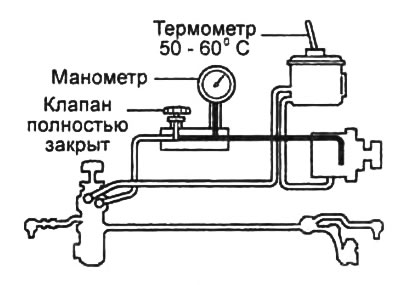
If the measured pressure is lower than the specified value, repair or replace the power steering pump.
9. Measure the liquid pressure with the pressure gauge valve open.
a) Open the tap fully again and increase the engine speed to 1000-1500 rpm.
b) Turn the steering wheel all the way to the right and all the way to the left and measure the pressure developed.
Caution: If you hold the steering wheel in the extreme position for more than 5 seconds, this will lead to a sharp increase in the fluid temperature and damage to the pump.
- Minimum allowable pressure - 9.30-9.79 MPa
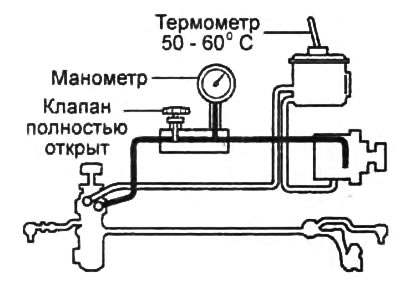
If the measured pressure is lower than the specified value, replace the steering gear assembly.
10. Remove the pressure gauge and connect the discharge hose.
- Tightening torque - 31-47 Nm
11. To remove air, bleed the system (see section "Bleeding the power steering system").