


The main functions of the system are optimal and correct control of the diesel fuel injection process at the right time and in the required quantity, l also at the required injection pressure, which is ensured by the use of an electronic control system. Such organization of the injection process control ensures smooth and economical operation of the diesel engine.
In this Common Rail fuel system, the fuel pressure can reach 160 MPa.
This system allows to reduce the content of solid soot particles in exhaust gases and nitrogen oxides NOx.
The Common Rail fuel system includes: a low-pressure stage, a high-pressure stage and an electronic engine management system.
The main elements of this system are electro-hydraulic injectors, high-pressure fuel pumps from Bosch (SRZ) (with fuel temperature sensor and fuel pressure control valve), fuel accumulator (with fuel pressure sensor and pressure reducing valve), sensors and valves of the engine management system and the electronic engine control unit.
The low pressure stage consists of the fuel tank, fuel filter and low pressure line pipes.
The high-pressure stage of the Common Rail fuel system includes the injection pump, fuel accumulator, injectors, high-pressure lines and fuel return lines.
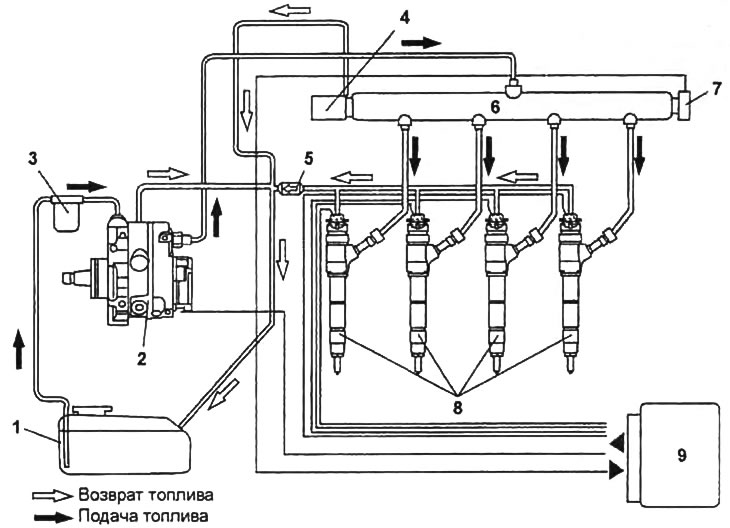
Common Rail fuel system diagram.
1 - fuel tank,
2 - fuel injection pump,
3 - fuel filter,
4 - pressure reducing valve,
5 - check valve,
6 - fuel accumulator,
7 - fuel pressure sensor in the accumulator,
8 - nozzle,
9 - engine control unit.
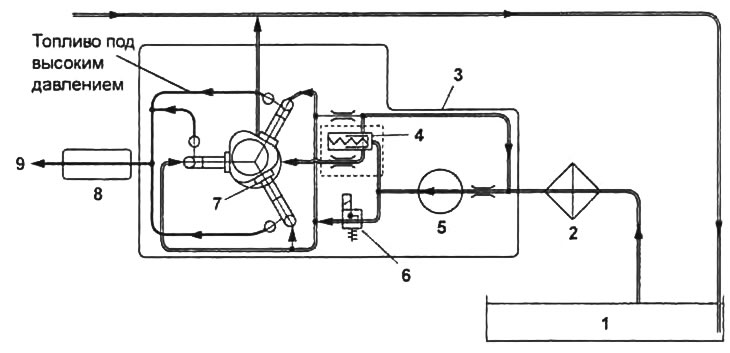
Fuel flow in the injection pump.
1 - fuel tank,
2 - fuel filter,
3 - fuel injection pump,
4 - control valve,
5 - fuel pump,
6 - fuel pressure control valve,
7 - high pressure chamber,
8 - fuel accumulator,
9 - to the injectors.
An additional fuel filter is installed in the nipple (2) of the high-pressure fuel pump for connecting the fuel supply hose from the fuel tank for better filtration of the fuel before it is supplied to the high-pressure line.
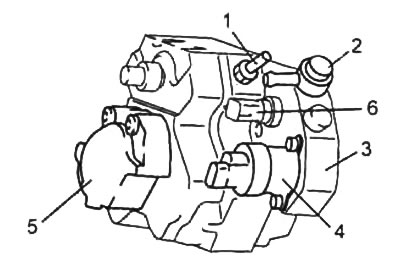
1 - fuel return nipple,
2 - fuel supply nipple from the fuel filter,
3 - fuel injection pump,
4 - fuel pressure control valve,
5 - fuel pump,
6 - fuel temperature sensor.
The high-pressure fuel pump is driven by a gear system from the crankshaft and supplies fuel at the required pressure to the fuel accumulator. The high-pressure fuel pump includes a fuel pump (pumping fuel from the fuel tank into the plunger chamber), a fuel temperature sensor, a fuel pressure regulating valve, a camshaft and three plungers (located at an angle of 120° relative to each other) pumping fuel under high pressure into the fuel accumulator.
The required amount of fuel is pumped into the high-pressure plunger chambers from the fuel tank using a gear fuel pump. The fuel pump consists of two gears with external engagement rotating in different directions. In the pump, fuel from the feed line gets into the gap between the gear teeth and the housing and is fed into the high-pressure chamber of the fuel injection pump. The return of fuel to the feed line is excluded due to the tight contact of the gear teeth. Since the rotation speed of the fuel pump depends on the crankshaft speed, it is necessary to regulate the amount of fuel pumped into the plunger chambers.
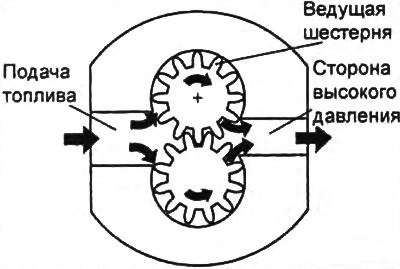
The amount of fuel supplied to the high-pressure plunger chamber is regulated by the fuel pump control valve. Through this valve, at an increased crankshaft speed, part of the fuel returns to the fuel supply line. The fuel pressure control valve regulates the amount of fuel supplied to the accumulator, thereby maintaining a constant pressure in the fuel accumulator. The valve is controlled by the engine control unit, upon the signal of which the valve opens and excess fuel is supplied to the return line.
The fuel supplied by the fuel pump passes into the inlet channel inside the pump. A safety valve is located behind the inlet channel. If the pressure created by the fuel pump exceeds the opening pressure of the safety valve, the fuel passes through the valve throttle into the lubrication and cooling circuit of the high-pressure fuel pump. The drive shaft with an eccentric moves the plunger in accordance with the lift of the eccentric. The fuel passes through the inlet valve (1) of the high-pressure fuel pump into the high-pressure chamber (5) of the pump element and, when the plunger (8) moves downwards, it implements the inlet stroke. The shaft (6) in the high-pressure fuel pump housing is installed in the central bearing. The eccentric (7) on the high-pressure fuel pump shaft ensures the reciprocating motion of the plungers. After reaching the bottom dead center BDC of the plunger, the inlet valve closes and the fuel can no longer exit the upper chamber of the pump element (plunger). Then, when the plunger moves upward, the fuel is compressed, the pressure increases and the outlet (discharge valve) (2) opens as soon as the pressure exceeds its level in the fuel accumulator. The compressed fuel then enters the high-pressure circuit.
The injection pump plunger continues to supply fuel until it reaches the TDC position (injection stroke). After this, the pressure drops, the outlet valve closes and the plunger moves down. When the pressure in the pump element chamber exceeds the pumping pressure, the inlet valve opens again and the process repeats.
The fuel temperature sensor includes a measuring resistor and is powered by 5 V. The resistor's resistance changes depending on the fuel temperature, which in turn affects the output voltage (signal) sent by the sensor to the control unit. The control unit receives a signal from the sensor and determines the fuel temperature according to the algorithm stored in its memory. The data received from the fuel temperature sensor are used to calculate the cyclic fuel supply.
Fuel from the high-pressure fuel pump enters the fuel accumulator under high pressure, from where it is supplied to the injectors. The fuel accumulator maintains optimum pressure (25 - 160 MPa).
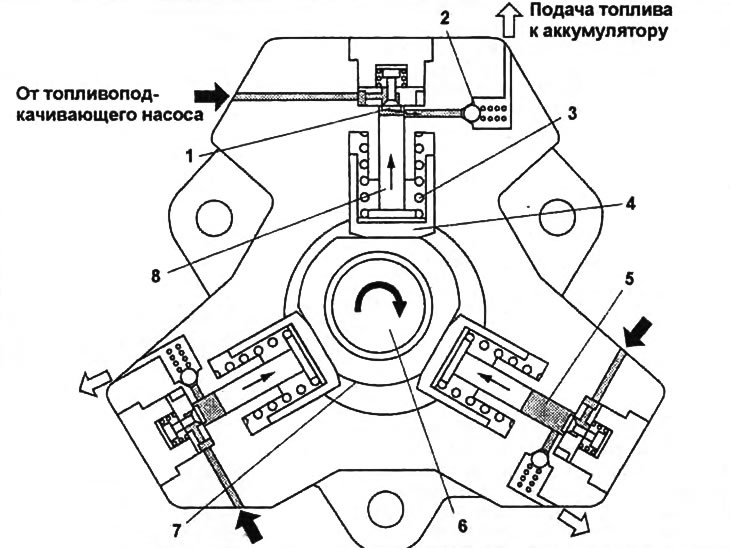
Cross-section of the fuel injection pump.
1 - inlet valve,
2 - exhaust valve,
3 - spring,
4 - pusher,
5 - high pressure chamber,
6 - drive shaft,
7 - eccentric,
8 - plunger.
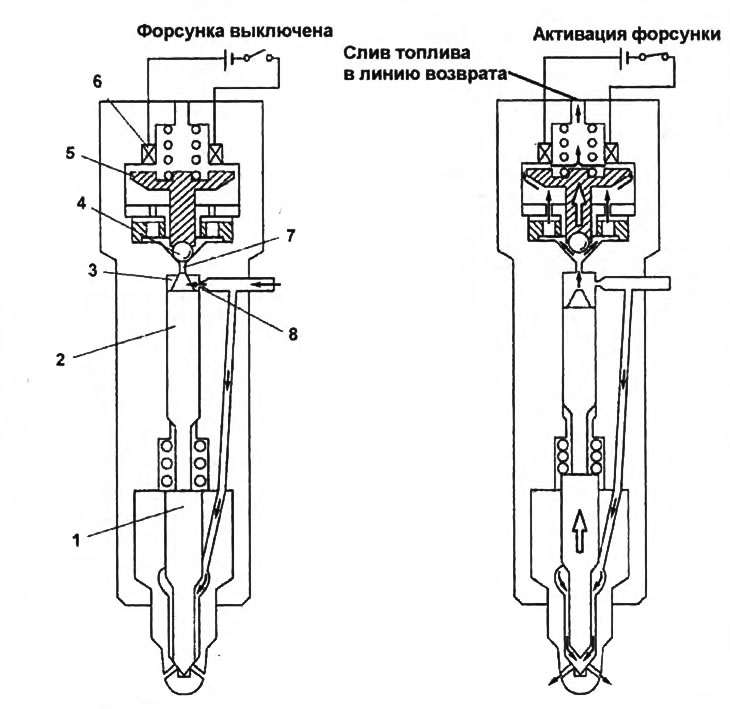
Operation of the injector.
1 - needle,
2 - piston,
3 - hydrochamber,
4 - ball valve,
5 - electromagnetic valve anchor,
6 - electromagnetic valve winding,
7 - return hole,
8 - feed hole.
When the pressure exceeds 195 MPa, part of the fuel is drained through the pressure reducing valve (mounted on the fuel accumulator) into the fuel return line. A pressure sensor is installed on the fuel accumulator.
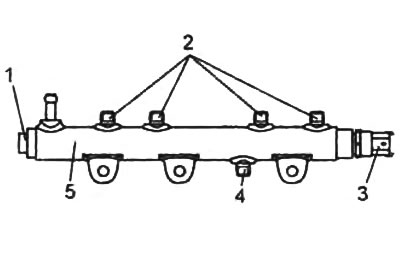
1 - pressure reducing valve,
2 - ports for connecting high-pressure fuel supply pipes to the injectors,
3 - fuel accumulator pressure sensor,
4 - port for connecting the high-pressure fuel supply pipe from the high-pressure fuel pump,
5 - fuel accumulator.
The system includes injectors with an electromagnetic control valve. The injectors are controlled by the engine control unit. Each injector consists of a spring-loaded piston (2), a needle (1), an electromagnetic valve (6) and a hydraulic chamber (3) (see the figure "Injector Operation"). Fuel is supplied from the fuel accumulator to the injector, entering the hydraulic chamber, through the opening (8) and to the injector needle. In the hydraulic chamber, the fuel is under pressure equal to the pressure in the fuel accumulator. When the injector is closed, the fuel presses on the spring-loaded piston, which, in turn, acts on the injector needle, preventing it from opening. When the electronic engine control unit issues a control start signal to the corresponding electromagnetic valve of the injector, the anchor (5) with the ball valve (4) rises. The ball valve opens the channel (7) connecting the hydraulic chamber to the fuel return line, as a result of which some of the fuel is drained and the pressure in the injector hydraulic chamber weakens. At the same time, the pressure of the fuel supplied to the injector needle overcomes the force of the piston spring and the needle opens, as a result of which the injector injects fuel into the cylinder.
A check valve is installed in the fuel return line from the injectors. This valve prevents fuel diverted into the return line from the injectors from flowing back to the injectors.
The engine control unit controls the amount of fuel injected and the injection timing. This fuel system can provide up to three consecutive injections (multi-stage injection). Each injector is connected to the fuel return line.
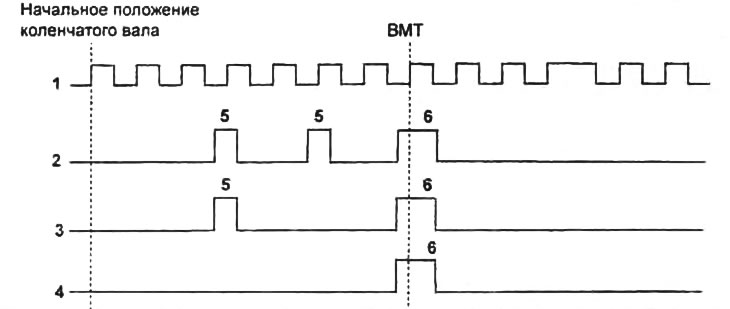
Controlling the amount of fuel injections.
1 - crankshaft position sensor signal,
2 - three injections,
3 - two injections,
4 - one injection,
5 - pilot injection,
6 - main injection.
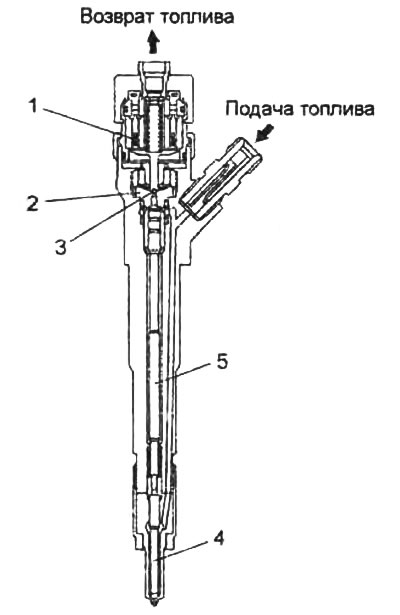
1 - electromagnetic valve,
2 - plate with holes,
3 - ball valve,
4 - injector needle,
5 - piston.
Fuel injection is controlled by the engine control unit based on signals from a number of engine control system sensors and depending on the engine operating mode. The control unit controls the amount of injected fuel, the injection moment and the number of injections per stroke in each cylinder separately. The amount of fuel injected by the injector is determined by the opening time of the injector needle, which in turn depends on the time during which the engine control unit sends a control signal to the injector electromagnetic valve. The opening time of the injector needle is controlled by the engine control unit depending on the accelerator pedal press and the crankshaft speed. The calculated amount of injected fuel is adjusted depending on the air temperature at the intake, mass air flow, coolant temperature and atmospheric pressure. The control unit also adjusts the amount of injected fuel for each injector depending on the injector identification code, which should be programmed into the engine control unit memory for each injector separately. This code contains encrypted mechanical characteristics that are specific to each individual injector.
The engine control unit constantly adjusts the amount of fuel injected into each cylinder depending on the change in crankshaft speed (especially at idle), to reduce rotational speed fluctuations and reduce vibrations.
The injection moment is calculated by the control unit based on signals from various sensors, engine operating mode, crankshaft speed and the amount of injected fuel according to an algorithm recorded in the control unit memory. The calculated fuel injection time is adjusted depending on the air temperature at the intake, the coolant temperature and the atmospheric pressure.
The injection pressure is directly dependent on the pressure in the fuel accumulator and is controlled by the engine control unit based on the signal from the fuel accumulator pressure sensor.
The fuel pressure is regulated by the control unit depending on the crankshaft speed and the cyclic fuel supply using the fuel pressure control valve installed in the high-pressure fuel pump. Creating the optimal fuel injection pressure for each engine operating mode helps reduce the toxicity of exhaust gases.
The number of injections made by the injector into the cylinder is controlled by the engine control unit depending on the vehicle's driving conditions and serves to reduce vibrations and exhaust gas toxicity. This battery fuel system allows up to three injections into one cylinder per cycle.
Several optimal fuel injection algorithms for different conditions are programmed in the control unit memory. Thus, at low crankshaft speed and low load, three injections are made per cycle to reduce the likelihood of detonation. At high crankshaft speed and high load, only one injection is made per cycle to improve power performance and reduce fuel consumption.
[Original version of the article on the website: mazbook.ru]
Additional control functions serve to improve emissions and fuel consumption characteristics or are used to increase safety, comfort and ease of operation.