


Variable Sequence Control (VSC)
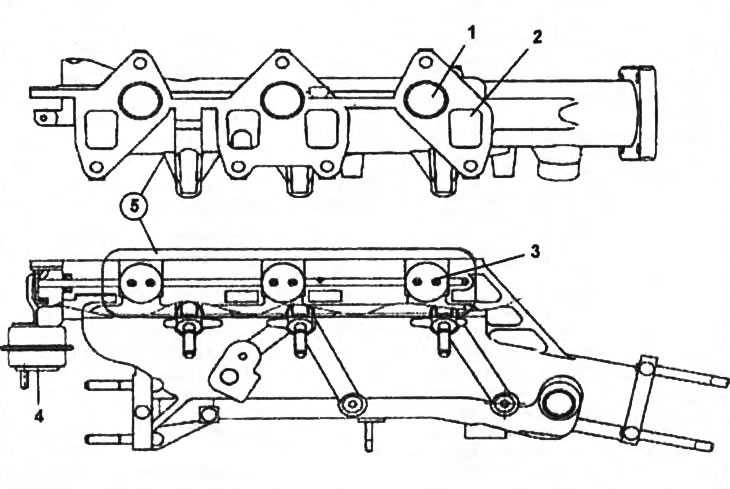
Variable air flow control system (VSC).
1 - secondary inlet port,
2 - primary inlet port,
3 - VSC valve,
4 - pneumatic drive of VSC dampers,
5 - intake manifold.
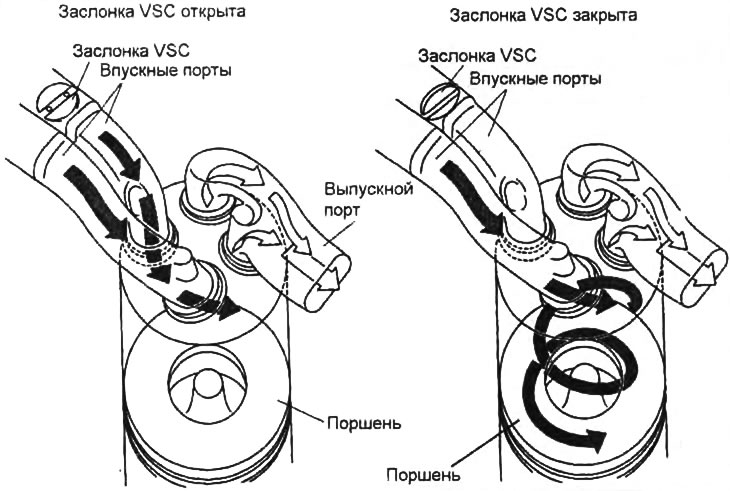
Operation of the variable air flow control system (VSC).
The system consists of an electro-pneumatic valve, a drive and four flaps installed in the intake manifold and blocking one of the two intake ports of each engine cylinder. The system serves to reduce the toxicity of exhaust gases at low crankshaft speed. At low speed, upon a signal from the engine control unit, the electro-pneumatic valve opens a vacuum channel, as a result of which a vacuum is supplied to the VSC system drive. Under the action of a vacuum, the drive, using flaps, closes one of the intake ports of each cylinder, as a result of which air is supplied to the open intake port with greater intensity and a swirl occurs in the cylinder, contributing to better evaporation of the fuel, distribution of the fuel-air mixture throughout the combustion chamber, and also helps to reduce smoke.
(Original version of the article on the website: «Mazbook»)
Turbocharger with variable geometry guide vanes
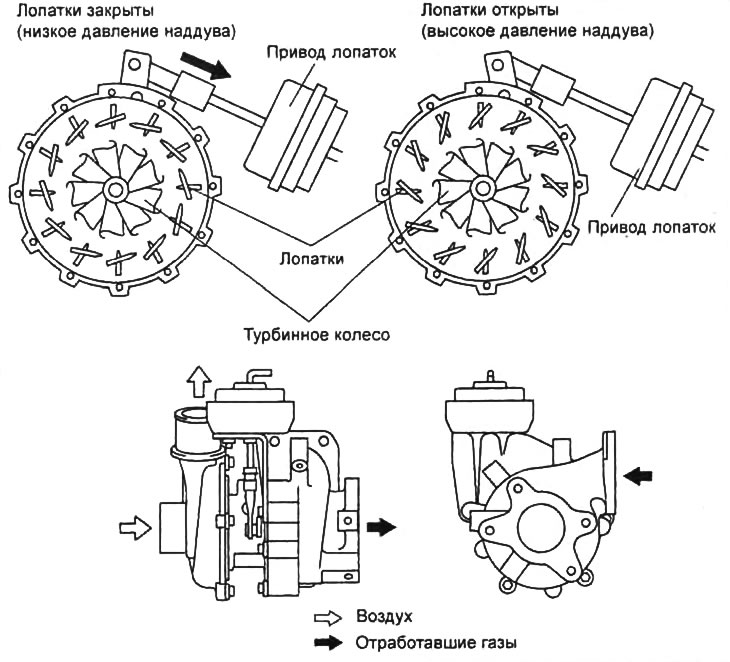
Operation of a turbocharger with variable geometry guide vanes.
The new generation WL engine is equipped with a turbocharger with a variable geometry system (changes in the position of the blades located in the nozzle apparatus) VGT (Variable Geometry Turbocharger).
The main advantages of a variable geometry turbocharger are as follows.
When operating at low engine speeds for a conventional turbocharger with an EGR valve (mounted on WL-T engines) there is a phenomenon called "turbo lag" caused by a decrease in flow (quantities) and pressure (and with it the speed) exhaust gases. In other words, the exhaust gas flow is insufficient to bring the turbine, which is directly connected to the compressor, to operating speed, at which the turbocharger is effective. Consequently, the boost pressure drops, and with it, both the cylinder filling and the engine torque decrease. The use of a turbocharger with variable geometry allows minimizing the "turbo lag" phenomenon by changing the flow area in the turbine nozzle apparatus. When the flow area in the turbine nozzle apparatus decreases, the exhaust gas pressure in front of it increases, which is then converted after passing through the nozzle apparatus into the flow velocity incident on the turbine wheel. The turbine wheel speed increases, the compressor wheel speed increases, and, consequently, the boost pressure.
The turbocharger uses the energy of the exhaust gases to further compress the intake air and supply it to the cylinders with higher pressure and density, resulting in increased power, reduced fuel consumption and improved engine performance.
The boost pressure is changed by changing the position of the guide vanes mounted on the turbine housing. The position of the guide vanes is controlled by the engine control unit using the boost pressure control electromagnetic valve.
On signal from the engine control unit, the electromagnetic valve opens, connecting the vacuum channel between the vacuum pump and the pneumatic drive of the turbocharger guide vanes, as a result of which the drive rod, connected to the lever of the blade position control mechanism, begins to be drawn into the drive, thereby adjusting the opening angle of the guide vanes and the boost pressure.
In the free state, the turbocharger blades are maximally open and direct a greater amount of exhaust gases to the turbine wheel, as a result of which the turbine wheel rotates faster under the action of the energy of a small flow of exhaust gases. Through the shaft, rotation is transmitted to the compressor wheel, which pumps more air into the intake tract, this helps to increase the boost pressure and filling of the cylinders at low crankshaft speeds.
As the crankshaft speed increases and the exhaust gas flow increases, the engine control unit begins to regulate the opening angle of the guide vanes by supplying vacuum to their drive through the electromagnetic valve. Under the action of the drive rod, the vanes begin to close until they are completely closed. The exhaust gas flow directed to the turbine wheel decreases and the boost pressure decreases. In this mode, the turbine wheel rotates at a lower speed with a higher exhaust gas flow.
This is necessary to prevent turbocharger failure due to overload (exceeding the maximum rotation speed) and engine damage.
After passing the compressor wheel and compression, the air heats up and its density decreases. To cool the supercharged air and increase its density, a cooler made of aluminum alloy is installed after the turbocharger. This is necessary to improve the filling of the cylinders.