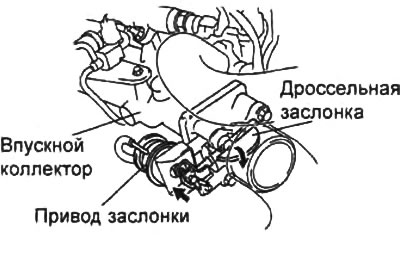


- EGR and throttle valve - reduction NOx, as well as reducing soot in the exhaust gas (black smoke).
- Oxidizing neutralizer - reduction NOx, CH, CO.
The engine is equipped with a forced crankcase ventilation system. The system serves to remove exhaust gases that have broken through from the combustion chamber into the engine crankcase. For this purpose, a hose is connected to the cylinder head cover and is connected to the intake manifold. The crankcase gases enter the intake manifold through the hose and then into the combustion chamber.
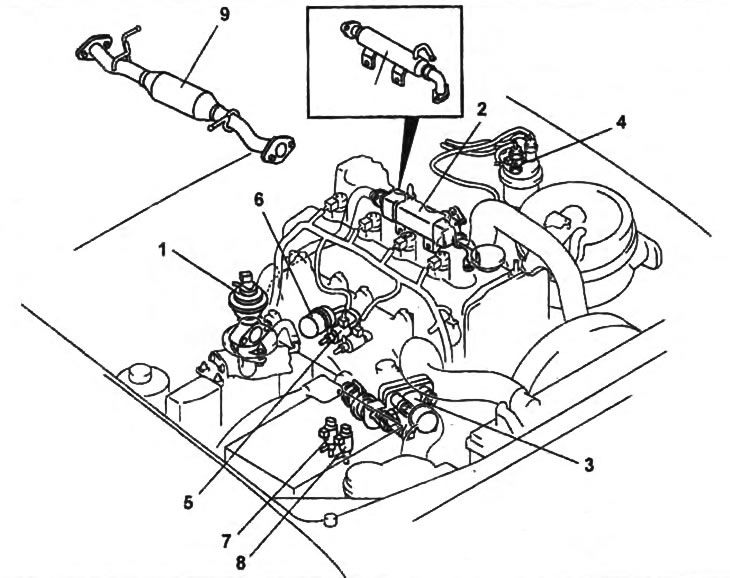
Location of emission control system components.
1 - EGR valve,
2 - EGR cooler,
3 - throttle valve,
4 - electromagnetic valve of the exhaust gas recirculation system,
5 - control electromagnetic valve of the exhaust gas recirculation system,
6 - air filter,
7 - electromagnetic valve No.1 of throttle control,
8 - electromagnetic valve No.2 for throttle control,
9 - oxidizing neutralizer.
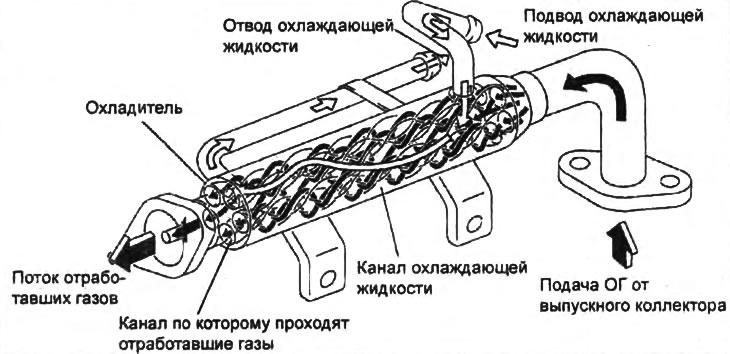
Cooling of exhaust gases in the EGR cooler.
Exhaust Gas Recirculation (EGR) System
Exhaust Gas Recirculation System EGR (Exhaust gas recirculation) serves to reduce the toxicity of exhaust gases by burning nitrogen oxides NO in the combustion chamber.
The system consists of an EGR valve with a position sensor, two electromagnetic valves, a cooler and a tube system.
With the help of a cooler, the temperature of the exhaust gases is reduced, which is necessary to prevent the air from heating up when it mixes with the exhaust gases entering the intake and, accordingly, to improve the filling of the cylinders and reduce the smoke of the exhaust gases.
Cooling of exhaust gases in the EGR cooler is carried out by means of coolant supplied to the cooler from the engine cooling system.
The exhaust gas recirculation system is controlled by the engine control unit using electromagnetic valves. The system has electromagnetic valve No.1 (vacuum valve) and electromagnetic control valve No.2 (ventilation valve), using both electromagnetic valves, the engine control unit controls the opening of the EGR valve. Based on a signal from the control unit, the electromagnetic valves open and close, supplying either vacuum from the vacuum pump to the valve diaphragm (through the electromagnetic vacuum valve) or atmospheric pressure (through a ventilation valve connected to the atmosphere). By opening the EGR valve, the amount of exhaust gases recirculated into the intake manifold and then into the combustion chamber is regulated. Afterburning of NO occurs in the combustion chamberx.
The calculation of the required opening of the EGR valve is performed by the engine control unit based on the crankshaft speed, fuel delivery cycle and readings from the mass air flow sensor.
To optimize the operation of the exhaust gas recirculation system, it is necessary to adjust the parameters of the mass air flow sensor, which change depending on the service life of the sensor (see chapter "Fuel injection system", chapter "Engine control unit").
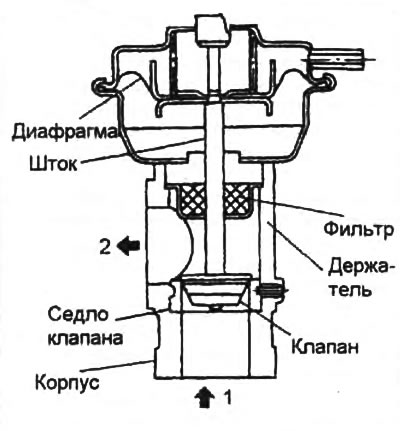
EGR valve.
1 - from the EGR cooler,
2 - to the intake manifold.
To improve the operation of the exhaust gas recirculation system, a pneumatically driven throttle valve is installed in the intake tract, controlled by the engine control unit using two electromagnetic valves. When the exhaust gas recirculation system is activated, the throttle valve closes, resulting in an additional vacuum being created in the intake manifold, which helps improve the flow of exhaust gases from the EGR system into the combustion chamber.
[Original version of the article on the website: MazBook]
When the engine is idling, the throttle valve is also closed, which helps reduce the noise of the intake air.