


Note:
- To avoid fuel leaks, do not remove the fuel pressure sensor and pressure relief valve.
- When removing and installing the fuel accumulator, follow the assembly drawing "Removing and installing the high-pressure fuel pump".
Checking the fuel accumulator
Check the fuel accumulator for leaks, damage, and deformation.
Replace the fuel accumulator if necessary.
Checking the fuel pressure sensor in the fuel tank
1. Start the engine and warm it up to normal operating temperature.
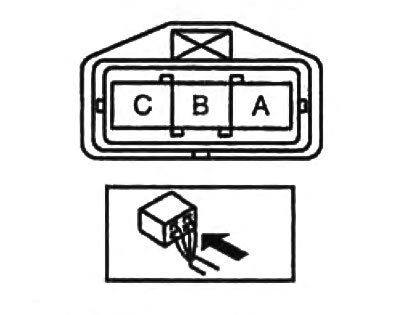
2. Using a voltmeter, measure the voltage between terminals "A" and "B" of the sensor connector on the wiring harness side at idle speed.
- Voltage is about 1.25V
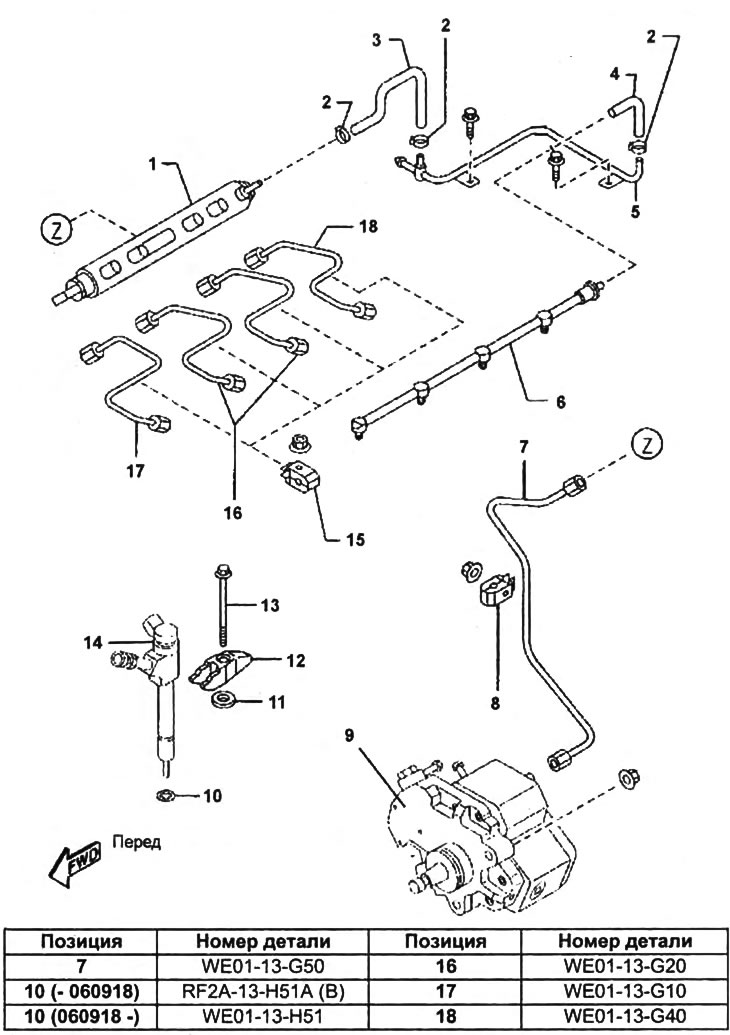
High pressure fuel line components.
1 - fuel accumulator,
2 - clamp,
3, 4 - fuel return hose,
5, 6 - fuel return pipe,
7 - high pressure fuel pipe for supplying fuel from the high pressure fuel pump to the fuel accumulator,
8, 15 - tube retainer,
9 - Fuel injection pump,
10 - washer,
11 - gasket,
12 - nozzle holder,
13 - injector holder bolt,
14 - nozzle,
16, 17, 18 - high-pressure fuel pipe for supplying fuel from the fuel accumulator to the injectors.
[The original article is posted on: mazbook]
If the voltage is different from the set value, check the wiring harness. If the wires are OK, replace the fuel accumulator.
3. Stop the engine and wait for about 3 minutes.
4. Set the ignition switch to the "ON" position (without starting the engine).
5. Using a voltmeter, measure the voltage between terminals "A" and "B" of the sensor connector on the wiring harness side.
- Voltage - 0.494 - 0.506 V
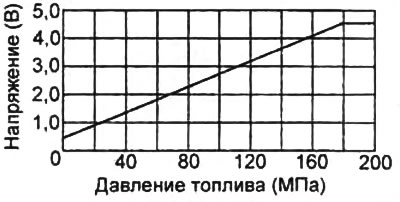
If the voltage is different from the set value, check the wiring harness. If the wires are OK, replace the fuel accumulator.