
MazBook.ru
English Русский
Български
Беларускі
Український
Српски
Hrvatski
Română
Polski
Slovenský
Magyar
• Bookmark • Sitemap • Contacts •   
Cars Opel Cars Ford Cars Volkswagen Cars Audi Cars Kia Cars Renault Cars Peugeot


Familia Capella Mazda3 Mazda6 CX-? Others Articles
Capella 3 (1982-1992, petrol) Capella 3 and 4 (1982-1992) Capella 4 (1987-1992) Capella 5 (1991-1997) Capella 6 (1997-2005, petrol)

Positive Crankcase Ventilation (PCV) system (Mazda Capella GC)

  • Home
  • Mazda Capella
  • Capella GC (1982-1992)
  • Power unit
  • Emission control system
  • Positive Crankcase Ventilation (PCV) system
0
Contents: General description ⇓ Examination ⇓ Replacement of parts ⇓
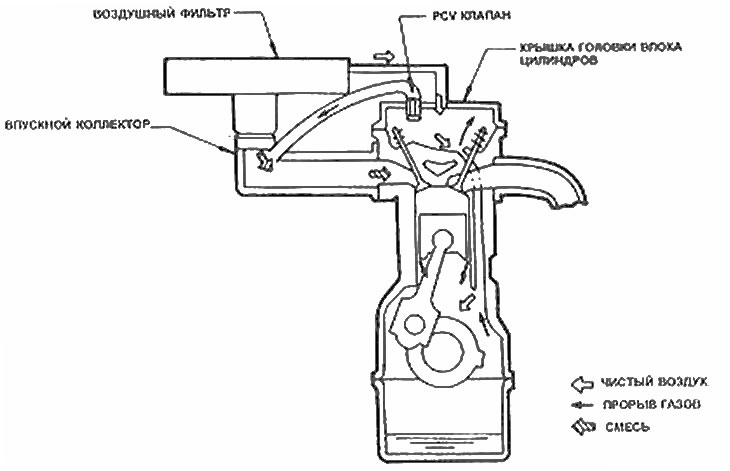
PCV system diagram

PCV system diagram


General description


1. A positive crankcase ventilation system reduces harmful exhaust emissions by circulating fresh air through the crankcase to pick up the slack from gases that are misdirected through the intake manifold and would be burned in the engine.

2. The main components of this system are vacuum hoses and the PCV valve, which regulates the flow of gases according to engine speed and manifold vacuum.

Examination


3. The PCV system can be quickly and easily tested to ensure proper operation. This system should be checked regularly as carbon and soot from the gases will eventually clog the PCV valve and/or system hoses. When PCV flow is reduced or stopped, common signs include a rough idle or a decrease in engine speed while idle.

4. To check for proper vacuum in the system, remove the top air cleaner plate and position the small PCV filter on the inside of the air cleaner housing.

5. Disconnect the pipe to this filter.

6. With the engine idling, place a large pressure washer on the end of the hose. You should feel a slight vacuum. The suction can be heard as soon as your thumb is released. This will indicate that air is being pulled completely through the system. If there is a vacuum, the system is functioning properly. Check that the filter inside the air filter housing is not clogged or dirty. If in doubt, replace it with a new one (contact Section 1).


7. If there is little or no vacuum at the hose end, the system is not clogged and should be inspected further.

8. Turn off the engine and install the PCV valve. Gently pull it away from the rubber sealing ring. Shake it and listen for a clicking sound. These are the locking balls rolling. If the valve does not click freely, replace it with a new one.

9. Start the engine at idle with the PCV valve removed. Place your thumb on the end of the valve and feel for suction. This will be a relatively strong vacuum that will be immediately felt. See also Section 1, Chapter 31.

10. If little or no vacuum is felt at the PCV valve, turn off the engine and disconnect the vacuum hose from the other end of the valve. Start the engine at idle and check the vacuum at the end of the hose, just disconnected. The absence of vacuum at this point indicates that the corresponding vacuum hose or inlet in the engine is engaged. If this hose is blocked, replace it with a new one or remove it from the engine and blow it out with compressed air. A clogged passage in the carburetor or manifold requires the assembly to be removed and completely cleaned to remove the carbon buildup. A strong vacuum senses the PCV valve's entry, but a small or no vacuum from the valve indicates a faulty PCV valve and requires replacement with a new one.

11. When purchasing a new PCV valve, make sure it is for your engine. An incorrect PCV valve can produce too little or too much vacuum, possibly causing engine damage.

Replacement of parts


12. The procedures for replacing the PCV valve and filter are described in Section 1.
This article is available at: russian, bulgarian, belarusian, ukrainian, serbian, croatian, romanian, polish, slovak, hungarian
This text was checked by: Evdokia Filimonova
Share with friends on social networks:

Previous
Capella 3 » Emission control system
Next

Coasting mixture leaning system
Air intake system
Contactless ignition system
Emission control system details
General description of the emission control system
Intake air temperature control system
Deceleration control system
Economy mode indication system
More articles on repairing other Mazda models
Technical characteristics of the lubrication system Mazda Familia 5 (1985-1989)
Electronic immobilizer (anti-theft system) Mazda3 BK (2003-2009)
Door lock control system Mazda6 GG (2002-2008)
Precautions when working with Supplemental Restraint System (SRS)… Mazda CX-5KE (2012-2017)
Heating and ventilation system (2000-2001) Mazda 121 (3) (1996-2003)
Link in different formats to this article
Comments and feedback from visitors
No comments yet


How much will 38 + 22 ?


Capella 6 (1997-2005, petrol) 
  • General information
  • Introduction to guide
  • User manual
  • Troubleshooting
  • Maintenance
  • Power unit
  • 4-cylinder engines
  • 6-cylinder engines
  • Engine overhaul
  • Cooling and ventilation
  • Power and exhaust systems
  • Engine electrics
  • Control system
  • Transmission
  • Mechanical gearbox
  • Automatic gearbox
  • Clutch and drive shafts
  • Chassis
  • Brake system
  • Car suspension
  • Steering
  • Body
  • Exterior (external elements)
  • Interior (internal elements)
  • Doors, windows and locks
  • Electrical equipment
  • Equipment and devices
  • Electrical circuits
Capella 5 (1991-1997) 
  • General information
  • User manual
  • Maintenance
  • Helpful hints
  • Power unit
  • Petrol engines 1.6 and 1.8
  • Petrol engines 2.0
  • 2.5 petrol engines
  • Overhaul engines 1.6 and 1.8
  • Overhaul engines 2.0 and 2.5
  • Diesel engine 2.0
  • Engine electrics
  • Cooling system
  • Air conditioner
  • Carburetor Nikki 30/34
  • Power system (1.6 and 1.8)
  • Power system (2.0 and 2.5)
  • Control system
  • Transmission
  • Mechanical gearbox
  • Automatic gearbox
  • Clutch and axles
  • Chassis
  • Brake system
  • Suspension and wheels
  • Steering
  • Body
  • Exterior (external elements)
  • Interior (internal elements)
  • Doors and windows
  • Electrical equipment
  • Equipment and devices
  • Electrical circuits
Capella 4 (1987-1992) 
  • General information
  • Introduction to manual
  • Vehicle specifications
  • Power unit
  • Engine repair
  • Lubrication system
  • Cooling system
  • Fuel system (carburetor)
  • Fuel injection (FE)
  • Fuel injection (DOHC)
  • Fuel system (diesel)
  • Ignition system
  • Transmission
  • Clutch
  • Gearbox
  • Drive shafts
  • Chassis
  • Front suspension
  • Rear suspension
  • Steering system
  • Brake system
  • Electrical equipment
  • Equipment and devices
  • Electrical circuits
Capella 3 and 4 (1982-1992) 
  • General information
  • User manual
  • Maintenance
  • Power unit
  • Gasoline engine
  • Engine overhaul (gasoline)
  • Diesel engine
  • Cooling and heating
  • Supply system
  • Ignition system
  • Emission reduction
  • Transmission
  • Clutch
  • Mechanical gearbox
  • Automatic gearbox
  • Drive shafts
  • Chassis
  • Brake system
  • Suspension and wheels
  • Steering
  • Body
  • Exterior (external elements)
  • Interior (internal elements)
  • Electrical equipment
  • Equipment and devices
  • Power devices
  • Electrical circuits
Capella 3 (1982-1992, petrol) 
  • General information
  • User manual
  • Maintenance
  • Troubleshooting
  • Late models
  • Power unit
  • Engine in car
  • Engine overhaul
  • Cooling and heating system
  • Fuel and exhaust system
  • Engine electrical system
  • Emission control system
  • Transmission
  • Mechanical gearbox
  • Automatic gearbox
  • Clutch and drive shafts
  • Chassis
  • Brake system
  • Suspension and wheels
  • Steering
  • Body
  • Exterior (external elements)
  • Interior (internal elements)
  • Electrical equipment
  • Equipment and devices
  • Lighting and lamps
  • Electrical circuits
MazBook.ru © 2018–2026 · Mobile version · Articles and news · Sitemap: EN BG BY UA RS HR RO PL SK HU · Feedback · Site search · Add to bookmarks Familia 5 (BF) · Familia 6 (BG) · Capella 3 (GC) · Capella 3 and 4 (GC) · Capella 4 (GD) · Capella 5 (GE) · Capella 6 (GF) · Mazda3 BK · Mazda6 GG · CX-5KE · Mazda 121 (3) · Mazda BT-50 (1) ·
By continuing to use the site, you agree to the use of cookies 🔐