


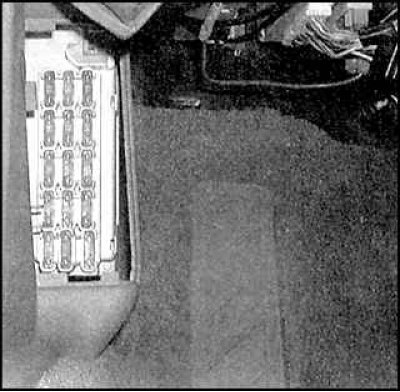
Removing the fuse box cover
Fuse box in the engine compartment
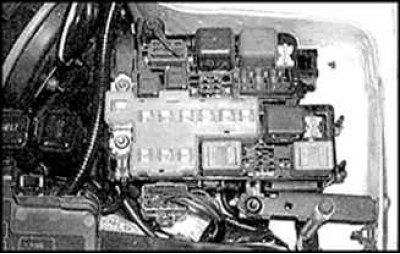
Checking the status of the fuse box
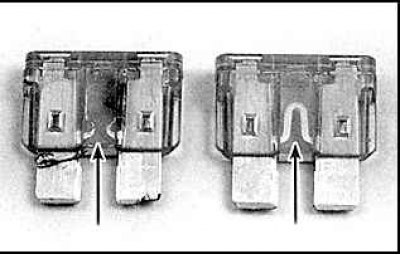
1. Blown fuse
2. A whole fuse
The electrical circuits of the car are protected by a set of fuses, switches and fuse jumpers. The fuse box block includes the fuse box itself, the wires and their connectors and is located behind the dashboard on the driver's side.
Each of the fuses protects its circuit and its belonging to a particular circuit is indicated on the cover of the fuse box. Miniature fuses with flat terminals are installed in the fuse box.
In case of failure of any element of electrical equipment, first of all, check the fuses. A blown fuse is easy to identify visually through the transparent plastic case. Also, the flat fuse terminals are visible in the fuse box and continuity can be checked.
It is very important to use fuses of the required capacity. Different electrical circuits require protection against currents of different capacities. The maximum allowable current for the circuit is indicated in amps on the fuse body with color codes and on the cover of the fuse box.
Attention! Do not replace the fuse with a piece of metal or foil. This can cause serious damage to the electrical system.
If a fuse blows immediately after replacement, do not replace it again until the cause of the problem has been identified and corrected. In most cases, the cause of the malfunction is a short circuit caused by a loose or old wire.
The stove and air conditioner consume a lot of electricity, so the fuse box has a switch to protect their circuits. If the circuit is opened by the switch, turn off the stove and air conditioner before pressing the switch reset button.
The fuse box is located on the left side of the instrument panel. The second fuse box is located under the instrument panel on the driver's side.
A blown fuse can be identified visually.