


Check the condition of the compressor drive belt. Replace the belt if necessary.
Check the belt tension and adjust it if necessary.
Inspect the system hoses for cracks, bulges, and chafed areas. Replace hoses if necessary.
Inspect the refrigerator fins and clean out any dirt stuck in them.
Check the refrigerant pressure.
Examination
1. Warm up the engine to operating temperature.
2. Set the temperature control knob to the cold air position. Turn on the blower fan to maximum speed.
3. After the air conditioning system reaches operating temperature, touch the two tubes connected to the refrigerator.
4. The thinner tube should be cold, and the thicker tube should be even colder (approximately -16°C or -12°C).
5. If the thick tube is much warmer than the thin one, the system needs to be additionally charged with refrigerant. Insert the thermometer into the center of the vent. The temperature of the air coming from the opening should be 20–25°C lower than the ambient air temperature. If this is not the case, the system must be additionally charged with refrigerant; for this, contact a specialist.
Coolant
Air conditioning system refrigerant recharging kit
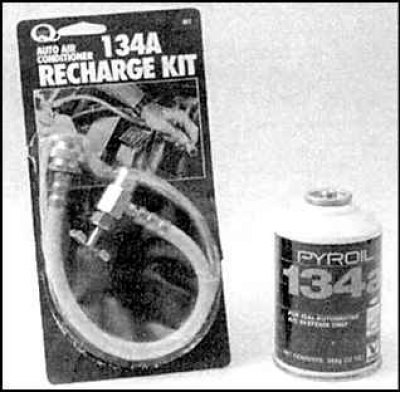
Any car enthusiast can recharge the air conditioning systems of later models that use R-134a refrigerant themselves. To do this, you need to purchase a special charging kit.
Two types of refrigerant are used to recharge the air conditioning system: R-12 and R-134a. Systems charged with R-12 refrigerant are used primarily in early models (1993–present). Maintenance of these systems must be performed in specialized workshops.
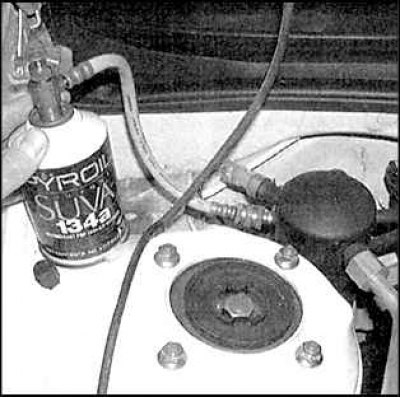
1. Connect the hose to the valve located on the refrigerant line or on the water separator.
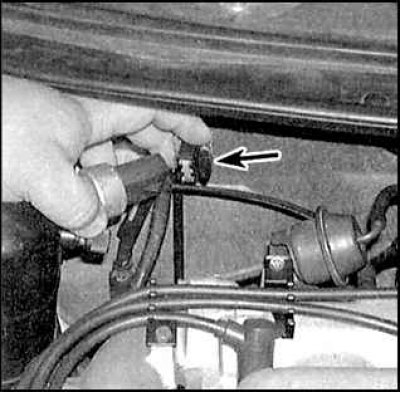
2. Close the contacts (indicated by an arrow) pressure switch with a jumper to keep the compressor running while you charge the system with refrigerant.
Heating system
Examination
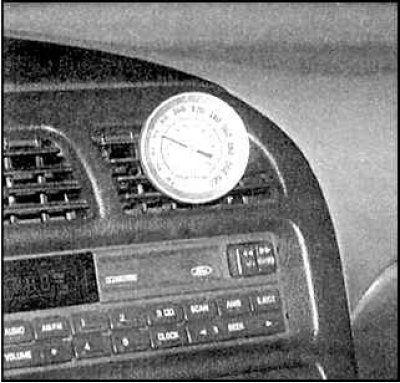
1. Measure the temperature of the air coming from the vent.
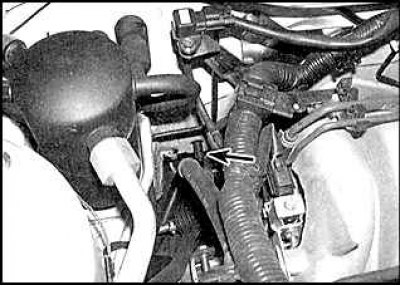
2. Inspect the heater and evaporator hoses to ensure they are not clogged.
If the air coming from the vents is not hot, the problem may be:
- a) The thermostat is stuck in the open position. Replace the thermostat.
- b) The heater radiator hose is clogged. Flush the radiator hoses and the radiator itself.
- c) The heater radiator is clogged. If flushing the radiator fails, replace it.
If the blower fan does not operate in all modes, see subsection 4.9.
If air is not coming out of the vents:
- a) Turn on the ignition and the blower fan. Listen to see if the fan motor is running.
- b) If the motor does not work, replace it.
If steam or an antifreeze smell is coming from the vents, the heater core is leaking and needs to be replaced.
Air conditioning system odors
To remove odors that arise in the air conditioning system, special disinfectants are usually used. And, although the best solution would be to contact a specialized workshop, you can treat the air conditioning system elements yourself.
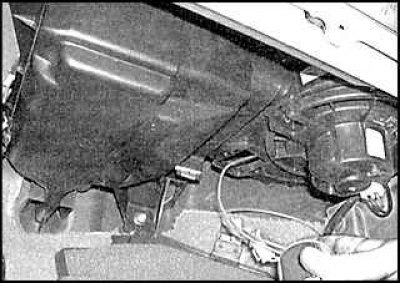
Remove the blower resistor and treat the evaporator with a disinfectant solution.