


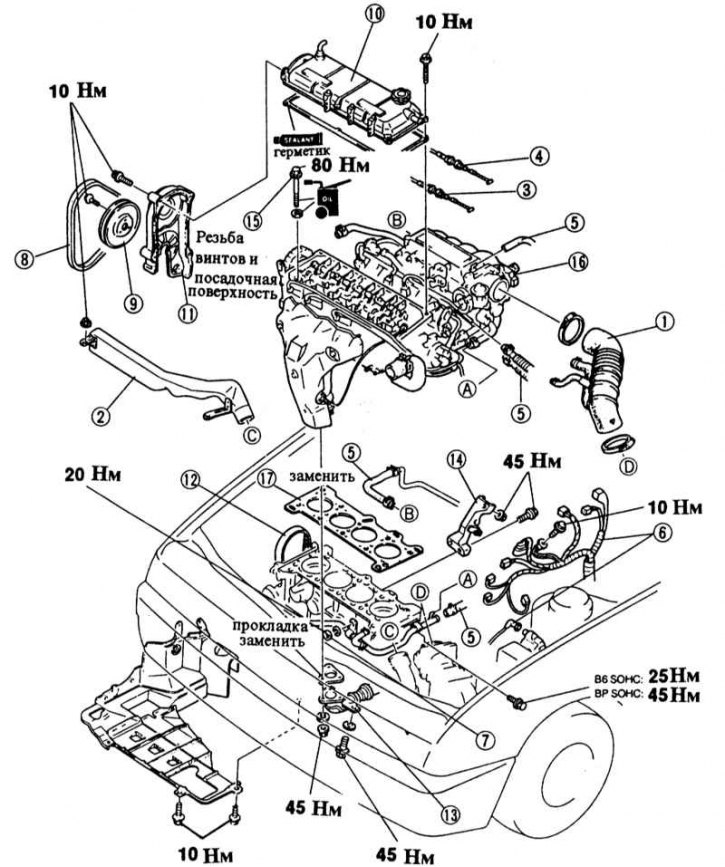
1 - air hose; 2 - resonance chamber; 3 - gas drive; 4 - throttle actuator (only with automatic transmission); 5 - hoses; 6 - cable harness; 7 - nut, cooling system bypass pipe; 8 - V-belt; 9 - water pump belt pulley; 10 - cylinder head cover; 11 - Upper timing belt casing; 12 - toothed belt; 13 - exhaust pipe; 14 - intake manifold mount; 15 - cylinder head bolts; 16 - cylinder head; 17 - cylinder head gasket
When removing the cylinder head, the engine must be cooled to at least room temperature. The exhaust and intake manifolds remain connected. Removal is described for the VZ, V5, V6 and VR engines. At the end of the chapter there are instructions for the diesel engine. The differences for the E series of engines are indicated in a separate chapter, see Section Removal and installation the camshaft/adjusting the valve timing.
A faulty cylinder head is identified by one or more of the following signs:
- Loss of power.
- Coolant loss. White exhaust clouds on warm engine.
- Loss of oil.
- Coolant in engine oil, oil level does not decrease, but increases. Gray color of engine oil, traces of foam on the dipstick, oil is diluted.
- Engine oil in coolant.
- The coolant is bubbling violently.
- There is no compression in two adjacent cylinders.
Removal
B6 engine with injection system
1. Disconnect the ground cable from the battery.
Warning! This will erase the engine fault memory or the radio security code. Before disconnecting the battery, read the instructions in Section Removal and installation the battery.
2. Injector engine: Loosen the clamps and remove the inlet hose.
3. Carburetor engine: Remove the air filter, see Chapter Power supply system, carburetor, fuel injection system, Chapter Removal and installation the air filter.
4. If present, remove the resonance chamber.
5. Drain the coolant, see Chapter Maintenance.
6. Remove the gas drive, see Chapter Power supply system, carburetor, fuel injection system, Chapter Checking/removing and installing automatic cold start.
7. Automatic transmission: Disconnect the throttle cable.
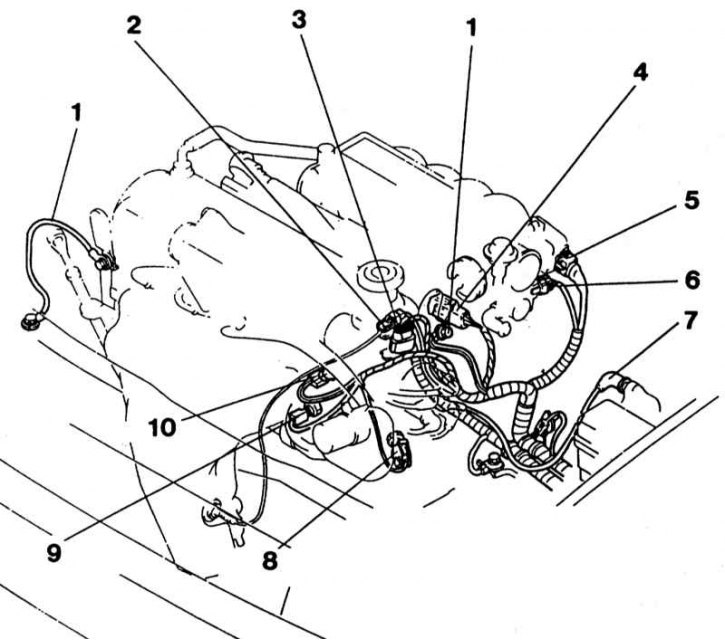
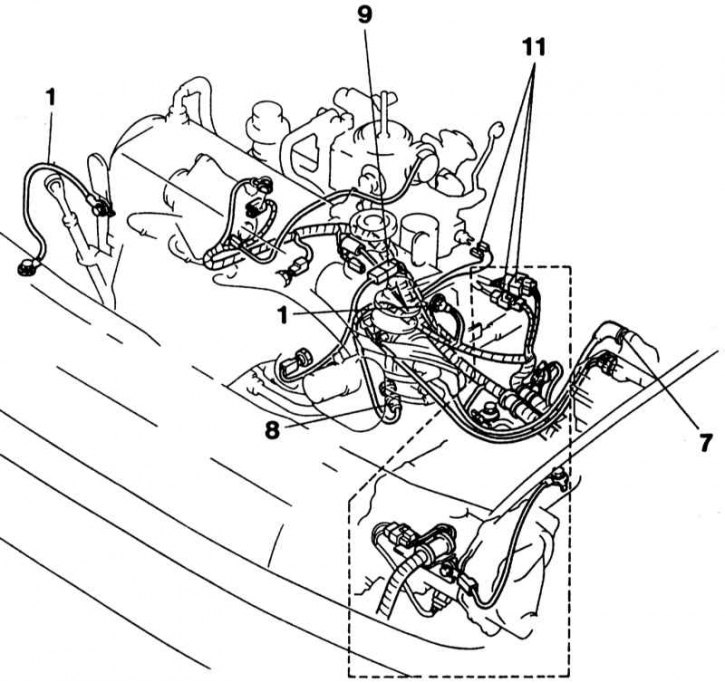
8. Disconnect all electrical wires to the cylinder head. To facilitate installation, the wires should be marked with adhesive tape beforehand.
- Unscrew the ground cable "1" on the engine.
- Disconnect plug "2" of the lambda probe.
- Disconnect combination plug "3" on the ignition distributor.
- Disconnect the combined plug "4" of the injection valves.
- Disconnect the combined plug of the throttle position sensor "5" and the idle speed control valve "6".
- Disconnect terminal 4 "7" on the ignition coil.
- Disconnect the combined plug "8" of the cooling system thermal switch.
- Disconnect plug "9" of the coolant temperature sensor.
- Disconnect ground cable "10" on the engine.
- Disconnect the combination plugs of the carburetor connections "11".
9. Disconnect the vacuum brake hose, having first loosened the clamp.
Injector engine
1. Loosen the hose clamps and disconnect the fuel hoses "2". When disconnecting, place a rag around the fuel lines to prevent fuel from splashing out when loosening. Immediately close the lines with suitable plugs, such as clean bolts of the appropriate diameter. To facilitate subsequent installation, mark the fuel lines with adhesive tape.
2. If available, disconnect the vacuum hose "4" of the cruise control.
3. Disconnect the ventilation vacuum hose "3".
Carburetor engine
1. Loosen the hose clamps and disconnect the fuel lines on the mechanical fuel pump. When disconnecting, place a rag around the fuel lines to prevent fuel from splashing out. Immediately close the lines with suitable plugs, such as clean bolts of the appropriate diameter. To facilitate subsequent installation, mark the fuel lines with adhesive tape.
2. Disconnect the hose from the intake air heating control device by loosening the clamp.
3. Disconnect the heater hoses "5", having first loosened the clamps.
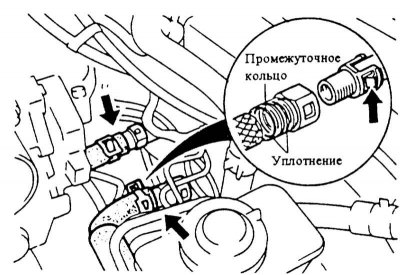
4. Models from 10/89: Press the "arrow" protrusion on the hose clamp and disconnect the heater hose.
Attention! There is a circular seal and an intermediate ring on the nipple. Do not forget them when installing.
5. Unscrew the nut securing the cooling system bypass pipe and disconnect the bracket.
6. Remove the timing belt, see Sections Removal and installation of the timing belt of VZ, B5, B6 (SOHC), BP (SOHC) engines, Removal and installation the timing belt (DOHC).
7. Unscrew the cylinder head cover.
8. Unscrew the exhaust pipe from the exhaust manifold, see Chapter Exhaust system.
9. Injector engine: Remove the intake manifold mount.
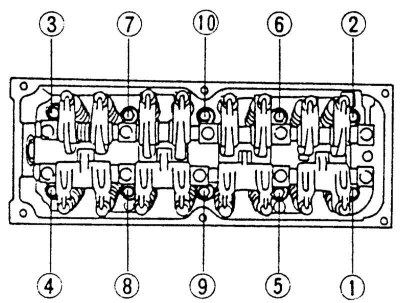
10. Loosen the cylinder head bolts in sequence 1 through 10 by 1/2 turn on the first pass, by one full turn on the second pass, and completely unscrew on the third pass.
Caution: Loosening the cylinder head bolts in the wrong order may result in deformation or cracks in the cylinder head.
11. Check that all hoses running from the cylinder head to the engine and body are disconnected.
12. Remove the cylinder head with the help of an assistant.
Caution! Do not place the cylinder head on the sealing surface after removal, otherwise the fully open valves may be damaged. Place the cylinder head on two wooden blocks.
Installation
1. Before installation, use a scraper to clean the block and cylinder head from any remaining sealant. The sealing surfaces must not be scratched. Make sure that no sealant residue falls into the cylinders. Cover the holes with a cloth.
2. Check that there is no oil in the cylinder head bolt holes, if necessary remove the oil with compressed air. If there is no compressed air, you can clean the holes with a small screwdriver wrapped in a rag.
Attention! In any case, the oil must be removed.
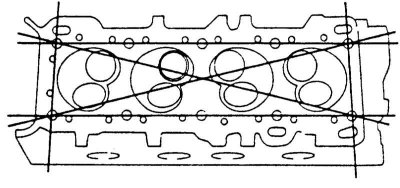
3. Check the cylinder head for deformation using a steel ruler and feeler gauge.
4. Check the deformation in the specified directions. The maximum permissible unevenness is 0.15 mm. If the limit value is exceeded, the cylinder head must be processed (is done in the workshop).
5. Check the cylinder head for cracks. If there are cracks, the head must be replaced.
6. Check water, oil and fuel hoses for cracks and breaks; replace if necessary.
7. Check valves and valve guides for wear and damage.
8. Apply the cylinder head gasket so that the holes in the cylinder block and gasket match.
9. Lubricate the mating surfaces and threads of the cylinder head bolts with a small amount of oil.
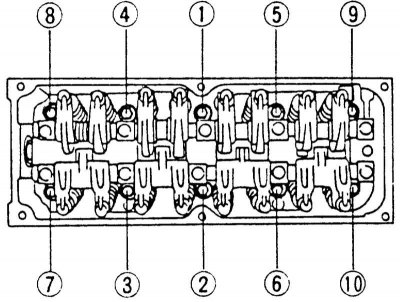
10. Tighten the 10 bolts until they touch the cylinder head by hand. Then tighten the bolts in three passes. In each pass, tighten the bolts in sequence from 1 to 10.
- 1st pass: 40 Nm
- 2nd pass: 60 Nm
- 3rd pass: 80 Nm
Caution! The cylinder head bolts must be tightened very carefully. Before tightening, the accuracy of the torque wrench must be checked. In addition, the tightening sequence must be followed precisely.
11. Injector engine: Tighten the intake manifold fasteners with force 25 Nm and 45 Nm.
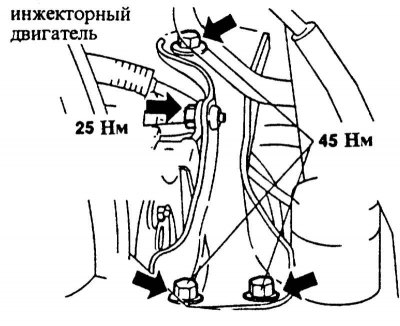
12. Screw the exhaust pipe to the exhaust manifold with force 45 Nm.
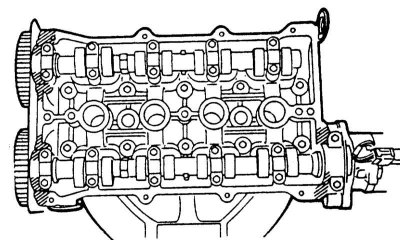
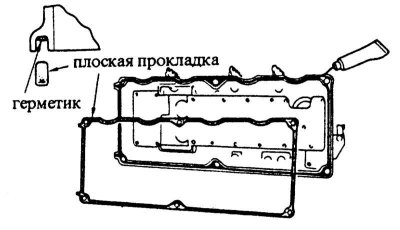
13. DOHC Engine: Apply silicone-based sealant to the shaded areas (for example, DOW CORNING Q3-7057). Install a new valve cover gasket.
14. SOHC Engine: Apply silicone-based sealant to the gasket groove in the cylinder head cover (for example, DOW CORNING Q3-7057). Apply a new cover gasket.
15. Install the cylinder head cover and tighten it with force 10 Nm.
16. Install the timing belt, see Sections Removal and installation of the timing belt of VZ, B5, B6 (SOHC), BP (SOHC) engines, Removal and installation the timing belt (DOHC).
17. Install the cooling system bypass pipe and tighten the fastening nut with force 20 Nm.
18. Install and adjust the throttle drive, see Chapter Power supply system, carburetor, fuel injection system, Chapter Checking/removing and installing automatic cold start.
19. Connect all electrical wires and vacuum hoses in accordance with the marks applied.
20. Put on the heater hoses and, depending on the model, snap them in place or secure them with clamps.
21. Connect the supply and return fuel lines and secure with clamps.
22. Install the air filter, see Chapter Power supply system, carburetor, fuel injection system, Chapter Removal and installation the air filter.
23. Check the frost resistance of the coolant and fill it into the system, see Chapter Maintenance.
24. Connect the battery ground cable.
25. If available, set the time on the clock and set the security code for the radio receiver.
26. Change engine oil, see Chapter Maintenance.
27. Check the ignition timing, adjust if necessary, see Chapter Ignition system, Chapter Checking/adjusting ignition timing.
28. Check idle speed, adjust if necessary, see Chapter Power supply system, carburetor, fuel injection system.
29. Warm up the engine, check the coolant level and the tightness of all hose connections.
30. If necessary, check the valve clearance, see Section Checking/adjusting valve clearance.
Diesel engine
Removal
1. Remove the battery and unscrew the battery holder, see Chapter Electrical equipment system, Chapter Removal and installation the battery.
2. Remove the air filter, see Chapter Power supply system, carburetor, fuel injection system, Chapter Removal and installation the air filter.
3. Remove the injection pipes, see Chapter Diesel engine.
4. Unscrew the supply and return pipes.
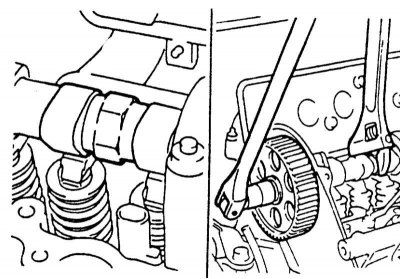
5. Hold the camshaft with an adjustable wrench, such as HAZET 279-15, and unscrew the camshaft gear mounting bolt. Remove the camshaft gear, and if necessary, knock it off with light blows of a rubber hammer.
Caution: When holding the camshaft, do not damage the cylinder head with a wrench.
6. Unscrew the rear timing belt cover.
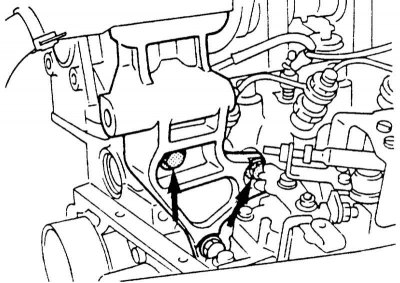
7. Unscrew the bolts securing the "arrow" of the front engine support.
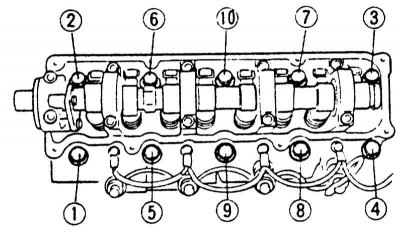
8. Loosen the cylinder head bolts in sequence 1 through 10 by 1/2 turn on the first pass, by one full turn on the second pass, and completely unscrew on the third pass.
Caution: Loosening the cylinder head bolts in the wrong order may result in deformation or cracks in the cylinder head.
Installation
1. Check the cylinder head for deformation. The maximum permissible deformation on the sealing surface can be 0.1 mm. If the deformation exceeds the limit value, the cylinder head should be processed (is done in the workshop).
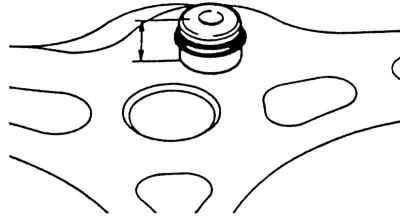
2. Measure the amount of plug protrusion. The required value is 7 - 8 mm. If necessary, hammer the plug to the specified size. Cover new apply a small amount of oil to the O-ring seal and insert it into the groove of the plug.
3. Measure the length of the cylinder head bolts from the bottom edge of the head to the end of the rod. The maximum length of 114.5 mm should not be exceeded. If the value does not meet the requirement, the bolt should be replaced.
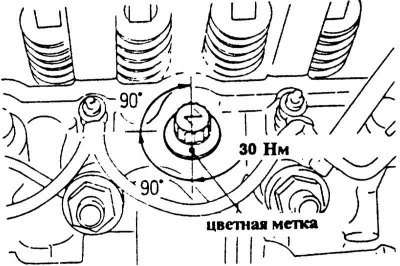
4. Tighten the 10 cylinder head bolts by hand until they are snug against the head. Then tighten the bolts in three passes. In each pass, tighten the bolts in the sequence shown in the illustration from 1 to 10.
1st pass: with a torque wrench with force 30 Nm
2nd pass: tighten it an additional 1/4 turn with a hard wrench without removing the wrench
3rd pass: tighten it an additional 1/4 turn with a hard wrench without removing the wrench
5. Screw the front engine mount with force 45 Nm.
6. Install the rear timing belt cover and tighten it down firmly 10 Nm.
7. Install the toothed wheel and wedge. Hold the camshaft with a wrench to tighten the mounting bolt. Tightening torque: 50 Nm.
8. Install the timing belt, see Chapter Diesel engine.
9. Install the fuel supply and return lines as well as the injection line, see Chapter Diesel engine.
10. Install the air filter, see Chapter Power supply system, carburetor, fuel injection system, Chapter Removal and installation the air filter.
11. Install the battery holder and screw it on tightly 10 Nm.
12. Install the battery, see Chapter Electrical equipment system, Chapter Removal and installation the battery.