


Contents: Removal ⇓ Carburetor engine ⇓ Cars with power steering (servo…⇓ Cars with air conditioning ⇓ Manual transmission ⇓ Installation ⇓ Manual transmission ⇓ Automatic transmission ⇓ Power assisted cars ⇓ Cars with air conditioning ⇓
Removing the engine is only possible together with the gearbox. Therefore, before removing, you should also read Chapter Removal and installation the gearbox. The exhaust and intake manifolds, as well as the carburetor and generator, remain mounted on the engine. A crane is required to remove the engine. Under no circumstances should the engine be lowered using a shop lift, as the lift can seriously damage the engine. The fenders should be covered before installation in the engine compartment.
It is recommended that all electrical cables and vacuum lines be marked with adhesive tape before disconnecting so that they can be easily reconnected to their original locations during installation.
Depending on the year of manufacture and equipment, electrical wires or vacuum and water hoses may be routed differently in the engine compartment. Since it is not possible to describe all the individual variations, it is recommended to mark the relevant pipes and wires with adhesive tape before disconnecting. The next chapter will describe the removal and installation of a 1.4 L petrol engine with fuel injection.
Removal
B6 injection engine with injection system
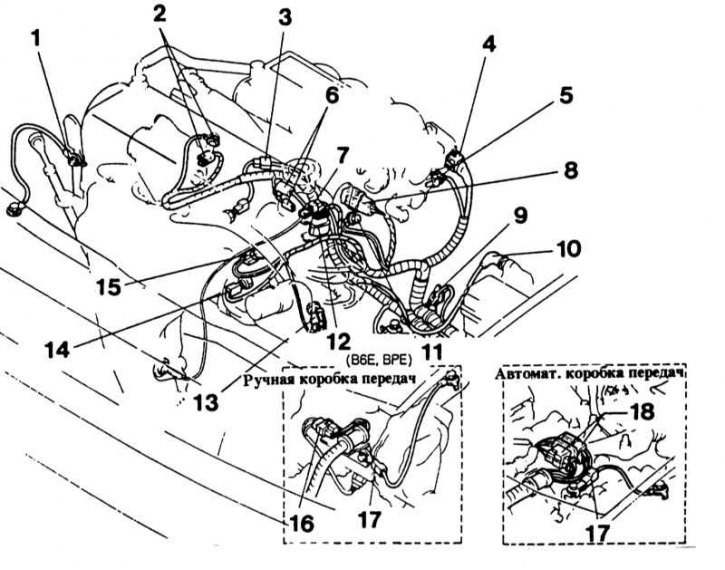
1. Disconnect the battery, follow the instructions, see Section Removal and installation the battery.
2. Unscrew the battery holder.
3. Remove the air filter, see Chapter Removal and installation the air filter.
4. Drain the coolant and remove the radiator with the fan, see Chapter Engine cooling system.
5. Drain the transmission oil, see Chapter Maintenance.
6. Remove the hood, see Chapter Body, car painting, car care.
7. Remove the gas drive.
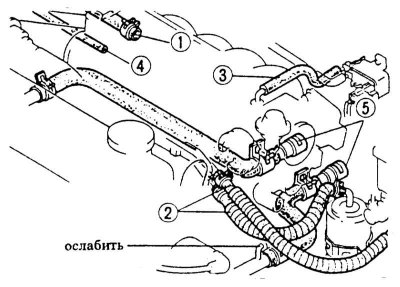
8. Disconnect the vacuum brake hose "1", having first loosened the clamp.
9. Loosen the clamps and disconnect the fuel hoses "2". When disconnecting, place a rag around the fuel line to prevent fuel from splashing out when loosening. Close the lines immediately with suitable plugs. To do this, insert, for example, clean bolts of the appropriate diameter into the holes. To facilitate installation, mark the fuel lines with adhesive tape.
10. Disconnect the ventilation vacuum hose "3".
11. If equipped, disconnect the vacuum hose "4" of the cruise control.
Carburetor engine
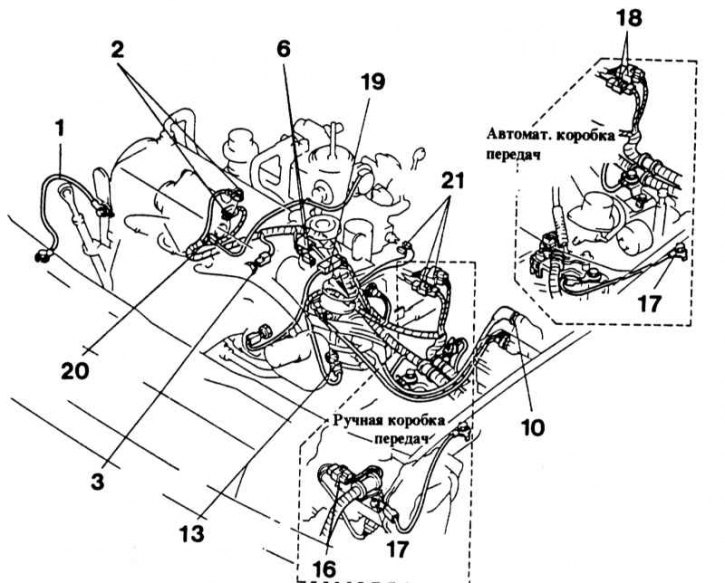
1. Loosen the clamps and disconnect the fuel hoses of the mechanical fuel pump. When disconnecting, place a rag around the fuel line to prevent fuel from splashing out when loosening. Close the lines immediately with suitable plugs. To do this, insert, for example, clean bolts of the appropriate diameter into the holes. To facilitate installation, mark the fuel lines with adhesive tape.
2. Disconnect the vacuum hoses to the carburetor. Mark the hoses with tape to make installation easier.
3. Disconnect the heater hoses "5", having first loosened the clamps.
4. Disconnect all electrical connections from the engine. To facilitate installation, mark the wires with adhesive tape beforehand.
- Unscrew the ground cable "1" on the engine.
- Disconnect the generator connections "2" by unscrewing the thick cable B+ and disconnect the plug.
- Disconnect the oil pressure sensor plug "3".
- Disconnect the combined plug of the throttle position sensor "4" and the idle speed controller "5".
- Disconnect the starter connections "6" by unscrewing the thick cable and disconnecting the combination plug.
- Disconnect plug "7" of the lambda probe.
- Disconnect the combined plug of the injection valves "8".
- Disconnect plug "9" of the neutral sensor (manual transmission only).
- Disconnect terminal 4 "10" on the ignition coil.
- Unscrew the ground cable "11" on the engine.
- Disconnect the combination plug "12" on the ignition distributor.
- Disconnect the combined plug of the coolant temperature switch "13".
- Disconnect plug "14" of the coolant temperature sensor.
- Disconnect ground plug "15".
- Disconnect the combination plug "16" on the reverse switch (manual transmission only).
- Unscrew the ground cable "17" on the gearbox.
- Disconnect the combination plug "18" of the starter switch.
- Disconnect plug "19" of the temperature sensor.
- If available, disconnect the "20" plug of the starting automatic heating.
- Disconnect the combination plug "21" of the carburetor.
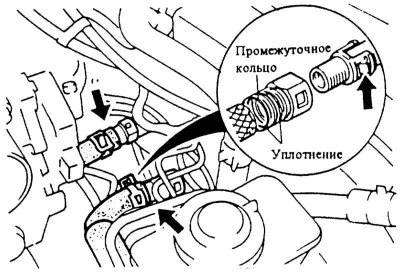
5. Models from 10/89.: Press the "arrow" nose of the hose clamp and disconnect the heater hose.
Attention! There is a circular seal and an intermediate ring on the nipple, do not lose them during installation.
6. Raise the car.
7. If present, remove the lower engine compartment trim.
Cars with power steering (servo control)
1. Remove the V-belt from the servo pump, see Section Removal and installation/tensioning the V-belt.
2. Unscrew the pump with the holder and hang it on the wire with the hoses connected so that the pump does not interfere with further removal and the hoses are not stretched.
Cars with air conditioning
Warning! The air conditioning circuit must not be opened. The refrigerant contains substances that, if they come into contact with the skin, can cause frostbite. The engine can be removed without opening the air conditioning circuit.
1. Remove the V-belt, see Section Removal and installation/tensioning the V-belt.
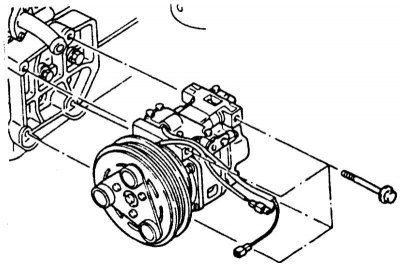
2. Unscrew the air conditioning compressor with the holder and hang it on a wire with the hoses connected so that it does not interfere with further removal and the hoses are not stretched.
Manual transmission
1. Disconnect the shift rod and extension rod on the gearbox, see Section Removal and installation the gearbox.
2. Models with hydraulic clutch: Unscrew the clutch slave cylinder with the hydraulic line and put it aside so that it does not interfere with further removal, see also Chapter Clutch.
Caution! The hydraulic line remains connected, otherwise the system will need to be bled after installation. Do not press the clutch pedal when the slave cylinder is removed. On some models, the clutch line is removed after the engine mount is removed.
3. Models with cable clutch: Disconnect the clutch cable, see Chapter Clutch, Chapter Adjusting the clutch pedal/cable.
4. Automatic transmission: Remove the cotter pin and disconnect the shift cable on the gearbox. Unscrew the cable mount on the gearbox.
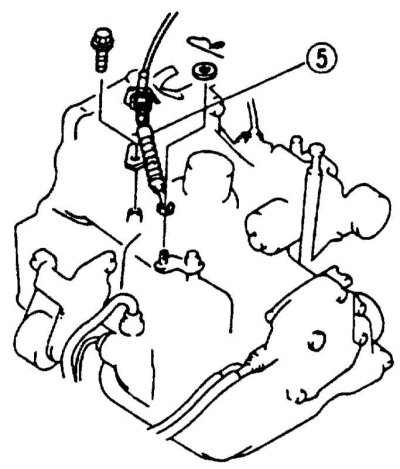
5. Remove the speedometer shaft, see Chapter Manual gearbox.
6. Unscrew the exhaust pipe from the exhaust manifold, see Chapter Exhaust system.
7. Remove the drive shafts, see Chapter Suspension and steering system, Chapter Removal and installation the drive shaft.
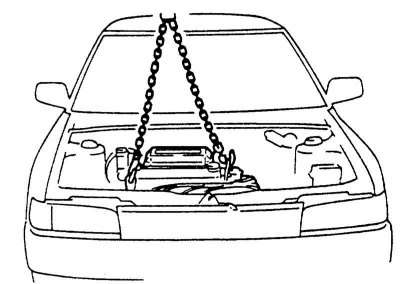
8. Attach a suitable chain to the engine earrings and lift the engine to relieve the load on its supports.
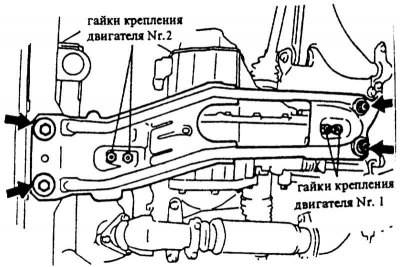
9. Unscrew engine mounting nuts No.1 and No.2.
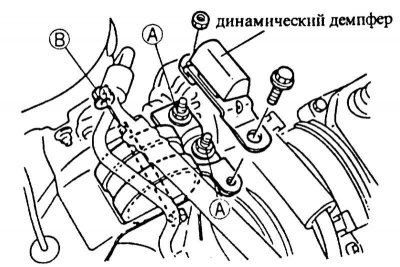
10. Unscrew the dynamic damper and mounting nuts "A".
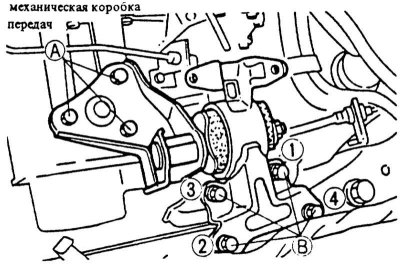
11. Unscrew nut "B", remove the bolt and remove the engine support.
12. Unscrew the mounting bolts "A" and "B" of the engine support on the gearbox side and remove the support complete with the holder.
13. Check that all hoses leading from the engine to the body have been removed. Then remove the engine using the crane upwards.
Caution: Carefully guide the engine when lifting to avoid damage to the body.
14. Remove the gearbox from the engine, see Chapter Manual gearbox, Chapter Removal and installation the gearbox.
Installation
1. Check engine mounts, water, oil and fuel hoses for cracks and breaks, replace if necessary.
2. Check the ease of movement of the release bearing and clutch release lever; replace if necessary.
3. Check the thickness and condition of the friction lining of the driven clutch disc; replace if necessary.
4. Clean the splined connection of the clutch shaft and lubricate with MoS2 grease.
5. Attach the gearbox to the engine, see Chapter Manual gearbox.
6. Carefully insert the engine from above into the engine compartment using a crane. When lowering, make sure that the bolts of the lower engine mounts enter the holes in the beam.
7. Install the lower engine mount mounting nuts.
8. Install the upper engine mount bolts. On some models, it is necessary to run a line to the clutch slave cylinder before installing the mounts.
9. Align the engine.
10. Tighten the mounting nuts on the lower engine mounts with force 70 Nm up to 9/89.; with effort 50 Nm starting from 10/89 issue.
11. Tighten the engine support mounting nuts "A" with force 80 Nm.
12. Tighten nut "B". Tightening torque: up to 9/89 g. 60 Nm, starting from 10/89 issue. 80 Nm.
13. If present, tighten the dynamic damper with force 70 Nm.
14. Models from 10/89: Tighten the engine mount mounting bolts "B" in the specified order from 1 to 4 with force 50 Nm. Tighten nuts "A" with force 80 Nm.
15. Install the drive shafts, see Chapter Suspension and steering system, Chapter Removal and installation the drive shaft.
16. Install the exhaust pipe and exhaust pipe or catalytic converter.
Manual transmission
1. Attach the shift rod and extension rod to the gearbox. Screw the extension rod in with force 40 Nm, shift rod with force 20 Nm.
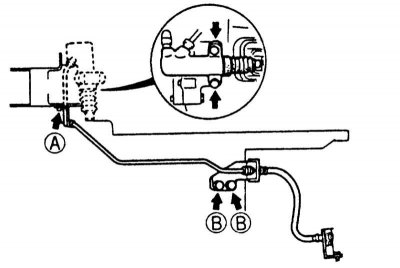
2. Models with hydraulic clutch drive: Install the clutch slave cylinder with the hydraulic line and tighten the "B" bolts to 20 Nm, "A" with effort 10 Nm.
3. Tighten the clutch slave cylinder mounting bolts with force 20 Nm.
Models with cable clutch
1. Install the clutch cable, see Chapter Clutch, Chapter Adjusting the clutch pedal/cable.
2. If equipped, install the lower engine compartment trim.
3. Lower the vehicle.
4. Install and adjust the throttle drive, see Chapter Power supply system, carburetor, fuel injection system, Chapter Checking/removing and installing automatic cold start.
5. Install the speedometer shaft.
Automatic transmission
1. Attach the shift cable to the gearbox and insert the cotter pin. Tighten the cable mount on the gearbox with force 10 Nm.
Power assisted cars
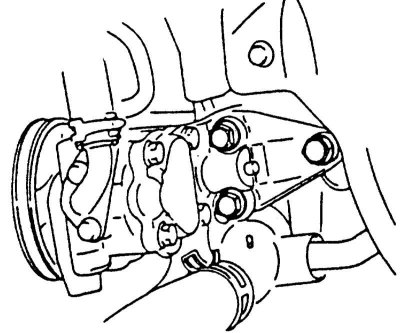
1. Install the pump with the holder and screw it on with force 50 Nm.
2. Install the servo pump V-belt, see Section Removal and installation/tensioning the V-belt.
Cars with air conditioning
1. Install the air conditioning compressor with the holder and screw it on with force 30 Nm.
2. Install the air conditioning compressor V-belt, see Section Removal and installation/tensioning the V-belt.
3. Connect and tighten all electrical wires and vacuum hoses according to the marks applied.
4. Put on the heater hoses and, depending on the model, secure them with clamps.
5. Connect the supply and return fuel lines and secure with hose clamps.
6. Install the radiator, see Chapter Engine cooling system, Removal and installation the radiator.
7. Fill the engine and gearbox with oil, see Chapter Maintenance.
8. Check the coolant for frost resistance and fill it, see Chapter Engine cooling system, Chapter Replacing the coolant.
9. Install the air filter, see Chapter Removal and installation the air filter.
10. Install the hood, see Chapter Body, car painting, car care, Chapter Removal and installation/adjustment of the hood
11. Screw the battery holder on firmly 20 Nm.
12. Install the battery, see Chapter Electrical equipment system, Chapter Removal and installation the battery.
13. If necessary, adjust the valve clearance, see Section Checking/adjusting valve clearance.
14. Check the ignition timing, adjust if necessary, see Chapter Ignition system, Chapter Checking/adjusting ignition timing.
15. Check idle speed, adjust if necessary, see Chapter Power supply system, carburetor, fuel injection system.
16. Warm up the engine, check the coolant level and the tightness of all connections.