


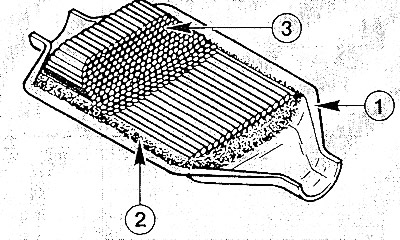
The catalyst consists of a ceramic honeycomb (3), which is located inside the protective layer of the mount. On the attachment layer are salts of noble metals, which provide the conversion process. In case (1) the catalyst is fixed with an insulating protective layer (2), which also compensates for thermal expansion.
Gasoline engines
Thanks to the joint work of the electronic injection system and the lambda probe, the portions of fuel for combustion are precisely dosed so that the catalyst can reduce the concentration of toxic substances. The lambda probe is located in the exhaust pipe in front of the catalytic converter and flows around here with the exhaust gas stream. The lambda probe is an electrical measuring sensor that determines the residual oxygen content in the exhaust gases by fluctuating electrical voltage and makes it possible to correct the composition of the air-fuel mixture. In a fraction of a second, the lambda probe can send a corresponding signal to the injection system control unit and, thanks to this, the ratio between fuel and air is corrected. On the one hand, this is necessary, because working conditions (idle, full load) are constantly changing, but, on the other hand, optimal afterburning in the catalyst occurs only when there is a sufficient amount of gasoline in the exhaust gases.
In order for afterburning to occur in the catalyst at temperatures between 300 and 800°C, there must be more oxygen in the air-fuel mixture than is required for clean combustion.
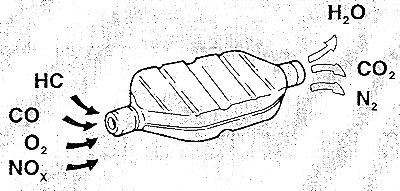
The catalyst used is the so-called 3-stage catalyst. This means that this catalyst, thanks to lambda regulation, simultaneously oxidizes carbon monoxide (SO) and hydrocarbons (CH), as well as a decrease in the concentration of nitric oxide (NOx).
Catalyst for diesel engines
On vehicles with diesel engines, a catalytic converter is fitted as standard. However, in this case, there is no correction of the air-fuel mixture. The catalyst, however, reduces emissions of toxic carbon monoxide and hydrocarbons to a level that is noticeably less than that of gasoline engines with controlled catalysts. In addition, the characteristic noise from the diesel engine is reduced.
Exhaust gas recirculation system
An exhaust gas recirculation system is installed in order to keep the concentration of nitrogen oxides already in front of the catalyst at a low level. Exhaust gas recirculation, depending on the operating mode of the engine, through a controlled valve directs a certain amount of exhaust gases back into the air flow into the engine. Because of this, the combustion temperature decreases. The lower it is, the less toxic nitrogen oxides are formed in the exhaust gases.