


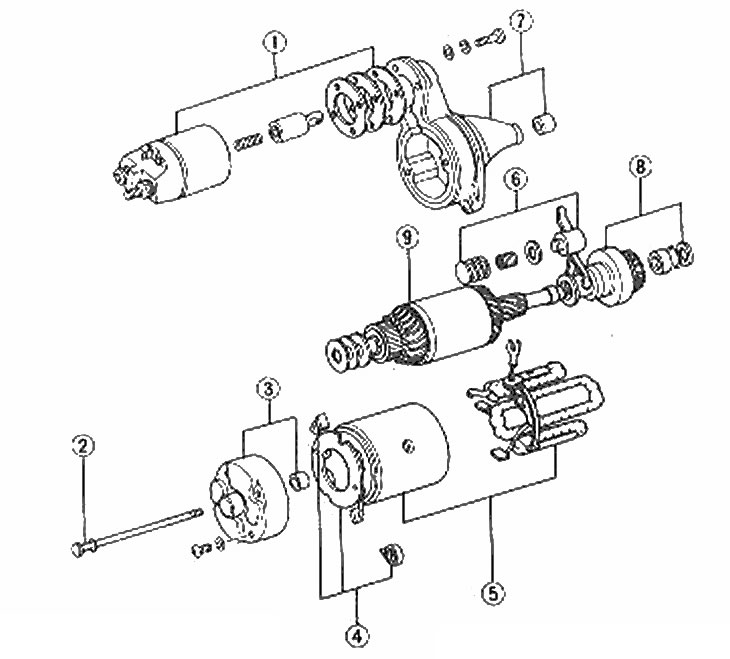
Starter parts
1. Solenoid and gaskets; 2. Tie bolt; 3. Anchor cover and sleeve; 4. Brush components; 5. Pole shoe and field coils; 6. Control Lever Components; 7. Drive housing and bushing; 8. Assembling the clutch gear; 9. Anchor
Removal
1. Remove the starter from the vehicle (Chapter 18) and clean it.
2. Unscrew the nut that secures the connecting belt to the traction relay. Remove the belt.
3. Remove the two or three screws that secure the solenoid relay to the starter housing. Remove the solenoid fork and gaskets, noting their numbers and locations. Remove the spring.
4. Disconnect the solenoid plunger from the control lever.
5. Remove all three brushes as described in the previous chapter. Remove the brush mounting plate.
6. Carefully pull the fork off the lid.
7. Disconnect the control lever from the gear clutch.
8. Remove the armature, clutch and gears from the starter housing.
9. To remove the gear/clutch assembly from the cover, secure it in a vice. Use a hammer and a piece of pipe to lower the bearing toward the gear until the spring ring is released. Remove the spring ring, bearing and gear/clutch.
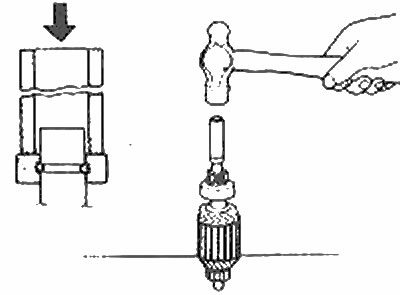
Removing the gear/clutch assembly
Inspection
10. Use a multimeter to check the insulation resistance of the armature. The resistance between any part of the commutator and the anchor layers must be infinite (open circuit).
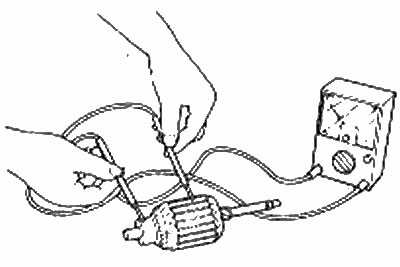
Checking the insulation resistance of the armature
11. Inspect the commutator for burnout or other damage. Grinding off a burnt-out layer of metal is sometimes possible, but this is a job for a specialist. Remove carbon and other dirt from between the commutator plates with a knife blade or similar tool. The depth of the slots should be as shown in the figure.
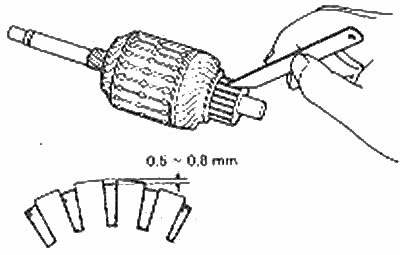
Trimming the switch
12. Check the insulation resistance between the excitation winding connector and the stator housing. It must be infinite (make sure that the field brushes do not touch the stator housing). Check the resistance between the field wires of the brush - it should be insignificant.
13. Check the resistance between the brush mounting plate and each brush (positive) brush holder - it should be infinite. Otherwise, replace the brush mounting plate.
14. Inspect the brushes and replace them if necessary as described in the previous Chapter.
15. The armature end brushes can be removed from the casings and replaced with new ones if necessary. Some of these brushes must be lubricated with motor oil before installation.
16. Inspect the traction relay components for signs of damage and clean off any corrosion. Function testing will be described later.
Bulkhead
17. Begin assembly by attaching the gear/coupling to the armature shaft. Place the gear/coupling on the shaft and secure it with the snap ring. Install a new snap ring into the shaft groove and secure it by bending the locking rim of the ring upwards using a pair of double-ended wrenches.
18. Install the anchor into the drive housing. Insert the starter lever into the clutch/gears. Install the washer and springs onto the starter lever pivot pin and carefully install the pole shoe into place.
19. Install the brush holder, spacers, commutator end cover and tie bolts as described in previous chapter.
20. Engage the traction relay switch rod with the starting lever. Install the spring, pole shoe and shims using the same number of shims as noted during removal. Install and tighten the traction relay mounting screws, but do not connect the drive belt.
Stationary testing
21. To perform testing, you will need a 12V battery and several load resistors.
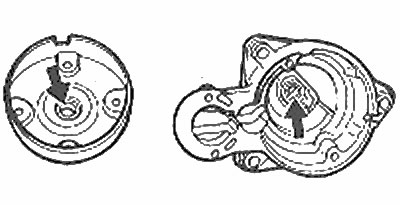
Starter covers and bushings (marked with arrows)
22. Check the synchronization function by connecting the negative terminal of the battery to the pole shoe of the traction relay and the "M" clamp (big bottom). Connect the positive battery terminal to the "S" terminal: the traction relay should operate and the gear should move outward. Do not apply voltage for more than ten seconds.
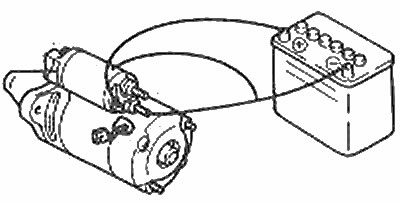
Checking the synchronization function of the traction relay
23. Check the 'holding' function of the traction relay by repeating the above test but disconnecting the 'M' terminal and leaving the 'S' terminal of the pole shoe connected. The gear should remain in the retracted position.
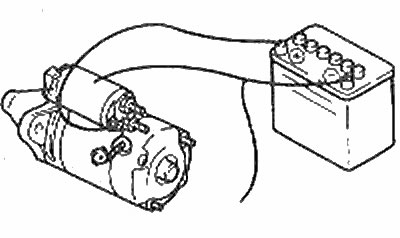
Checking the traction relay holding function
24. Check the return function by connecting the positive battery terminal to the "M" terminal and leaving the negative terminal connected to the pole shoe. Pull the gear back manually and release it: it should return immediately.
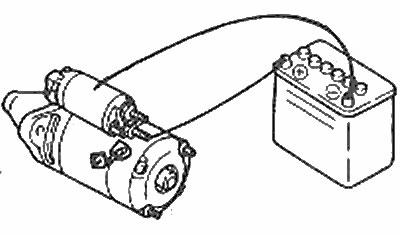
Checking the return function of the traction relay
25. Replace the traction relay if it fails any of these tests. If the relay is good, check the drive gear play as follows:
26. Connect the negative terminal to the pole shoe of the traction relay and the positive terminal of the battery to the "S" clamp.
27. The gear play can be adjusted by adding or removing shims installed between the pole shoe and the housing icon. Adding spacers reduces the gap and vice versa.
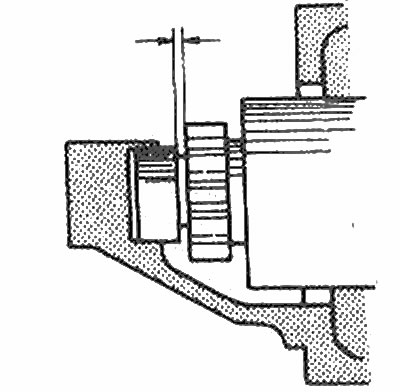
The gear clearance is measured between the arrows
28. If everything is normal, reconnect the cable to the "M" terminal of the traction relay and secure it with a nut.
29. If suitable test equipment is available, measure the starter operating current. Connect the starter as shown in the figure and install it in a vice. At 11.5 V, the current should not exceed 60 A and the engine speed should not exceed 6500 rpm. Do not run the engine at this speed for long periods.
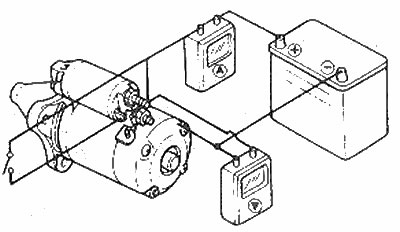
Wiring diagram for measuring the starter operating current