


Contents: Conditions for carrying out…⇓ Adjusting the engine idle speed and…⇓ Setting the fuel level in the float…⇓ Adjusting the mechanical air damper ⇓ Fast idle adjustment - carburetor…⇓ Automatic air damper ⇓ Fast Idle Adjustment - With Engine…⇓ Fast idle adjustment (models with…⇓ Fast idle adjustment (models with…⇓ Opening the air damper at full…⇓ Opening the air damper (all…⇓
Conditions for carrying out adjustments
If your vehicle is equipped with a constant idle speed control system, you must turn off all vehicle electrical equipment and position the front wheels straight ahead before adjusting the idle speed or fuel mixture (or before adjusting the ignition timing or the duration of the closed state of the breaker contacts). Otherwise, the stabilization system will be active and the adjustment will be incorrect.
Disconnect the vacuum hose from the idle air control valve when the engine temperature is high (if installed) and plug the pipe on the carburetor.
Adjusting the engine idle speed and idle fuel mixture (IFM) quantity
Idle speed adjustment screws
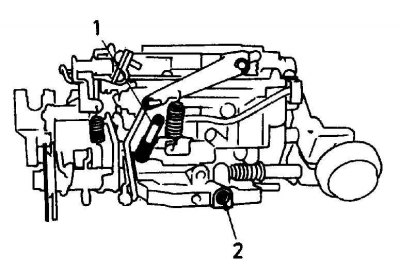
1. Crankshaft speed adjustment screw when the engine is idling
2. Idle mixture adjustment screw
1. Increase the engine speed to 3000 rpm and hold it at this level for 30 seconds to clear the intake manifold of fuel vapor, then leave the engine running in idle mode.
2. Using the idle speed adjustment screw, adjust the engine idle speed (see subsection 5.1.1).
3. Check your CO levels; if it differs from the one specified (see subsection 5.1.1), remove the seal and adjust the idle mixture adjustment screw to obtain the correct CO level. Turn the screw clockwise (twisting) decreases the CO level by turning the screw counterclockwise (twisting) increases CO levels. If you don't have a CO sensor, adjusting the idle mixture without a CO sensor is described in the relevant chapter.
4. Repeat the operations described above until both adjustments are correct.
5. Clean the intake manifold every 30 seconds while making adjustments by increasing the engine speed to 3000 rpm for 30 seconds.
6. Increase the engine speed to 2000 rpm and measure the CO level. The reading should be less than half the CO level when the engine is idling.
7. Install a new seal on the mixture quantity adjustment screw after completing the adjustment.
Setting the fuel level in the float chamber/adjusting the float stroke
Float chamber window
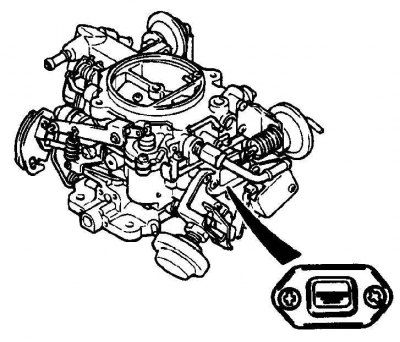
The fuel level in the float chamber can be checked without removing the carburetor. When the engine is running, the fuel level can be checked through the sight glass of the float chamber. If the fuel level does not match the mark, adjustment is required.
1. Remove the carburetor cover following the instructions in subsection 5.1.3.
2. Turn the carburetor cover over so that the float is facing up and the needle valve is closed.
3. Measure the distance "H" (float installation height) between the carburetor cover and the plastic float (without gasket). Check that the float installation height is as specified in subsection 5.1.1.
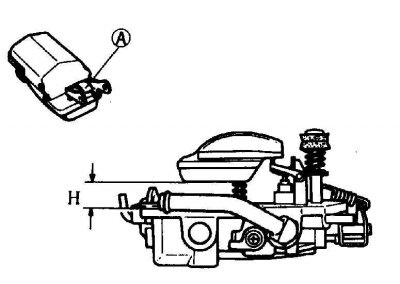
H. Float installation height
4. Adjust the float installation height by bending the float lever "A".
5. Turn the carburetor cover over and check that the float has dropped as far as the limiter tab allows it to.
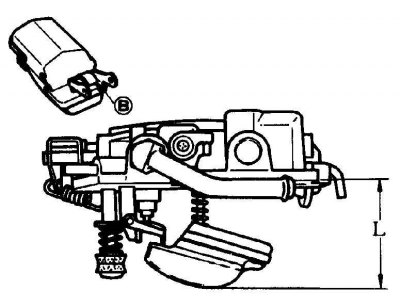
6. Measure the distance "L" (float stroke) between the carburetor cover and the underside of the float. Compare the obtained value with the value specified in subsection 5.1.1.
7. Adjust the float stroke by bending the limiting tab "B".
Adjusting the mechanical air damper
Before adjusting the choke, check that the idle speed and idle mixture quantity are adjusted correctly.
Remove the air filter. Disconnect the engine crankcase ventilation hose. Vacuum hoses must remain connected (or disconnect them and plug the holes).
Fast idle adjustment - carburetor removed from engine
Checking the position of the air damper when the engine is running in fast idle mode
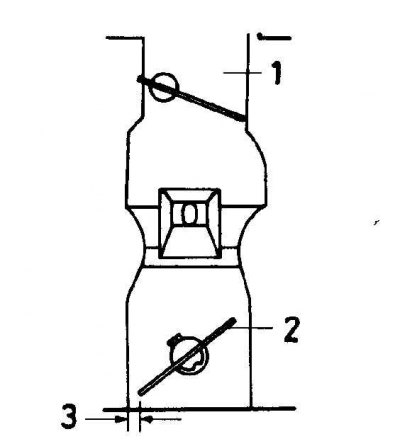
1. Air damper
2. Throttle valve - primary chamber
3. Gap
1. To adjust the fast idle system, the carburetor must be removed from the engine.
2. Turn the carburetor over and use the choke lever to completely close the choke.
3. The adjusting screw will open the throttle valve, creating a small gap.
4. Using a drill bit, measure the gap between the carburetor chamber wall and the edge of the throttle valve (see figure Checking the position of the air damper when the engine is running in fast idle mode). Compare the obtained value with the value specified in subsection 5.1.1.
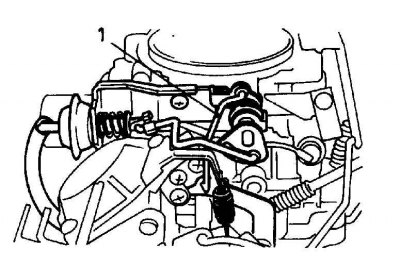
5. Adjust the gap by bending the connecting rod at point 1.
Automatic air damper
The conditions for adjusting the automatic air damper were specified (see subsection 5.1.1).
Fast Idle Adjustment - With Engine Running
1. Open the throttle slightly and set the fast idle lever to the upper tooth of the fast idle cam.
2. Start the engine without pressing the accelerator pedal and note the engine speed at fast idle. Compare the obtained frequency with the value given in subsection 5.1.1.
3. Adjust the crankshaft speed by turning the fast idle speed adjustment screw in the desired direction.
Fast idle adjustment (models with semi-automatic air damper) – the carburetor is removed from the engine
Fast idle adjustment
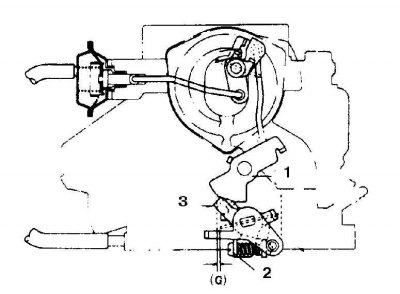
1. Cam of the fast idling system
2. Adjusting screw
3. Fast idle system lever
1. Turn the carburetor over, then open the throttle slightly and set the fast idle lever to the second tooth of the fast idle cam. The adjusting screw will open the throttle valve, creating a small gap.
2. Check that the air damper is completely closed. Using a drill bit, measure the gap "G" between the carburetor chamber wall and the edge of the throttle valve (see figure Fast Idle Adjustment). Compare the obtained value with the value specified in subsection 5.1.1.
3. Adjust the gap size by turning the adjusting screw in the required direction.
Fast idle adjustment (models with automatic air damper) – the carburetor is removed from the engine
Alignment of marks on the fast idle cam and lever
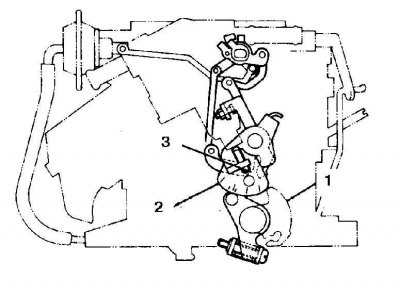
1. Throttle lever
2. Fast idle system lever
3. Adjusting screw
1. Wait until the carburetor temperature drops to 25°C and keep the carburetor at this temperature for at least an hour.
2. Check that the "25°" mark on the fast idle cam is aligned with the center of the fast idle lever.
3. Adjust the position of the mark by turning the adjusting screw in the required direction.
4. Turn the carburetor over and use a drill bit to measure the gap between the carburetor chamber wall and the edge of the throttle valve (see figure Checking the position of the air damper when the engine is running in fast idle mode). Compare the obtained value with the value specified in subsection 5.1.1.
5. Adjust the gap size by turning the adjusting screw in the required direction.
Opening the air damper at full throttle
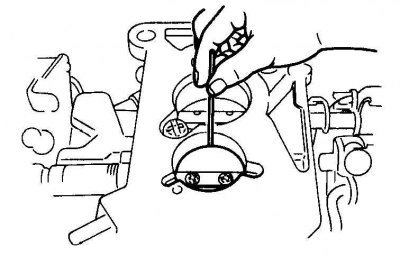
1. Open the throttle valves fully and use a drill bit to measure the clearance "R" between the top edge of the air damper and the air intake duct. Compare the obtained value with the value specified in subsection 5.1.1.
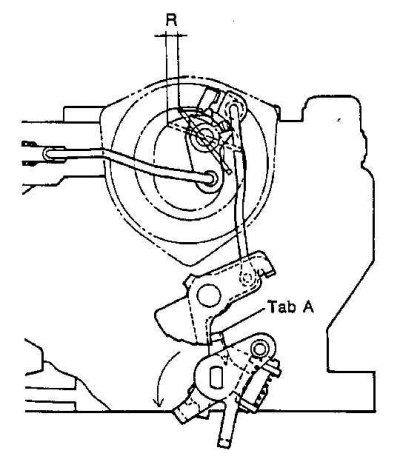
2. Adjust the gap size (R) by bending tab "A".
Opening the air damper (all carburetors)
Checking the throttle opening diaphragm, measuring the gap size
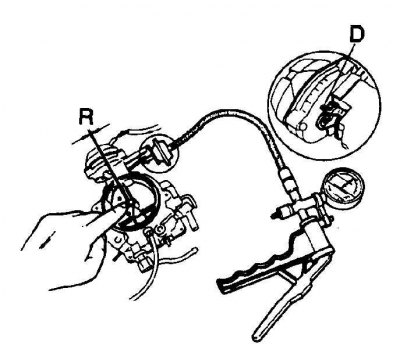
D. Adjusting lever - automatic air damper
R. Gap
1. Disconnect the vacuum hose and connect a vacuum pump to each choke valve opening diaphragm in turn. Pump out air to achieve a vacuum of 400 mmHg; the diaphragm should fully open the air damper and the vacuum should be maintained for at least 30 seconds. Replace the diaphragm if it is faulty.
2. Maintain a vacuum of 400 mmHg to allow the choke opening diaphragm rod to rise fully.
3. Using a drill bit, measure the gap between the top edge of the air damper and the wall of the air intake duct. Compare the obtained gap value with the value specified in subsection 5.1.1.
4. Adjust the gap by bending the rod (mechanical air damper) or lever (automatic air damper) at the end of the diaphragm rod.
5. Some models are equipped with two air damper opening diaphragms. Check both diaphragms. The thermal vacuum valve of the second opening diaphragm must be open when the coolant temperature is above 19±3°C.