MazBook.ru
English Русский
Български
Беларускі
Український
Српски
Hrvatski
Română
Polski
Slovenský
Magyar
• Bookmark • Sitemap • Contacts •   
Cars Opel Cars Ford Cars Volkswagen Cars Audi Cars Kia Cars Renault Cars Peugeot


Familia Capella Mazda3 Mazda6 CX-? Others Articles
Capella 3 (1982-1992, petrol) Capella 3 and 4 (1982-1992) Capella 4 (1987-1992) Capella 5 (1991-1997) Capella 6 (1997-2005, petrol)

Constant velocity joint protective covers for drive shafts — replacement (Mazda Capella GF)

  • Home
  • Mazda Capella
  • Capella GF (1997-2005)
  • Transmission
  • Clutch and drive shafts
  • Constant velocity joint protective covers for drive shafts — replacement
0
Contents: Inner hinge and its cover ⇓ Outer hinge ⇓
Note 1: If constant velocity joint repair is required (usually due to damage to the protective covers), carefully study all the details of the upcoming work before starting it. It is more convenient to purchase a refurbished hinge instead of repairing it, which will save a lot of time and effort. However, in any case, first find out the cost of spare parts and the possibility of purchasing them, and then begin the repair.


Note 2: Replacement protective boots may be designed to be installed without removing the drive shaft. Purchasing such covers is a temporary measure. It is also advisable to remove the drive shaft to ensure that the constant velocity joint is not contaminated. Otherwise, the hinge will quickly fail.


Note 3: In vehicles equipped with the ABS system, the system sensor rings are installed on the outer hinges. Inspect the rings and make sure they are not damaged. Sweep the rings if necessary.


1. Remove the drive shaft (see paragraph 11).

2. Clamp the drive shaft in a vice, placing wooden shims underneath (to avoid damaging the shaft).

Inner hinge and its cover


Three-finger hinge


Disassembly


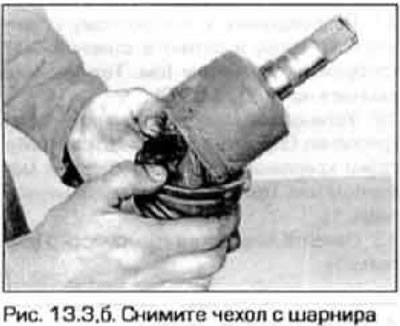
3. Remove the cover clamps (figure 13.3, a, b).
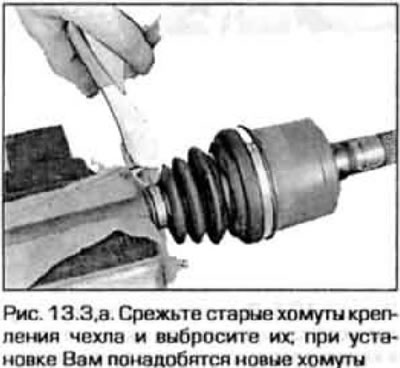
3. Remove the cover clamps (figure 13.3, a, b).

4. Remove the cover from the hinge, then remove the retaining ring and remove the housing from the hinge. Before doing this, mark the position of the hinge relative to the body (figure 13.4).
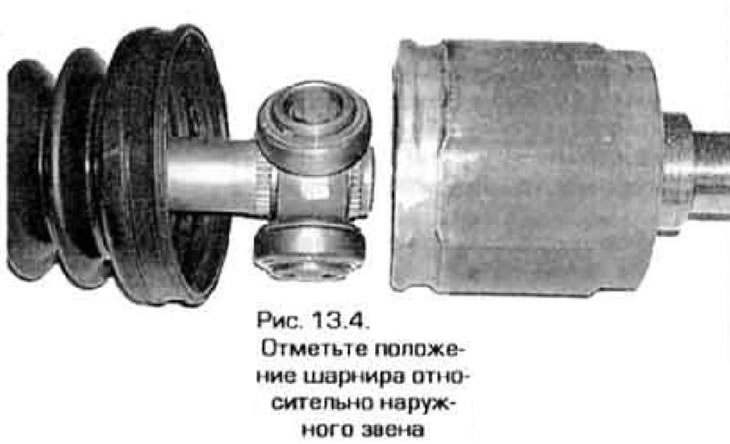


4. Remove the cover from the hinge, then remove the retaining ring and remove the housing from the…


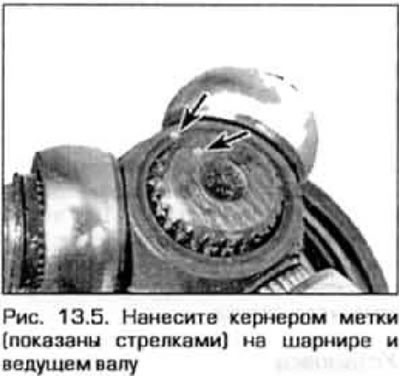
5. Use a center punch to mark the joint and drive shaft to ensure proper assembly (figure 13.5).

5. Use a center punch to mark the joint and drive shaft to ensure proper assembly (figure 13.5).

6. Using pliers, remove the retaining ring from the drive shaft (figure 13.6).

6. Using pliers, remove the retaining ring from the drive shaft (figure 13.6).


7. Using a hammer and a soft metal punch, knock the joint off the drive shaft (figure 13.7).
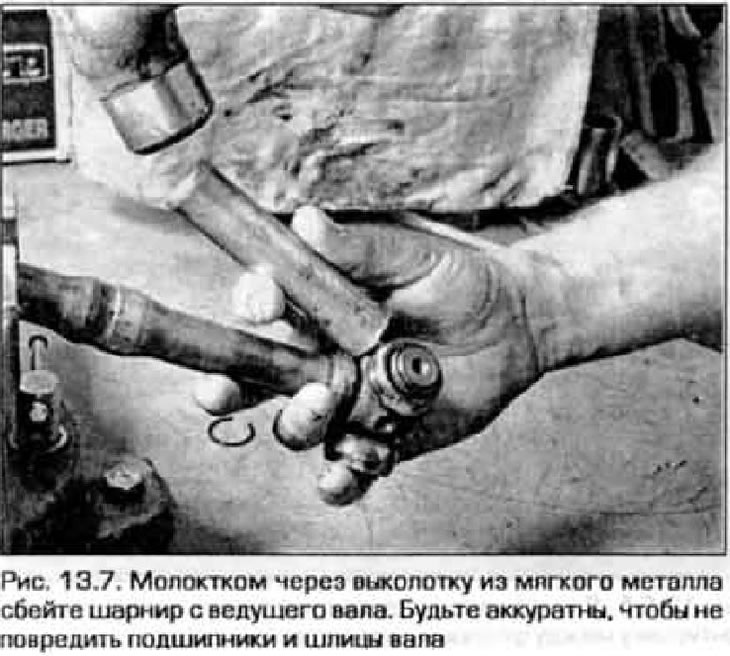
7. Using a hammer and a soft metal punch, knock the joint off the drive shaft (figure 13.7).


Examination


8. Remove old grease from the housing and from the hinge. Disassemble each section of the hinge one by one (do not disassemble sections at the same time to avoid mixing up the parts) and wash the bearing needles in solvent.


9. Inspect the bearing needles, axles and outer bearing races for damage or wear. Replace the joint if necessary.

Assembly


10. Wrap the splines of the drive shaft with insulating tape to prevent them from damaging the boot. Place the clamps and boot on the drive shaft (figure 13.10).
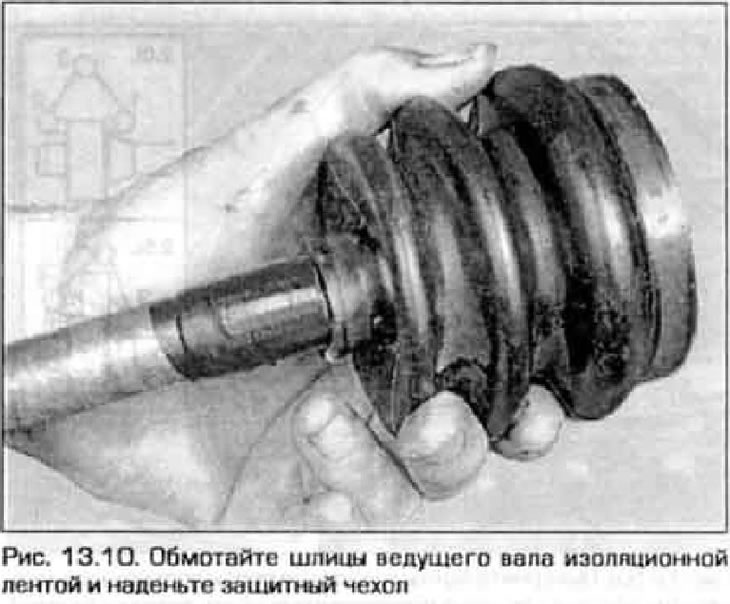
10. Wrap the splines of the drive shaft with insulating tape to prevent them from damaging the…


11. Install the joint on the drive shaft (so that the marks made before removing the hinge match), then insert the retaining ring. Apply grease to the hinge, the inner surface of the hinge housing and place it in the boot (figure 13.11).
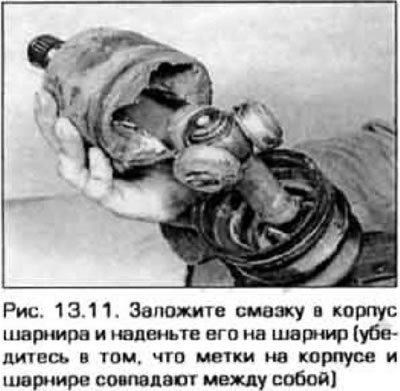
11. Install the joint on the drive shaft (so that the marks made before removing the hinge match),…


12. Place the cover on the hinge so that its ends fit into the corresponding grooves.

13. Adjust the length of the hinge according to Technical data (Fig. 13.13).
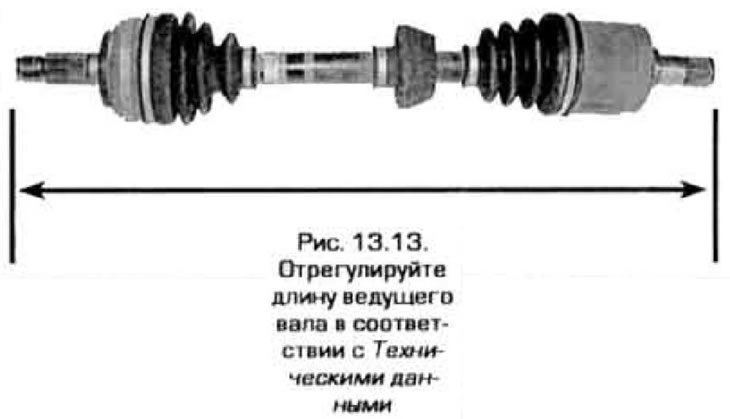
13. Adjust the length of the hinge according to Technical data (Fig. 13.13).


14. Equalize the air pressure inside the case (figure 13.14).
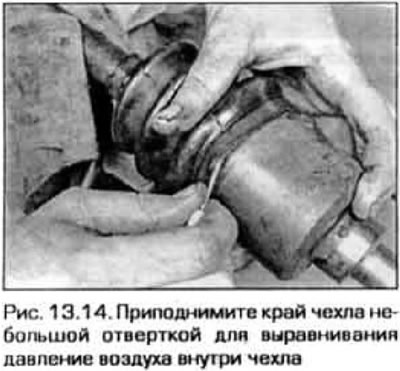


14. Equalize the air pressure inside the case (figure 13.14).


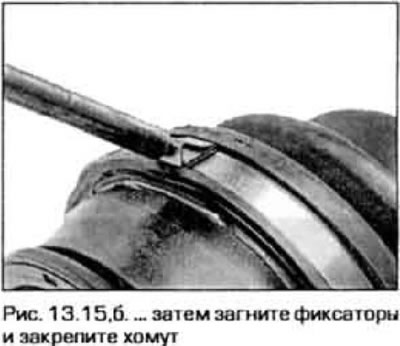
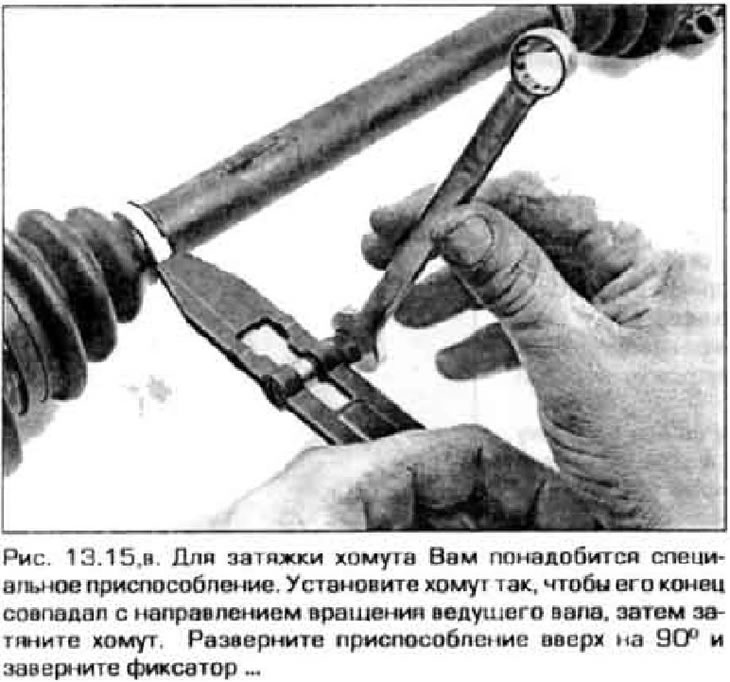
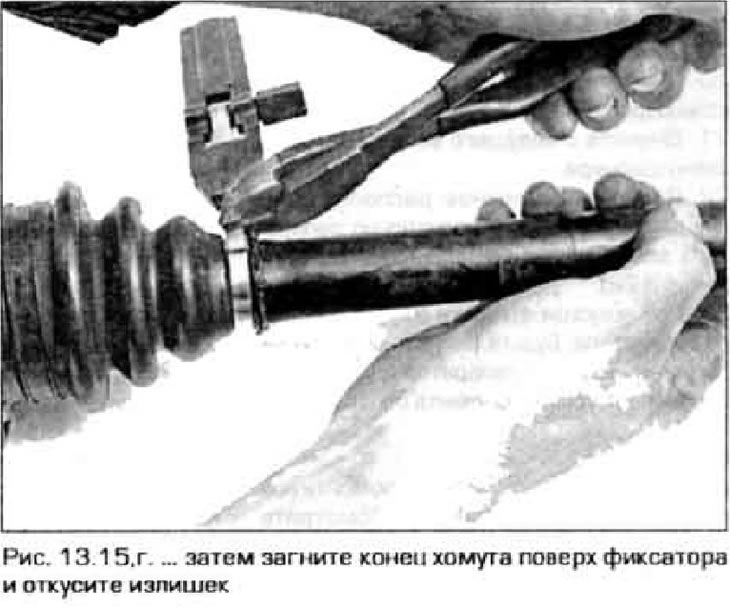
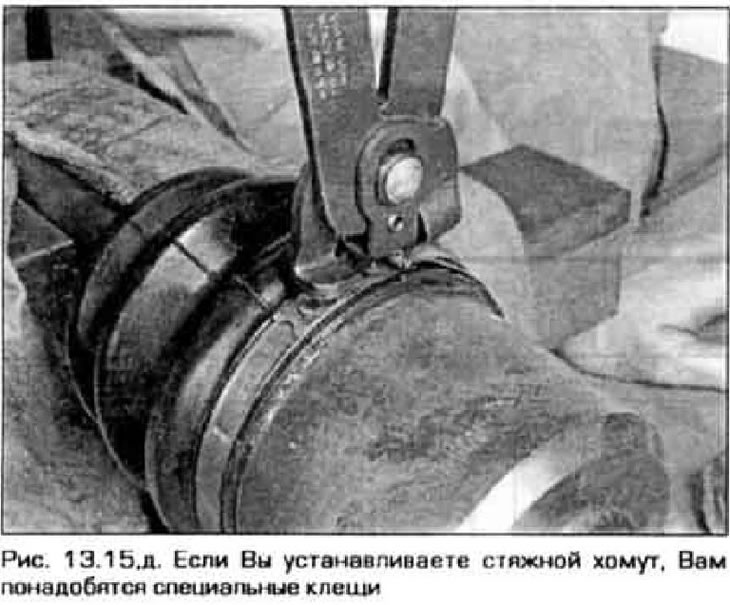
15. Tighten the cover mounting clamps (fig. 13.15, a-d). Go to p. 35.
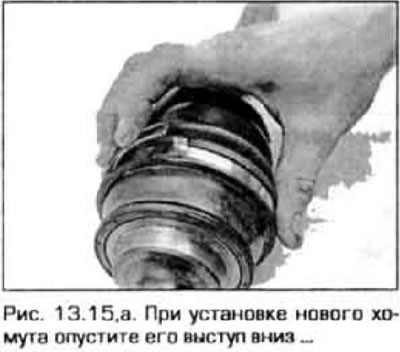
15. Tighten the cover mounting clamps (fig. 13.15, a-d). Go to p. 35.

15. Tighten the cover mounting clamps (fig. 13.15, a-d). Go to p. 35.


15. Tighten the cover mounting clamps (fig. 13.15, a-d). Go to p. 35.


15. Tighten the cover mounting clamps (fig. 13.15, a-d). Go to p. 35.


Ball joint


Disassembly


16. Remove the cover clamps (see Fig. 13.3,a) and throw them away.


17. Remove the cover from the hinge.

18. Remove the retaining ring from the hinge housing (Fig. 13.18).
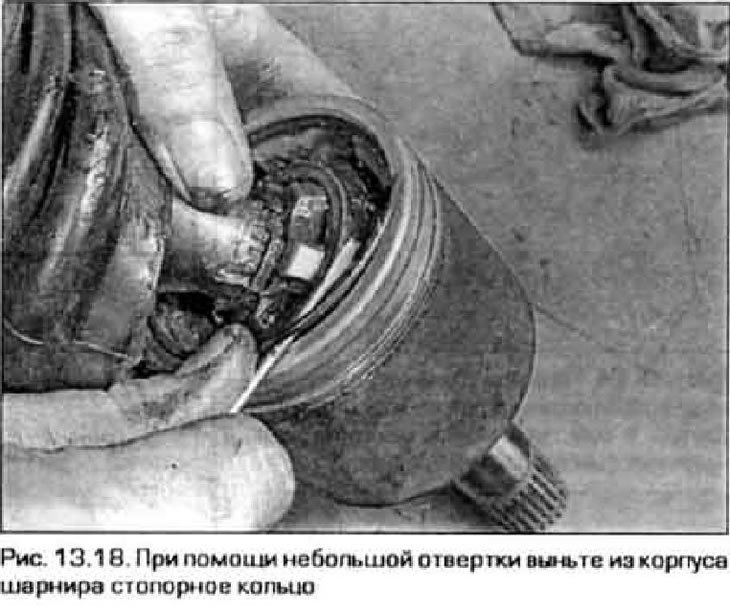
18. Remove the retaining ring from the hinge housing (Fig. 13.18).


19. Remove the housing from the hinge (figure 13.19).
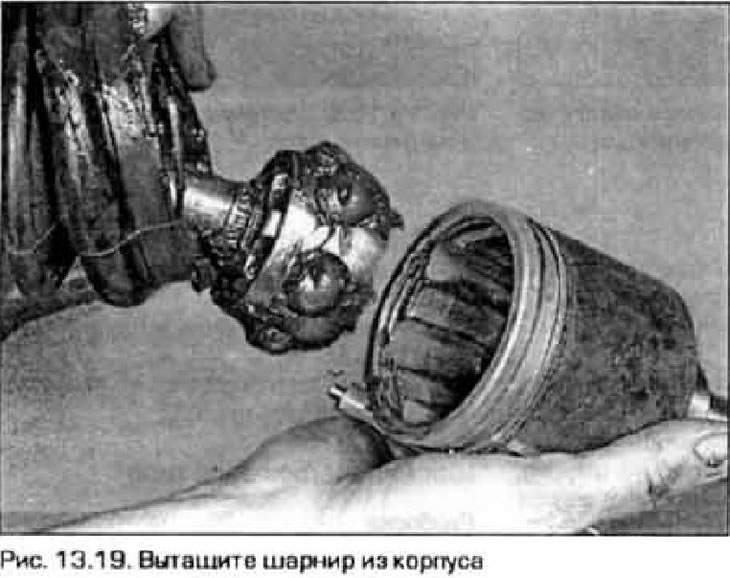
19. Remove the housing from the hinge (figure 13.19).


20. Remove the retaining ring from the drive shaft (figure 13.20).
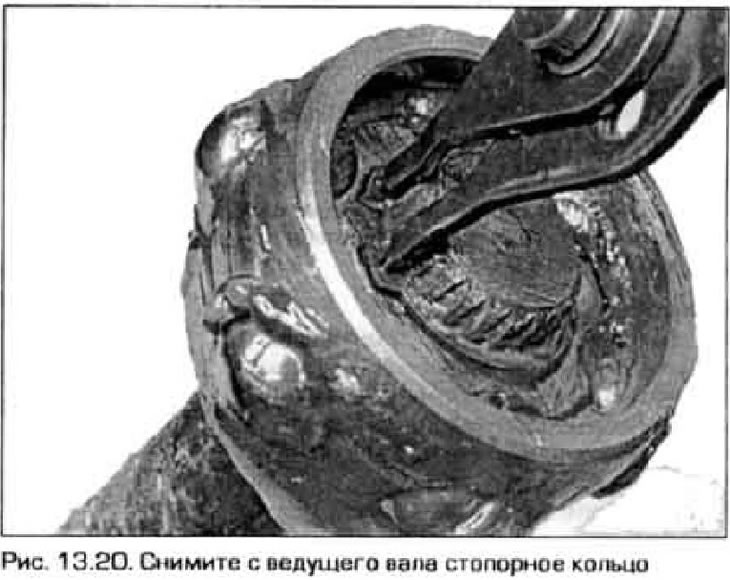
20. Remove the retaining ring from the drive shaft (figure 13.20).


21. Remove the inner link of the joint from the drive shaft.

22. Mark the relative position inside its ring relative to the separator to ensure correct assembly (figure 13.22).
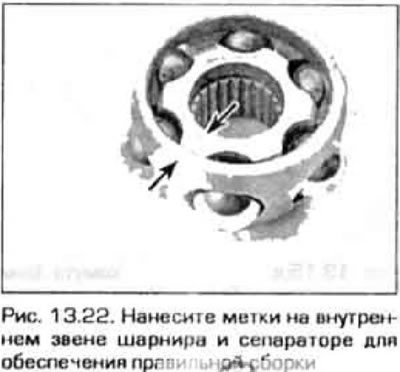


22. Mark the relative position inside its ring relative to the separator to ensure correct assembly…


23. Using a screwdriver, remove the balls from the separator. Be careful not to damage the balls, cage, or inner link of the joint. Remove the separator.

Examination


24. Remove old grease and wash all components in solvent. Inspect the separator and rings for signs of pitting, chipping, wear or damage (figure 13.24, a, b). Shiny spots on surfaces are not a sign of their malfunction.
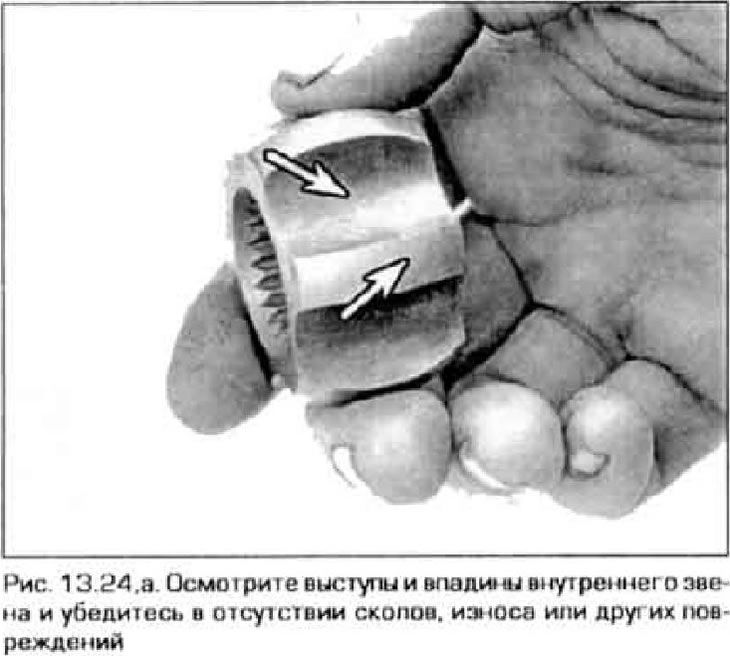
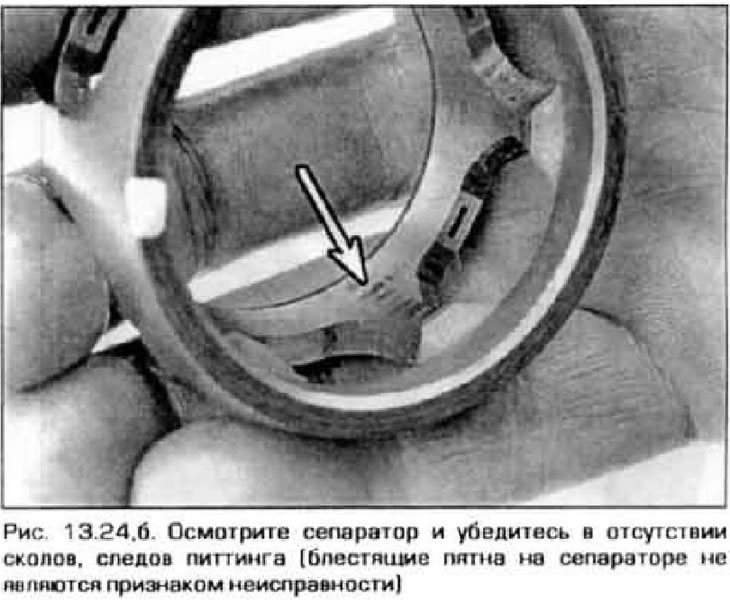
24. Remove old grease and wash all components in solvent. Inspect the separator and rings for signs…


24. Remove old grease and wash all components in solvent. Inspect the separator and rings for signs…


Assembly


25. Wrap the drive shaft splines with insulating tape to prevent them from damaging the boot. Place the clamps and boot on the drive shaft, then remove the insulating tape.


26. Assemble the hinge unit. To do this, place the separator on the inner link. Insert (by hand) the balls into the holes of the separator (figure 13.26).
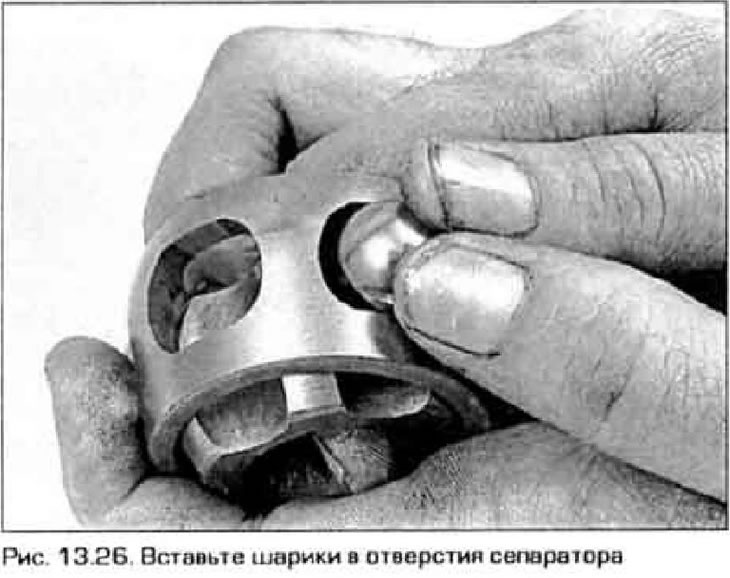
26. Assemble the hinge unit. To do this, place the separator on the inner link. Insert (by hand)…


27. Lubricate the hinge with fresh grease (usually this grease is included with the hinge repair kit).

28. Place the hinge assembly on the drive shaft so that the smaller diameter of the separator is on the inside (figure 13.28).
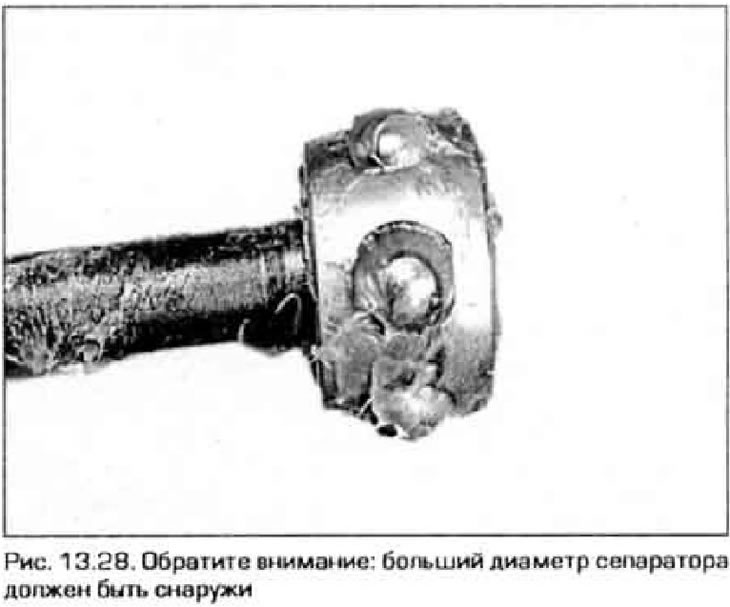
28. Place the hinge assembly on the drive shaft so that the smaller diameter of the separator is on…


29. Insert the retaining ring into the shaft groove. Lift the inner hinge link outward to ensure it is securely fastened.

30. Fill the joint housing with grease so that it completely fills the entire housing.

31. Install the bearing retaining ring.

32. Remove excess grease from the groove under the boot on the hinge housing. Place the boot on the drive shaft so that it fits into the groove of the drive shaft. Place the cover over the hinge housing.


33. Insert a small screwdriver between the boot and the hinge housing and equalize the air pressure inside the boot (see figure 13.13). Do not damage the case.

34. Adjust the length of the drive shaft according to Technical data (see figure 13.14).

35. Tighten the cover mounting clamps (see Fig. 13.15, a-d). Proceed to the next item.

For all internal hinges


35. Install a new retaining ring on the inner joint shaft (see figure 11.10, a, b).

36. Install the drive shaft on the vehicle (see paragraph 11).

Outer hinge


37. Remove the cover clamps (see figure 13. H, A, B) and pull the cover back so that you can inspect the hinge.

38. Thoroughly rinse the joint in solvent and dry it with compressed air (if such an opportunity exists). The outer hinge is non-detachable, making it difficult to clean from old grease. However, if you are patient, cleaning the hinge is entirely possible.

39. Turn the joint housing over to see the balls, inner ring and separator. Inspect these components for wear or damage. If necessary, replace the joint together with the drive shaft (figure 13.39).
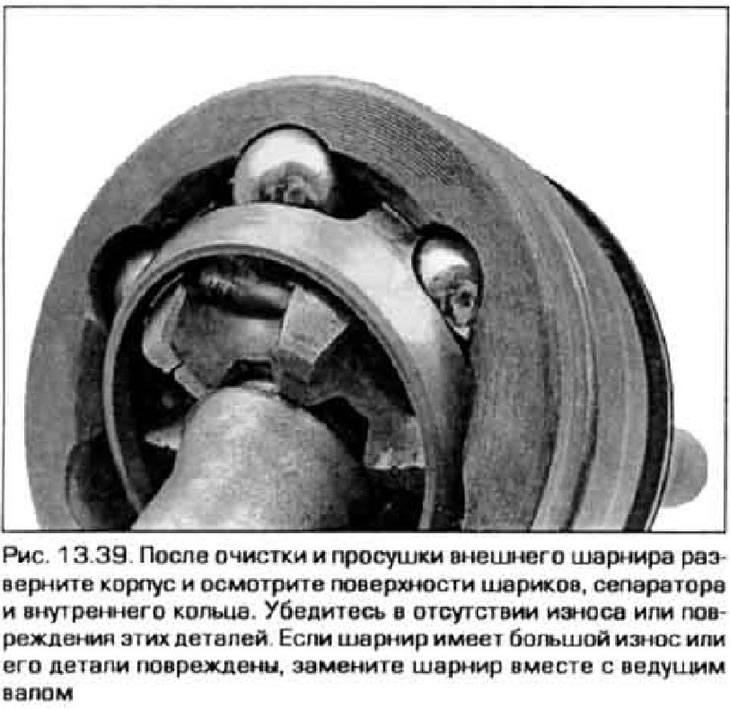
39. Turn the joint housing over to see the balls, inner ring and separator. Inspect these…


40. If the outer joint boot is damaged and the joint itself is in good condition, remove the inner joint and the outer joint boot (removal of the three-pin type inner joint is described in paragraphs. 3-9, and removal of the ball-type joint - in paragraphs 18-24). If a dynamic damper is installed on the shaft, mark its position relative to the shaft, then remove the clamp and damper.

41. Place the new outer joint boot onto the drive shaft. To prevent damage to the boot, wrap the end of the drive shaft with electrical tape (see Fig. 13.10). After this, apply fresh grease to the outer hinge and its boot. Put the boot on the hinge, equalize the air pressure in it and secure it with new clamps (see Figure 13.15, a-d). Install a dynamic damper on the drive shaft (if there is one) and secure it with a new clamp, aligning the marks on the shaft and damper (see item 40). Tighten the damper fasteners.

42. Place a smaller diameter clamp and the inner joint cover on the drive shaft and install the inner joint (installation of the three-pin type inner joint is described in paragraphs. 10-15, and installing a ball-type joint - in paragraphs 25-35). Before tightening the clamps securing the inner joint boot, adjust the length of the drive shaft.

43. Install the drive shaft on the vehicle (see paragraph 11).
This article is available at: russian, bulgarian, belarusian, ukrainian, serbian, croatian, romanian, polish, slovak, hungarian
This text was checked by: German Vorobyov
Share with friends on social networks:

Previous
Capella 6 » Clutch and drive shafts
Next

Intermediate shaft — removal and installation
Drive shafts — removal and installation
Drive shafts — basic information and inspection
Clutch Pedal Start Switch — checking, replacing, and adjusting
Clutch pedal adjustment
More articles on repairing other Mazda models
Removal the front wheel drive shafts Mazda Familia 5 (1985-1989)
Technical characteristics of drive shafts Mazda3 BK (2003-2009)
Front drive shafts Mazda6 GG (2002-2008)
Disassembly and assembly of the front drive shaft with constant… Mazda CX-5KE (2012-2017)
Checking the rubber boots of the drive shafts Mazda 121 (3) (1996-2003)
Link in different formats to this article
Comments and feedback from visitors
No comments yet


How much will 49 + 10 ?


Capella 6 (1997-2005, petrol) 
  • General information
  • Introduction to guide
  • User manual
  • Troubleshooting
  • Maintenance
  • Power unit
  • 4-cylinder engines
  • 6-cylinder engines
  • Engine overhaul
  • Cooling and ventilation
  • Power and exhaust systems
  • Engine electrics
  • Control system
  • Transmission
  • Mechanical gearbox
  • Automatic gearbox
  • Clutch and drive shafts
  • Chassis
  • Brake system
  • Car suspension
  • Steering
  • Body
  • Exterior (external elements)
  • Interior (internal elements)
  • Doors, windows and locks
  • Electrical equipment
  • Equipment and devices
  • Electrical circuits
Capella 5 (1991-1997) 
  • General information
  • User manual
  • Maintenance
  • Helpful hints
  • Power unit
  • Petrol engines 1.6 and 1.8
  • Petrol engines 2.0
  • 2.5 petrol engines
  • Overhaul engines 1.6 and 1.8
  • Overhaul engines 2.0 and 2.5
  • Diesel engine 2.0
  • Engine electrics
  • Cooling system
  • Air conditioner
  • Carburetor Nikki 30/34
  • Power system (1.6 and 1.8)
  • Power system (2.0 and 2.5)
  • Control system
  • Transmission
  • Mechanical gearbox
  • Automatic gearbox
  • Clutch and axles
  • Chassis
  • Brake system
  • Suspension and wheels
  • Steering
  • Body
  • Exterior (external elements)
  • Interior (internal elements)
  • Doors and windows
  • Electrical equipment
  • Equipment and devices
  • Electrical circuits
Capella 4 (1987-1992) 
  • General information
  • Introduction to manual
  • Vehicle specifications
  • Power unit
  • Engine repair
  • Lubrication system
  • Cooling system
  • Fuel system (carburetor)
  • Fuel injection (FE)
  • Fuel injection (DOHC)
  • Fuel system (diesel)
  • Ignition system
  • Transmission
  • Clutch
  • Gearbox
  • Drive shafts
  • Chassis
  • Front suspension
  • Rear suspension
  • Steering system
  • Brake system
  • Electrical equipment
  • Equipment and devices
  • Electrical circuits
Capella 3 and 4 (1982-1992) 
  • General information
  • User manual
  • Maintenance
  • Power unit
  • Gasoline engine
  • Engine overhaul (gasoline)
  • Diesel engine
  • Cooling and heating
  • Supply system
  • Ignition system
  • Emission reduction
  • Transmission
  • Clutch
  • Mechanical gearbox
  • Automatic gearbox
  • Drive shafts
  • Chassis
  • Brake system
  • Suspension and wheels
  • Steering
  • Body
  • Exterior (external elements)
  • Interior (internal elements)
  • Electrical equipment
  • Equipment and devices
  • Power devices
  • Electrical circuits
Capella 3 (1982-1992, petrol) 
  • General information
  • User manual
  • Maintenance
  • Troubleshooting
  • Late models
  • Power unit
  • Engine in car
  • Engine overhaul
  • Cooling and heating system
  • Fuel and exhaust system
  • Engine electrical system
  • Emission control system
  • Transmission
  • Mechanical gearbox
  • Automatic gearbox
  • Clutch and drive shafts
  • Chassis
  • Brake system
  • Suspension and wheels
  • Steering
  • Body
  • Exterior (external elements)
  • Interior (internal elements)
  • Electrical equipment
  • Equipment and devices
  • Lighting and lamps
  • Electrical circuits
MazBook.ru © 2018–2026 · Mobile version · Articles and news · Sitemap: EN BG BY UA RS HR RO PL SK HU · Feedback · Site search · Add to bookmarks Familia 5 (BF) · Familia 6 (BG) · Capella 3 (GC) · Capella 3 and 4 (GC) · Capella 4 (GD) · Capella 5 (GE) · Capella 6 (GF) · Mazda3 BK · Mazda6 GG · CX-5KE · Mazda 121 (3) · Mazda BT-50 (1) ·
By continuing to use the site, you agree to the use of cookies 🔐