MazBook.ru
English Русский
Български
Беларускі
Український
Српски
Hrvatski
Română
Polski
Slovenský
Magyar
• Bookmark • Sitemap • Contacts •   
Cars Opel Cars Ford Cars Volkswagen Cars Audi Cars Kia Cars Renault Cars Peugeot


Familia Capella Mazda3 Mazda6 CX-? Others Articles
Mazda 121 (3) (1996-2003) Mazda BT-50 (1) (2006-2011)

Checking the shock absorber (Mazda 121 (3))

  • Home
  • Mazda
  • 121 JASM (1996-2003)
  • Chassis
  • Rear suspension
  • Checking the shock absorber
0
The following signs indicate a faulty shock absorber:
  • Long-term vibrations of the body after driving over uneven surfaces.
  • The body sways when driving over uneven surfaces one after another.
  • Wheels bounce on a smooth road.
  • Car "dive" when braking (there may be other reasons).
  • Instability when turning and insufficient straight-line holding, vehicle vibration.
  • Abnormal tire wear with scuffs on the tire tread.
  • A faulty shock absorber is also recognized by the fact that knocking and ringing sounds are heard during movement. However, these noises can often have other causes, such as loose bolts and nuts of the chassis, faulty wheel bearings, CV joints. Always check the shock absorber before replacing, preferably on a special stand.

The shock absorber can be checked manually. Accurate testing of the shock absorber efficiency is only possible on a special stand (shock absorber installed) or using a special device.

Manual check


Remove the shock absorber.

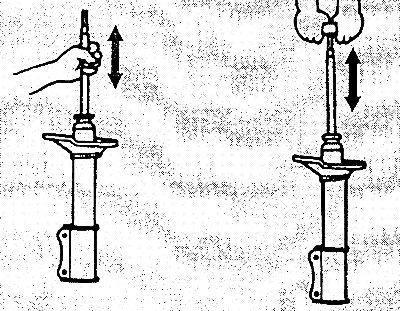
Holding the shock absorber in the installation position, stretch and compress it. The shock…


Holding the shock absorber in the installation position, stretch and compress it. The shock absorber should move with uniform force and without jamming throughout the entire compression and extension stroke.


In gas-filled shock absorbers, the rod returns to the extended position automatically with sufficient gas pressure. If this is not the case, the shock absorber must always be replaced. The operating mode corresponds to the operating mode of a conventional shock absorber, as long as there is no significant oil loss. The shock-absorbing functions are also retained without gas pressure, however, the noise characteristics are deteriorated.

If the shock absorber is working properly, small traces of shock absorber oil are not a reason to replace the shock absorber. There is a firm rule: if an oil stain is visible and it does not expand from the upper shock absorber mount (shock absorber piston rod seal) to the lower nut of the spring, then the shock absorber can be considered in good condition. It is assumed that the oil stain will decrease, weaken or dry out from dust. A small oil leak is even an advantage, because it lubricates the seal and its service life increases.

If the oil leak is severe, replace the shock absorber.
This article is available at: russian, bulgarian, belarusian, ukrainian, serbian, croatian, romanian, polish, slovak, hungarian
This text was checked by: Evgeny Mereshnikov
Share with friends on social networks:

Previous
Mazda 121 (3) » Rear suspension
Next

Disassembling the rear shock absorber strut
Removal and installation the rear shock absorber strut
Rear suspension — design description
Shock absorber disposal
Rear axle of Ford Fiesta Courier model
Removal and installation the shock absorber model Ford Fiesta Courier
More articles on repairing other Mazda models
Checking the shock absorber Mazda Familia 6 (1989-1994)
Adjustable shock absorber actuator with three-pin connector — checking Mazda Capella 3 (1982-1992, petrol)
Removal, checking and installation the front shock absorber and spring Mazda3 BK (2003-2009)
Removal, checking and installation the front shock absorber and spring Mazda6 GG (2002-2008)
Checking and disposing of the front shock absorber Mazda CX-5KE (2012-2017)
Link in different formats to this article
Comments and feedback from visitors
No comments yet


How much will 28 + 14 ?


Mazda BT-50 (1) (2006-2011) 
  • General information
  • Introduction to guide
  • User manual
  • Maintenance
  • Power unit
  • Engine repair (diesel)
  • Cooling and lubrication system
  • Fuel injection system
  • Intake and exhaust system
  • Engine electrical equipment
  • Transmission
  • Clutch
  • Mechanical gearbox
  • All-wheel drive system
  • Transfer case and gearboxes
  • Chassis
  • Front suspension
  • Rear suspension
  • Steering
  • Brake system
  • Body
  • Exterior (external elements)
  • Interior (internal elements)
  • Heating and air conditioning
  • Security system SRS
  • Electrical equipment
  • Equipment and devices
  • Electrical circuits
Mazda 121 (3) (1996-2003) 
  • General information
  • User manual
  • Maintenance
  • Power unit
  • Petrol engine 1.3 l
  • Petrol engine 1.25/1.4 l
  • Diesel engine
  • Lubrication system
  • Cooling system
  • Ignition system
  • Supply system
  • Fuel injection (gasoline)
  • Fuel injection (diesel)
  • Exhaust system
  • Transmission
  • Clutch
  • Car gearbox
  • Chassis
  • Front suspension
  • Rear suspension
  • Steering
  • Brake system
  • Wheels and tires
  • Body
  • Exterior (external elements)
  • Interior (internal elements)
  • Doors, windows and locks
  • Heating system
  • Electrical equipment
  • Troubleshooting
  • Equipment and devices
  • Lighting system
  • Power devices
  • Electrical circuits
MazBook.ru © 2018–2026 · Mobile version · Articles and news · Sitemap: EN BG BY UA RS HR RO PL SK HU · Feedback · Site search · Add to bookmarks Familia 5 (BF) · Familia 6 (BG) · Capella 3 (GC) · Capella 3 and 4 (GC) · Capella 4 (GD) · Capella 5 (GE) · Capella 6 (GF) · Mazda3 BK · Mazda6 GG · CX-5KE · Mazda 121 (3) · Mazda BT-50 (1) ·
By continuing to use the site, you agree to the use of cookies 🔐