


General information
1. The recirculation system reduces the content of nitrogen oxides in the exhaust gases by directing them into the intake manifold for afterburning in the combustion chambers.
2. The recirculation system consists of a recirculation valve, a valve position sensor, a control unit and various sensors. The ECU is programmed to ensure optimal opening of the recirculation valve under all engine operating conditions. If the system malfunctions, the ECU closes the recirculation valve and stops the flow of exhaust gases into the combustion chambers.
Examination
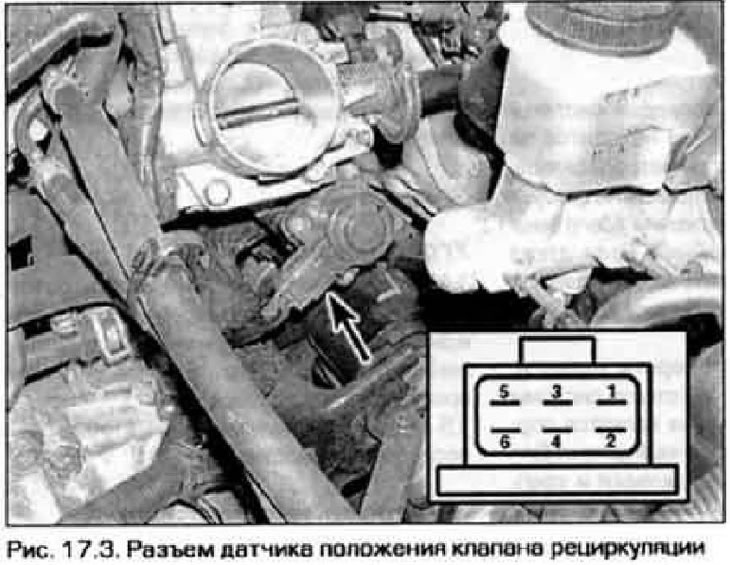
3. To check the EGR valve position sensor, disconnect the electrical connector from it and measure the resistance between contacts 1 and 3, 3 and 5, 2 and 4, 4 and 6 of the valve (figure 17.3). All resistance values should be approximately 22 ohms. If not, replace the sensor.
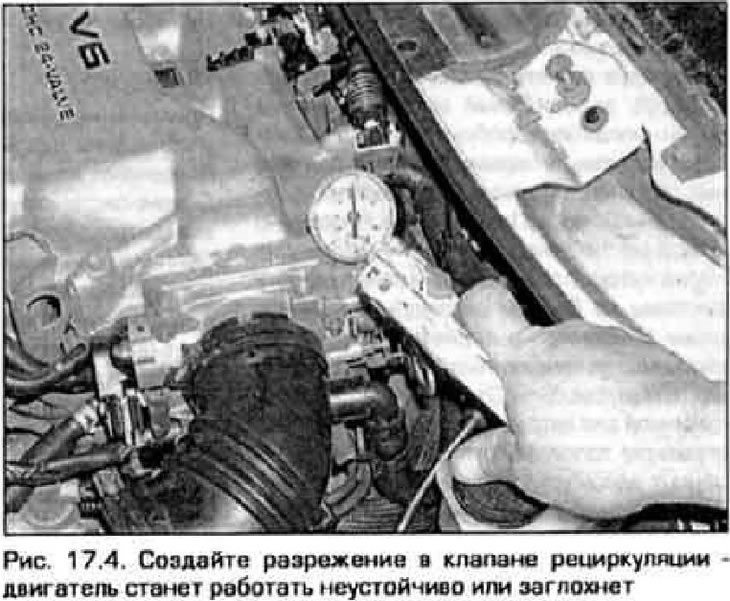
4. Warm up the engine to operating temperature. Disconnect the vacuum hose from the recirculation valve and connect a vacuum pump in its place (figure 17.4). With the engine idling, create a vacuum in the valve. The engine speed becomes unstable and the engine may stall. If no changes occur, then the valve is faulty and needs to be replaced.
5. Locate the recirculation control solenoid valve. Disconnect the vacuum hoses and electrical wiring from it. Connect the electromagnet directly to the battery. If you blow into one branch of the valve, the air should come out of the other branch (see Figure 15.7, b and 15.8). Turn off the power supply to the valve. Now, if you blow into the pipe closest to the solenoid, air should come out of the outlet at the end of the valve. It should be impossible to blow air through the pipe farthest from the magnet.
6. Further testing of the recirculation control system requires special equipment.
Replacing the recirculation valve
7. Disconnect the valve position sensor electrical connector.
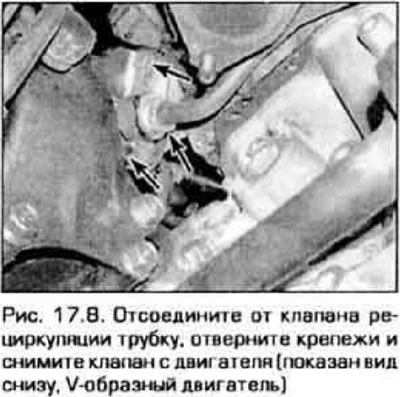
8. Disconnect the tube from the valve, unscrew the valve fastener and remove it from the engine (figure 17.8).
[The article is copied from the website: mazbook.ru]
9. Clean the mating surfaces of the valve and adapter.
10. Install the valve with a new gasket. Tighten the fasteners securely.
11. Connect the electrical connector to the valve.