


Note. The catalytic converter may have an extended warranty that is different from the vehicle warranty. Before changing the converter at your own expense, consult your dealer.
General information
1. The catalytic converter is part of the exhaust system and is designed to reduce the content of harmful components in the exhaust gases. There are two types of neutralizers. Conventional two-way neutralizer reduces carbon monoxide CO (carbon monoxide) and HC hydrocarbons by their oxidation in the presence of a catalyst. A three-component neutralizer, in addition to CO and HC, also reduces the content of nitrogen oxides NOx. The models described in this manual are equipped with a three-way converter.
Examination
2. Equipment for testing the converter is very expensive and difficult to handle. If you suspect that the converter is not working satisfactorily, have it checked or replaced by a specialized service station.
3. If the vehicle is raised to perform any underbody work, inspect the converter at the same time for leaks, corrosion, dents, or other damage. Check the flanges that secure the converter to the exhaust pipes. In the presence of significant damage, the neutralizer must be lured.
4. Gases inside the neutralizer flow through many thin capillaries that are easily clogged. You can check the exhaust system for blockage as follows:
- A) Connect a vacuum gauge to the intake manifold vacuum port.
- b) Warm up the engine to operating temperature, turn on the gearbox "neutral" (mechanical transmission) or "parking" (automatic transmission) and apply the parking brake.
- V) Read the vacuum gauge reading with the engine idling.
- G) Quickly open the throttle and close it again. Note the reading on the vacuum gauge.
- d) Repeat this test three more times, recording the gauge reading each time.
- e) If the vacuum after the fourth test has become less than at idle by at least 25 mm, then the exhaust system may be clogged (most likely - a converter, but it can be any other element of the exhaust system).
Replacement
5. Moisten the fasteners of the catalytic converter flanges to the exhaust system pipes with a liquid that penetrates into the threaded connections (pic. 20.5, a, b).
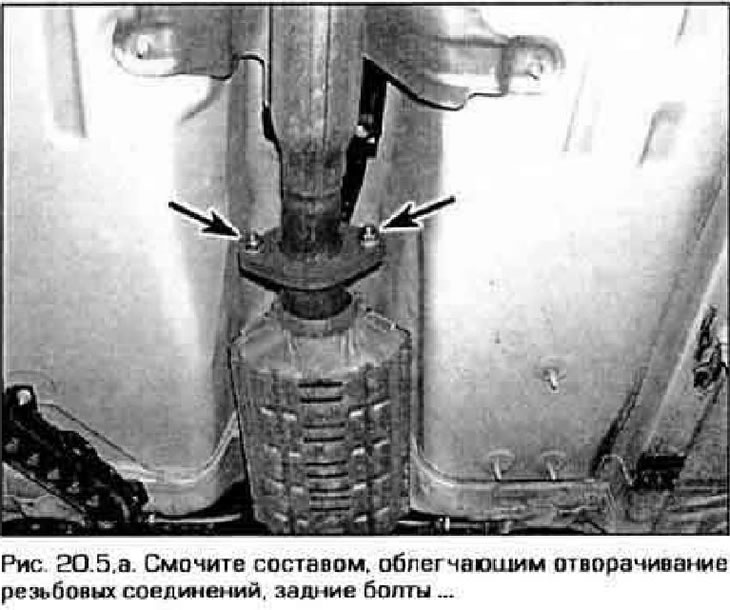
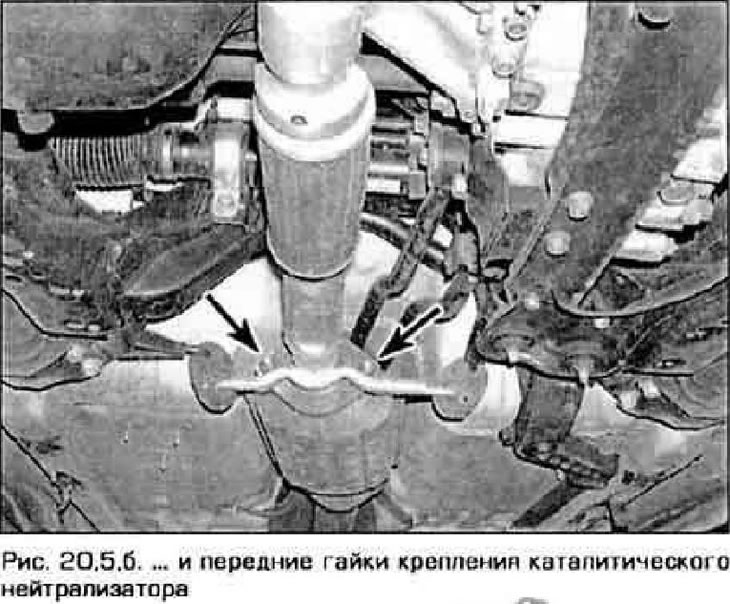
6. Turn away nuts of hairpins and remove converter.
7. Installation is carried out in reverse order.