


Examination
Attention! When performing checks with the engine off, keep hands, clothes, hair, etc. away from rotating parts.
1. Engine idle speed is controlled by the idle control valve. The idle air valve controls the amount of air that bypasses the throttle and enters the intake manifold. The valve is controlled by the BEU depending on the engine operating conditions (cold or hot engine, whether the air conditioner is on, what mode the power steering is in, etc.).
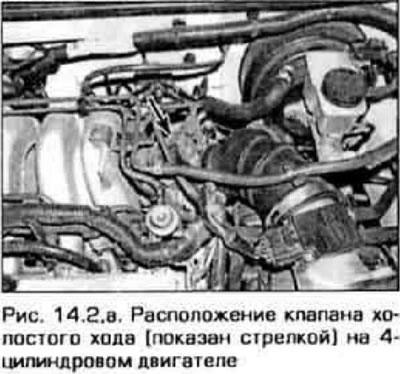
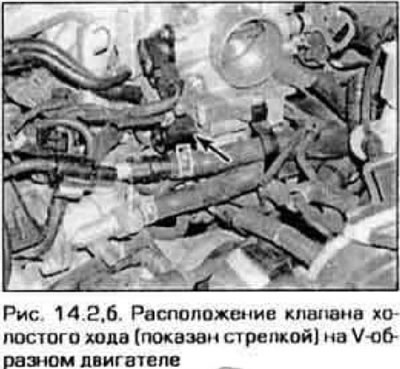
2. Apply the parking brake, put blocks under the wheels and turn on the gearbox "neutral" (mechanical transmission) or "parking" (automatic transmission). Connect a tachometer to the engine (using the manufacturer's instructions). Start the engine and keep it at 3000 rpm until the cooling fan turns on. Wait for the fan to turn off, reset the engine speed to idle and watch the tachometer. If the idle speed is within the specification, then the idle air valve is working properly. If the idle speed is below the required level, disconnect the electrical connector from the idle air valve (pic. 14.2,a,6). With the connector disconnected, the revolutions will start "swim". If it doesn't, then the idle air valve is probably defective.
 |  |
3. Measure the resistance between the valve contacts. It should be within 7.7-9.3 ohms (for 4-cylinder engine), 10.7-12.3 ohm (for V-engine produced from 1993 to 1997) or 9.7-10.5 ohm (for V-engine produced since 1998).
4. If the valve resistance is within the specified values, and the engine idles erratically, contact a specialist to check electrical purposes.
Replacement
5. Disconnect the electrical connector from the valve.
6. Remove the two screws and remove the valve from the throttle body.
7. Install the valve in reverse order. When installing, replace the valve seal.