


a) Jack up the front of the car.
b) Remove the wheels.
c) Check the thickness of the brake shoe linings.
- Minimum thickness - 2.0 mm
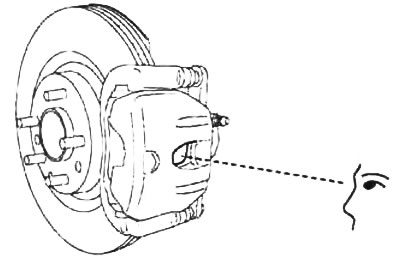
d) Replace the brake pads as a set (right and left side at the same time), if at least one of the pad linings has a minimum or lesser thickness.
2. Check the axial runout of the brake disc.
a) Secure the brake disc by tightening the wheel nuts.
b) Install the pointer indicator
c) Measure the axial runout of the disc at a distance of 10 mm from the outer edge of the disc.
- Maximum axial runout - 0.05 mm
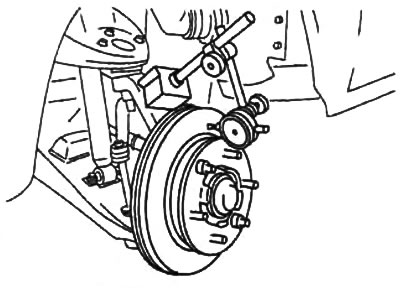
If the axial runout of the brake disc exceeds the established norm, grind or replace the brake disc.
3. Measure the thickness of the brake disc.
Brake disc thickness:
- Nominal - 28 mm
- Minimum allowable - 26 mm
- Minimum allowable after turning - 26.8 mm
If the brake disc thickness is less than the minimum allowable, replace the brake disc.
4. Check the uniformity of brake disc wear.
a) Clean the surface of the brake disc that contacts the brake pads.
b) Using a micrometer, measure the depth of the recesses shown in the figure.
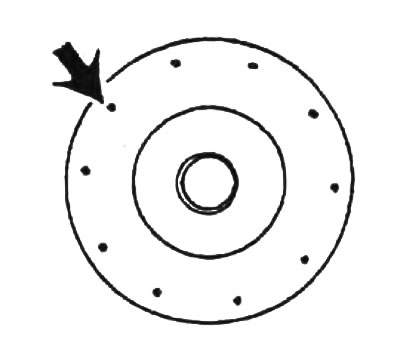
c) Subtract the minimum measured value from the maximum.
- Maximum measurement difference is 0.015 mm
If the difference in measurements exceeds the established norm, grind the brake disc.
[Original material on the website: MAZBOOK.ru]
Caution: When turning the disc, do not allow its thickness to become less than the minimum permissible value.
Note: turning the disc while removing it from the vehicle may result in axial runout significantly exceeding the permissible value. Carry out turning the brake disc without removing it from the vehicle.