


Contents: Without using devices ⇓ Using instruments ⇓
Without using devices
Note: If the brake booster is found to be not operating properly, replace the brake booster assembly.
Step 1
1. With the engine not running, press the brake pedal several times.
2. With the pedal depressed, start the engine.
3. If the pedal drops down a little immediately after starting the engine, the brake booster is working properly.
Step 2
1. Start the engine.
2. After 1-2 minutes of operation, turn off the engine.
3. Press the brake pedal several times with normal force.
4. If the pedal stroke is long when first pressed, but becomes shorter with subsequent presses, no faults in the vacuum booster have been detected.
Note: If any faults are found, check the vacuum hose or check valve and check their installation. If faults are found, repair them and recheck the brake booster operation.
Step 3
1. Start the engine.
2. Press the brake pedal with normal force.
3. Keeping the pedal depressed, turn off the engine.
4. Keep the pedal depressed for approximately 30 seconds.
5. If the pedal height has not changed, no faults in the vacuum booster have been detected.
Using instruments
1. Connect the pressure gauges, install the vacuum gauge and the brake pedal force measuring device as shown in the figure.
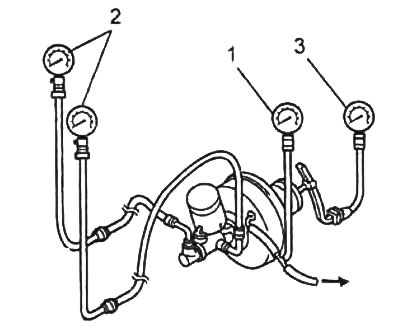
1 - vacuum gauge,
2 - pressure gauge,
3 - device for measuring the force on the brake pedal.
Note:
- Use standard diagnostic gauges to check brake fluid pressure and a standard force gauge.
- Remove air from the installed fixture and pressure gauges.
2. After bleeding the assembled system, perform the following checks:
a) Checking the reduction in vacuum.
When the brake pedal is not pressed:
1. Start the engine.
2. Stop the engine when the vacuum gauge shows a vacuum of 66.7 kPa.
3. Observe the pressure gauge readings for at least 15 seconds; if the vacuum is in the range of 64–66 kPa, no malfunction of the vacuum booster has been detected.
With the brake pedal depressed:
1. Start the engine.
2. Press the brake pedal with a force of 200 N.
3. Keeping the pedal depressed, turn off the engine when the vacuum gauge shows a vacuum of 67 kPa.
4. Observe the pressure gauge readings for at least 15 seconds; if the vacuum is in the range of 64–66 kPa, no malfunction of the vacuum booster has been detected.
b) Checking the brake fluid pressure developed by the master brake cylinder.
1. With the engine off (complete absence of vacuum) press the brake pedal with a force of 200 N. If the brake fluid pressure corresponds to the nominal value, no malfunction of the vacuum booster is detected.
- Brake fluid pressure (in the absence of vacuum) — not less than 593 kPa
2. Start the engine. When the vacuum gauge shows 67 kPa (500 mmHg.), press the brake pedal. If the brake fluid pressure is within the nominal value, no fault with the vacuum booster is detected.
- Brake fluid pressure (at a vacuum of 67 kPa) — not less than 6950 kPa