


Contents: Removal ⇓ Installation ⇓
Note: To remove the right-hand drive shaft on Ford Fiesta and Mazda 121 models, the left-hand drive shaft must first be removed.
On Ford KA models, the right drive shaft is removed in the same way as the left one. If the balancing weight is removed, the distance to the end of the drive shaft must be measured and recorded. Then the weight must be installed in the same position.
When only the covers need to be replaced, the drive shafts do not need to be removed completely.
Removal
Loosen the upper shock absorber strut nuts five turns.
Note: Nuts do not need to be replaced.
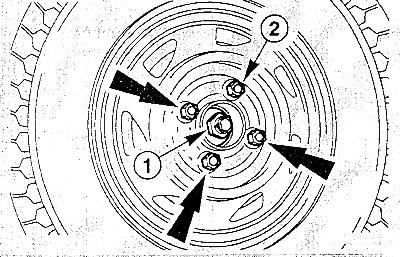
Bend back the tongue of the axle nut retainer (1) using a rod.
Loosen the axle nut with a 32 mm open-end wrench. If necessary, have an assistant hold the brake pedal down to prevent the front wheels from turning.
Precautions: When unscrewing the axle nut, the car must be on the ground, because the nut is tightened very tightly.
Mark the position of the front wheels on the hubs so that you can then install the balanced wheels in the same positions. Loosen the wheel nuts with the car on the ground. Support the car from the front and remove the front wheels.
If present, remove the lower engine compartment cover.
Disconnect the wishbone from the steering knuckle.
Disconnect the steering rods from the steering knuckles.
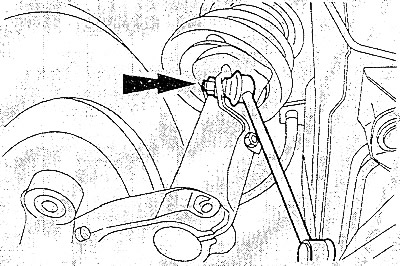
Loosen the nuts and remove the anti-roll bar connecting rods from the shock absorber struts.
Unscrew the axle nut and remove it together with the washer from the end of the drive shaft.
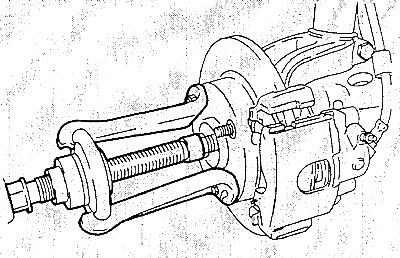
Remove the drive shaft from the wheel hub using a suitable puller.
Pull the steering knuckle outward and remove the drive shaft from the steering knuckle. To avoid impermissible load on the inner CV joint, hang the drive shaft on a wire. The maximum permissible angle of inclination of the CV joint on the gearbox side is 18°; the outer CV joint has a stop, but the drive shaft is not pressed with force against the stop.
Place a container to collect the oil under the inner CV joint and gearbox.
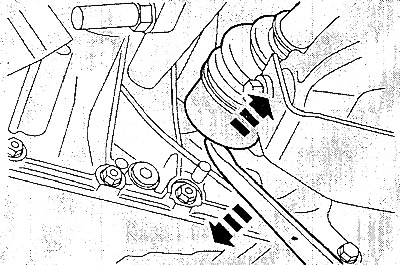
Press the left drive shaft out of the gearbox.
To do this, insert a large pry bar between the CV joint and the gearbox housing. Turn the pry bar and push out the CV joint.
Caution: When doing this, use wooden shims to avoid damaging the gearbox. Do not pull on the drive shaft!
Caution: When pulling out the shaft, oil will leak from the gearbox. Close the hole in the gearbox with a suitable plug.
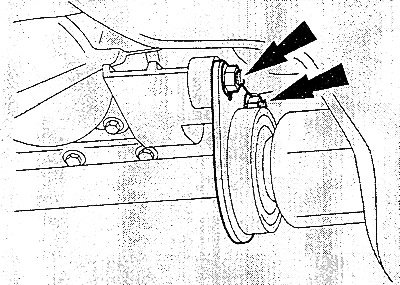
Unscrew the nuts and remove the intermediate shaft bearing from the front axle beam.
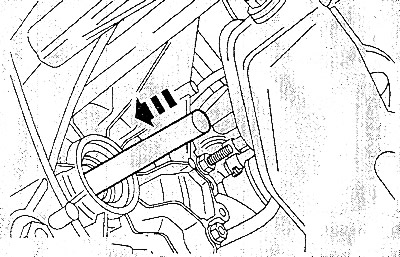
Knock out the right drive shaft from the gearbox from the opposite side using a suitable soft metal rod. Leave the rod in the gearbox until the right drive shaft is installed.
Close the hole with a suitable plug.
Installation
Before installation, check the wear of the drive shaft seal in the gearbox housing.
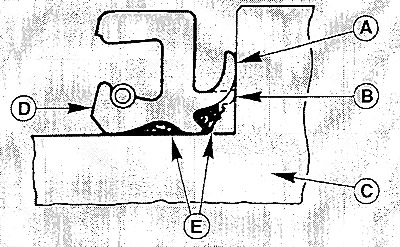
A. Sealing lip of the new oil seal; B. Sealing lip of worn oil seal; C. Wheel hub or drive shaft; D. Omentum; E. Lubrication.
Remove the worn seal with a screwdriver without damaging the gearbox housing.
Caution: If the seal is damaged or worn, check the rollers and bearing rings for damage and replace if necessary.
Lubricate the new seal as shown in the figure and push it in evenly with a suitable tube.
Replace all retaining rings, self-locking nuts and cotter pins. When installing drive shafts, pay attention to the correct fixation of the retaining ring.
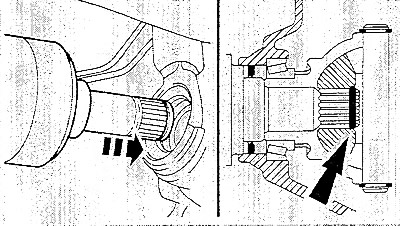
Insert the right drive shaft with the new circlip into the gearbox and secure it with strong pressure. Check by lightly pressing and pulling whether the shaft is secured.
Install the intermediate shaft bearing and tighten the mounting nuts to a torque of 25 Nm.
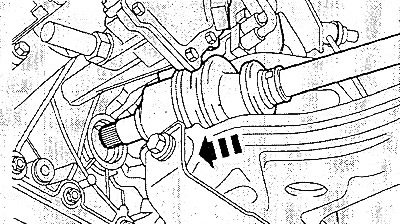
Insert the left drive shaft into the gearbox and secure it.
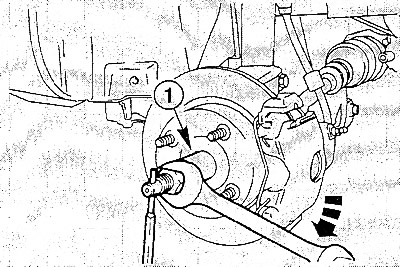
Pull the steering knuckle outward and insert the drive shaft into the wheel bearing by hand. Insert the washer, screw in the old axle nut and tighten the nut to pull the wheel hub onto the end of the drive shaft. Do not tighten the axle nut. Finally, unscrew the nut and replace it with a new one.
Note: If the nut does not fit, pull the hub onto the shaft until it stops using a special device. At the same time, turn the wheel hub so that the wheel bearing fits into place evenly.
Tighten the new axle nut and washer by hand until they fit against the hub, but do not tighten yet.
Install the stabilizer connecting rods onto the shock absorber struts and tighten the nuts to a torque of 50 Nm.
Install the wishbone onto the steering knuckle.
Install the tie rod end onto the steering knuckle
If removed, install the lower engine compartment cover.
Install the front wheels according to the marks made earlier. Before doing this, lightly lubricate the centering hole on the wheel disk with consistent grease. Do not lubricate the threads of the wheel studs. Tighten the wheel nuts. Lower the car and tighten the wheel nuts crosswise to a torque of 90 Nm.
Tighten the axle nut to 270 Nm and secure it.
Tighten the upper shock absorber strut mounting nuts to a torque of 90 Nm.
Check the freedom of movement of the brake hoses and sensor wires for the anti-lock system. To do this, an assistant should turn the front wheels to the right and left as far as they will go.
Check the gearbox oil level and top up if necessary.