
MazBook.ru
English Русский
Български
Беларускі
Український
Српски
Hrvatski
Română
Polski
Slovenský
Magyar
• Bookmark • Sitemap • Contacts •   
Cars Opel Cars Ford Cars Volkswagen Cars Audi Cars Kia Cars Renault Cars Peugeot


Familia Capella Mazda3 Mazda6 CX-? Others Articles
Capella 3 (1982-1992, petrol) Capella 3 and 4 (1982-1992) Capella 4 (1987-1992) Capella 5 (1991-1997) Capella 6 (1997-2005, petrol)

Steering system — general description (Mazda Capella GC)

  • Home
  • Mazda Capella
  • Capella GC (1982-1992)
  • Chassis
  • Steering
  • Steering system — general description
0
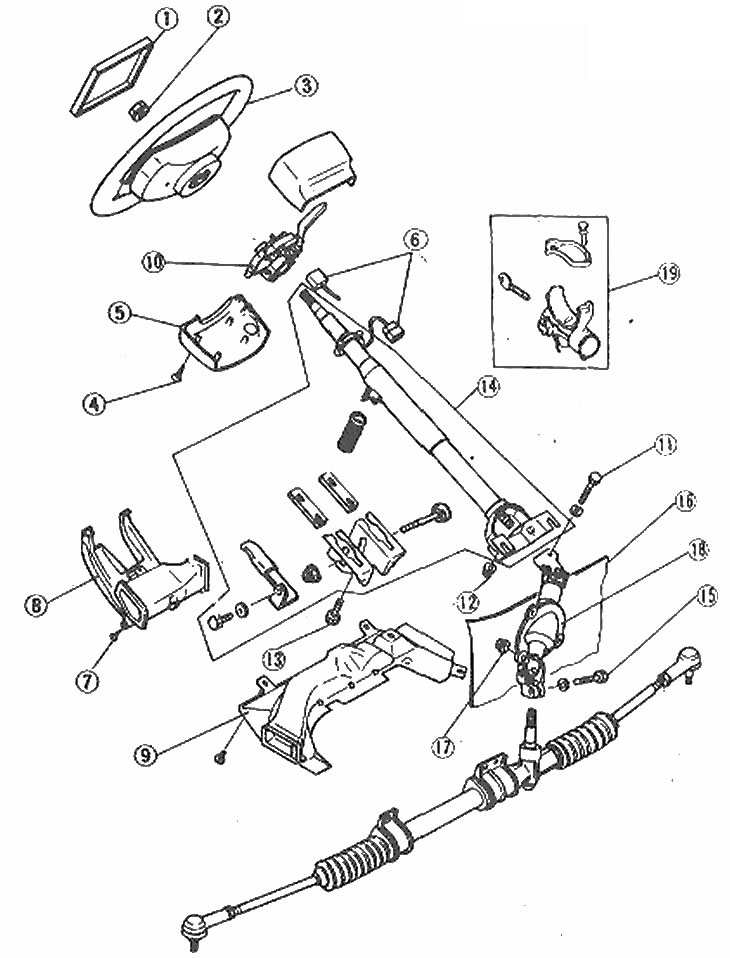
Location of steering components

Location of steering components

1. Horn cover; 2. Locknuts; 3. Steering wheel; 4. Screws; 5. Steering column covers; 6. Harness connections; 7. Screws; 8. Bottom panel; 9. Air duct; 10. Combination switch; 11. Bolt; 12. Nuts; 13. Bolts; 14. Steering shaft and steering column lock assembly; 15. Bolt; 16. Cabin insulator; 17. Nuts; 18. Intermediate howl; 19. Steering column lock


All models are equipped with rack and pinion steering. The components that make up this system are the steering wheel, steering column, intermediate shaft, rack and pinion assembly, tie rods and steering knuckles. In addition, the power steering system also uses a belt-driven pump to provide hydraulic pressure.

In a manual system, the rotational motion of the steering wheel is transmitted through the steering column and intermediate shaft to the output shaft in the rack and pinion assembly. The teeth on the output shaft are locked with the teeth on the rack, so as the shaft rotates, the rack moves left or right in the rack and pinion housing. Attached to each end of the rack are connecting rods, which in turn are attached to the steering knuckles on the front wheels. This movement of the rack left and right is the direct force that turns the wheels.


A power steering system operates essentially the same as a manual system, except that the power rack and pinion system uses hydraulic pressure to increase the direct force acting on the steering wheel. A rotary control valve in the rack and pinion assembly directs hydraulic fluid from the power steering pump to either side of the rack piston assembly, which is attached to the rack. Depending on which side of the piston this hydraulic pressure is applied to, the rack will move either left or right, moving the connecting rods, etc.

If the power steering system loses hydraulic pressure, it will still function manually, although with some increased effort.

The steering column is a collapsible, energy-absorbing type, designed to compress the front end in the event of a collision to minimize damage to the driver. The steering column also houses the ignition switch, key, warning buzzer, turn signal control unit, headlight switch control and windshield wiper control. The ignition and steering wheel can be locked while the vehicle is parked to prevent theft.

Due to the split type of steering column, it is important that only the specified screws, bolts and nuts are used as designated and that they are tightened to the specified torque Specification. Other precautions relating to this project are noted in the relevant Chapters.

In addition to the standard steering column, an optional tilt steering column is also available.

Because steering column disassembly is performed more often to rebuild a switch or other electrical component than to repair the steering, some steering column disassembly and repair procedures are included in Section 12.
This article is available at: russian, bulgarian, belarusian, ukrainian, serbian, croatian, romanian, polish, slovak, hungarian
This text was checked by: Evdokia Filimonova
Share with friends on social networks:

Previous
Capella 3 » Steering
Next

Steering specifications
Steering wheel — removal and installation
Steering column — removal and installation
Steering knuckle and hub — removal and installation
End of connecting rod — removal and installation
Rack and pinion boot seals — replacement
More articles on repairing other Mazda models
Detailed technical specifications of the steering system Mazda Familia 5 (1985-1989)
Power steering — general information Mazda3 BK (2003-2009)
Lubrication system — general information Mazda6 GG (2002-2008)
Intake system — general description Mazda CX-5KE (2012-2017)
General information about the exhaust system Mazda 121 (3) (1996-2003)
Link in different formats to this article
Comments and feedback from visitors
No comments yet


How much will 18 + 48 ?


Capella 6 (1997-2005, petrol) 
  • General information
  • Introduction to guide
  • User manual
  • Troubleshooting
  • Maintenance
  • Power unit
  • 4-cylinder engines
  • 6-cylinder engines
  • Engine overhaul
  • Cooling and ventilation
  • Power and exhaust systems
  • Engine electrics
  • Control system
  • Transmission
  • Mechanical gearbox
  • Automatic gearbox
  • Clutch and drive shafts
  • Chassis
  • Brake system
  • Car suspension
  • Steering
  • Body
  • Exterior (external elements)
  • Interior (internal elements)
  • Doors, windows and locks
  • Electrical equipment
  • Equipment and devices
  • Electrical circuits
Capella 5 (1991-1997) 
  • General information
  • User manual
  • Maintenance
  • Helpful hints
  • Power unit
  • Petrol engines 1.6 and 1.8
  • Petrol engines 2.0
  • 2.5 petrol engines
  • Overhaul engines 1.6 and 1.8
  • Overhaul engines 2.0 and 2.5
  • Diesel engine 2.0
  • Engine electrics
  • Cooling system
  • Air conditioner
  • Carburetor Nikki 30/34
  • Power system (1.6 and 1.8)
  • Power system (2.0 and 2.5)
  • Control system
  • Transmission
  • Mechanical gearbox
  • Automatic gearbox
  • Clutch and axles
  • Chassis
  • Brake system
  • Suspension and wheels
  • Steering
  • Body
  • Exterior (external elements)
  • Interior (internal elements)
  • Doors and windows
  • Electrical equipment
  • Equipment and devices
  • Electrical circuits
Capella 4 (1987-1992) 
  • General information
  • Introduction to manual
  • Vehicle specifications
  • Power unit
  • Engine repair
  • Lubrication system
  • Cooling system
  • Fuel system (carburetor)
  • Fuel injection (FE)
  • Fuel injection (DOHC)
  • Fuel system (diesel)
  • Ignition system
  • Transmission
  • Clutch
  • Gearbox
  • Drive shafts
  • Chassis
  • Front suspension
  • Rear suspension
  • Steering system
  • Brake system
  • Electrical equipment
  • Equipment and devices
  • Electrical circuits
Capella 3 and 4 (1982-1992) 
  • General information
  • User manual
  • Maintenance
  • Power unit
  • Gasoline engine
  • Engine overhaul (gasoline)
  • Diesel engine
  • Cooling and heating
  • Supply system
  • Ignition system
  • Emission reduction
  • Transmission
  • Clutch
  • Mechanical gearbox
  • Automatic gearbox
  • Drive shafts
  • Chassis
  • Brake system
  • Suspension and wheels
  • Steering
  • Body
  • Exterior (external elements)
  • Interior (internal elements)
  • Electrical equipment
  • Equipment and devices
  • Power devices
  • Electrical circuits
Capella 3 (1982-1992, petrol) 
  • General information
  • User manual
  • Maintenance
  • Troubleshooting
  • Late models
  • Power unit
  • Engine in car
  • Engine overhaul
  • Cooling and heating system
  • Fuel and exhaust system
  • Engine electrical system
  • Emission control system
  • Transmission
  • Mechanical gearbox
  • Automatic gearbox
  • Clutch and drive shafts
  • Chassis
  • Brake system
  • Suspension and wheels
  • Steering
  • Body
  • Exterior (external elements)
  • Interior (internal elements)
  • Electrical equipment
  • Equipment and devices
  • Lighting and lamps
  • Electrical circuits
MazBook.ru © 2018–2026 · Mobile version · Articles and news · Sitemap: EN BG BY UA RS HR RO PL SK HU · Feedback · Site search · Add to bookmarks Familia 5 (BF) · Familia 6 (BG) · Capella 3 (GC) · Capella 3 and 4 (GC) · Capella 4 (GD) · Capella 5 (GE) · Capella 6 (GF) · Mazda3 BK · Mazda6 GG · CX-5KE · Mazda 121 (3) · Mazda BT-50 (1) ·
By continuing to use the site, you agree to the use of cookies 🔐