


2. The vehicle owner can remove and disassemble the head, do an initial cleaning and inspection, then reassemble and submit the head to a service station or automotive repair shop.
3. The service department or automotive mechanic shop will remove the valves and springs, repair or replace the valves and valve seats, repair the valve guides, measure and replace the valve springs, spring retainers, replace the valve stem seals with new ones, reassemble the valve components and adjust the clearances. The cylinder head gasket surface will also be deformed if it is distorted.
4. After completing the work, the head is ready for installation in the car. Before installing it on the engine, re-inspect it and clean it to remove any metal particles that may still be present. Blow out all lubrication holes and passages with compressed air.
Lapping valves
5. If the valves and seats are slightly distorted, or if new valves are installed on guides and seats in good condition, the valves must be ground to their seats as follows.
6. Place a small amount of coarse paste on the valve head seal area. Insert the valve into the guide and rotate the head in the seat with a back-and-forth motion. A power drill can be used for this purpose. Periodically lift the valve from the seat to check the progress of the process and the presence of paste.
7. If the paste is distributed evenly over the entire surface of the valve head and seat, wipe off the crust and repeat the procedure with a fine-grained paste.
8. Once all the valves have been ground into their seats, thoroughly clean off all traces of the paste using kerosene, a rag and compressed air. Paste residue on the cylinder head can cause rapid wear.
9. It should also be noted that excessive grinding of old valves can reduce the valve head edge to an unacceptable limit (see Chapter 8).
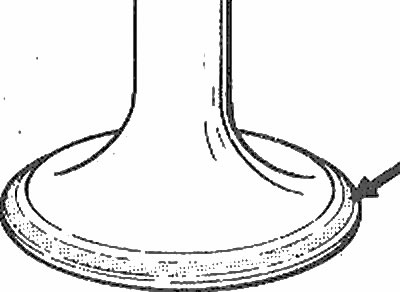
The edge width (arrow) on each valve must comply with Specifications. Otherwise, the valve must be replaced (Chapter 8)