


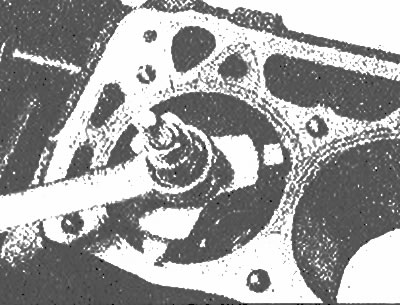
Use a special tool to remove the ridge formed by wear at the top of each cylinder before removing the pistons
2. Before removing the connecting rods, check their play. Set the micrometer so that its rod is parallel to the crankshaft axis and touches the side surface of connecting rod cap No. 1.
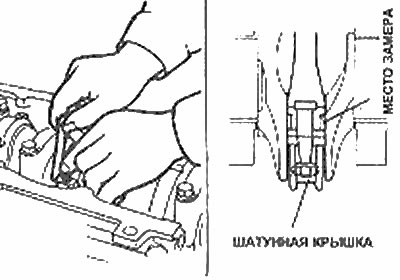
Checking connecting rod play
3. Pull the connecting rod back as far as possible and set the micrometer to zero. Then, move the connecting rod forward as far as it will go and record the micrometer reading - this is the amount of play. If the clearance exceeds the permissible wear limit, the connecting rod must be replaced. Repeat the procedure on the remaining connecting rods.
4. Alternative method: Insert a feeler gauge between the connecting rod and the crankshaft side surface, selecting a gauge thick enough to eliminate any play in the connecting rod (photo). The play is equal to the thickness of the feeler gauge.
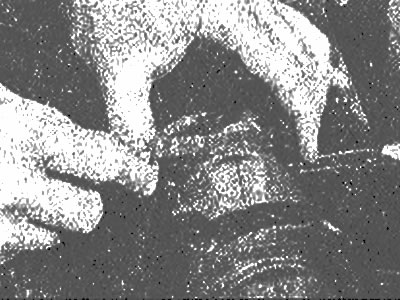
Insert a feeler gauge between the connecting rod and the side surface of the crankshaft to measure the clearance
5. Check that the connecting rods and their caps are numbered. If not, mark each connecting rod and cap with a small punch, making the number of indentations corresponding to the cylinder number in which the connecting rod is installed (photo).
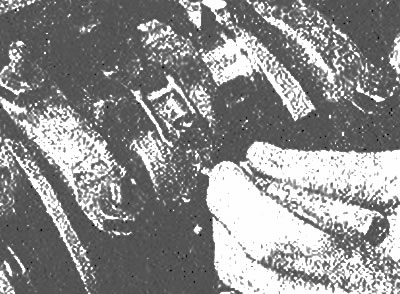
Use a punch to mark the cranks before removing them |
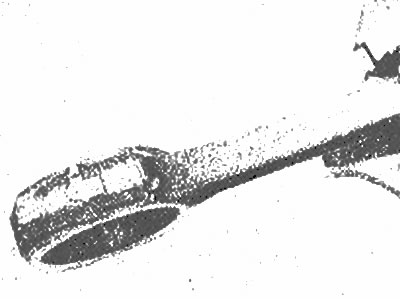
The number of punched holes must correspond to the number of the cylinder in which the connecting rod is installed, and marks must be made both on the connecting rod itself and on its cover to ensure their correct installation |
The article is reprinted from the portal: mazbook.ru
6. Loosen each connecting rod union nut by half a turn. Remove connecting rod cap No. 1 and bearing shell. Do not allow the bearing shell to fall out of the cover. Place a short piece of plastic or rubber tubing over each connecting rod cap bolt to protect the crankshaft journal (photo) and push the connecting rod piston assembly out the top of the cylinder. Use a suitable wooden block to rest against the upper bearing shell in the connecting rod. If resistance is felt, recheck to ensure that all the lip formed in the cylinder by wear has been ground down.
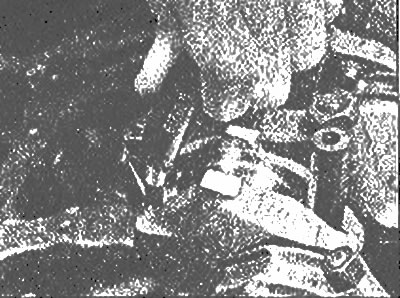
Hold the crankshaft and cylinder walls so that the bolt threads do not scratch the piston rod before removing the rods
7. Repeat the procedure for the remaining cylinders. Once removed, reassemble the connecting rod caps and bearing shells into their respective connecting rods and hand tighten the nuts. Leaving the old bearing shells in place until assembly will help protect the connecting rod bearing surfaces from accidental nicks or gouges.