


- reliability of fastening of power wires to the battery terminals (make sure they are clean and securely fastened);
- density of electrolyte in a battery (if the density is low, charge the battery);
- generator wiring and the reliability of its fastening;
- condition and tension of the generator drive belt;
- tightening the generator mounting bolt;
- noises heard from the generator after starting the engine.
With the ignition off, check the voltage at the battery terminals with a voltmeter by connecting it to the "B" terminal of the generator. The voltage should be about 12 V.
Caution! When checking the generator, do not connect the "L" terminal to ground while the engine is running, or start the engine with the wires disconnected from the "L" and "R" terminals.
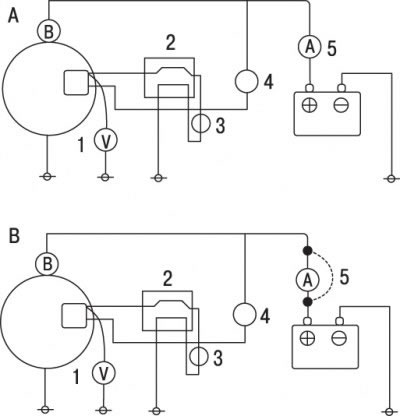
Figure 13.4. Electrical diagrams for testing the generator (A) and voltage regulator (B): 1 – voltmeter; 2 – relay for switching on the battery charging indicator lamp; 3 – battery charging indicator lamp; 4 – ignition switch; 5 – ammeter
To check the charging system, assemble the circuit according to the figure 13.4. With the ignition off, check the voltage between the ground and the L terminal of the generator. If the voltmeter does not show voltage, then the generator is faulty. Turn the ignition switch key to the "ON" position and check the voltage. If the voltmeter does not show voltage, then the generator or wires are faulty. If the voltage is close to battery voltage (12V), connect the "F" terminal to the rear bracket of the generator and check the voltage. If the voltage shown by the voltmeter is less than 12 V, the voltage regulator is faulty. To check the regulator voltage without load, make sure the battery is fully charged, connect the ammeter and voltmeter according to the diagram in the figure 13.4. When the ignition is off, the voltage shown by the voltmeter should be zero.
Turn on the ignition, and the voltmeter reading should be 1–3 V lower than the voltage at the battery terminals. If the voltmeter reading is equal to the voltage at the battery terminals, then the generator is faulty. Short-circuit the ammeter terminals with a jumper, start the engine and remove the jumper.
Caution! Before starting the engine, make sure the ammeter is not connected to the starter power supply circuit.
Increase the engine speed to 2500 min⁻¹ and read the ammeter and voltmeter readings. The current shown by the ammeter should be 5 A, the voltage – (14.7±0.3) V (at a temperature of 20°C).
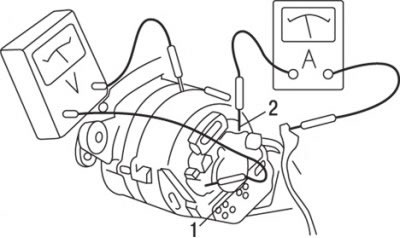
Figure 13.5. Electrical circuit for checking the voltage and current generated by the generator: 1 – terminal "L"; 2 – terminal "B"
To check the current and voltage produced by the generator, disconnect the wire from the negative terminal of the battery and connect an ammeter and voltmeter in accordance with the diagram shown in the figure 13.5.
Connect the cable to the negative terminal of the battery, start the engine and turn on the headlights. Gradually increase the engine speed and monitor the voltmeter readings. The charging system is functioning properly if the voltage is higher than the battery voltage and the ammeter shows current flowing.