


Control and measuring equipment
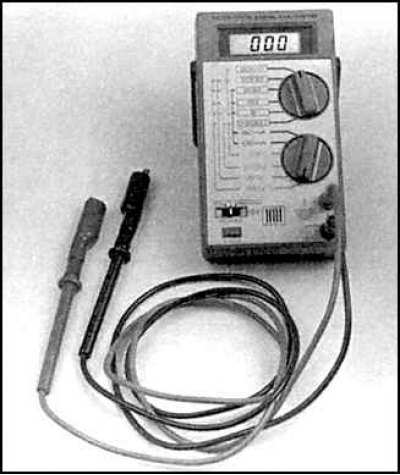
To test fuel injection systems and reduce exhaust toxicity, it is necessary to use digital universal instrumentation, as they have greater measurement accuracy and greater internal loop resistance.
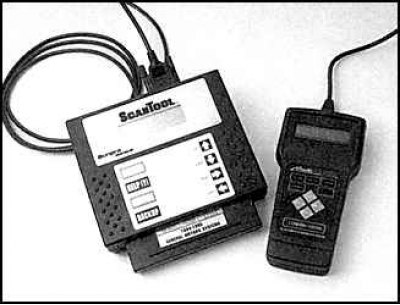
Hand-held scanners are the most convenient and versatile devices for checking engine control systems on later model years.
OBD-I systems (models up to 1995 release)
The electronic control unit has a built-in self-diagnosis system (On Board Diagnosis (OBD) system), which serves to troubleshoot the system and turns on the engine warning light on the instrument panel in case of malfunctions. The fault code is stored in the memory of the electronic control unit and is available for reading.
Reading trouble codes for OBD-I systems
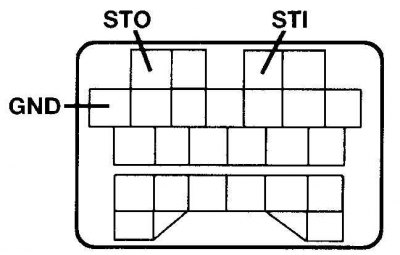
To read the fault codes recorded in the memory of the electronic control unit, connect the STI and GND terminals of the diagnostic connector.
Connect a voltmeter to the STO terminal and "mass" car. Turn on the ignition and count the number of gauge deflection or engine warning light flashes. For example, code 34 will be displayed as 3 long flashes of the light, a pause, 4 short flashes.
Clearing OBD-I Trouble Codes
To clear the DTCs, disconnect the negative battery cable and depress the brake pedal for more than 5 seconds.
Fault codes for OBD-I systems (1993-1995 models, except 1994 and 1995 models with 4-cylinder engine and automatic transmission)
| Fault code | Faulty element or system |
| 02 | crankshaft position sensor |
| 03 | Camshaft position sensor |
| 08 | Air flow sensor |
| 09 | coolant temperature sensor |
| 11 | Air temperature sensor |
| 12 | Throttle position sensor |
| 15 | Oxygen sensor |
| 16 | EGR valve sensor |
| 17 | Oxygen sensor (check the power supply and ignition system) |
| 25 | Fuel pressure valve |
| 26 | Purge valve |
| 28 | Exhaust gas recirculation valve |
| 29 | Exhaust Gas Recirculation Vent Valve |
| 34 | Idle air valve |
| 67 | Cooling Fan Relay |
Fault codes for OBD-I systems (1994 and 1995 models with 4-cylinder engine and automatic transmission)
| Fault code | Faulty element or system |
| 111 | No fault codes |
| 112, 113 | Air temperature sensor |
| 116, 117, 118 | coolant temperature sensor |
| 121, 122, 123 | Throttle position sensor |
| 157, 158, 159 | Air flow sensor |
| 172, 173, 179, 181 | Oxygen sensor |
| 211, 212, 213 | Ignition system |
| 214, 244 | Camshaft position sensor |
| 327, 332, 337 | Exhaust gas recirculation sensor |
| 411, 412 | Idle air valve |
| 452 | Speed sensor |
| 511, 512, 513 | Central control unit |
| 519, 521 | Power steering switch |
| 522 | Automatic transmission sensor |
| 536 | Stoplight switch |
| 538 | Dynamic test |
| 539 | Air conditioning sensor |
| 554 | Pressure control valve |
| 559 | A/C relay |
| 563 | Relay (high speed) cooling fan |
| 564 | Relay (low speed) cooling fan |
| 565 | Purge valve |
| 571 | Exhaust Gas Recirculation Ventilation Valve |
| 572 | Exhaust Gas Recirculation Vacuum Valve |
| 998 | Central control unit |
OBD II systems (models from 1996 release)
Diagnostic connector for connecting the OBD-II system
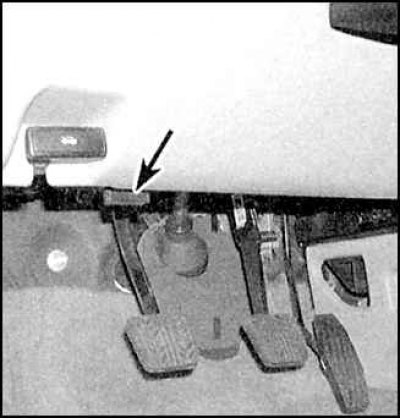
The connector is located under the instrument panel on the driver's side.
Models since 1996 have a second-generation OBD-II self-diagnosis system. Access to the electronic control unit of this system can only be obtained using a special scanner, which must be connected to the 16-pin diagnostic connector located under the instrument panel. When a malfunction is detected, the electronic control unit turns on the warning light on the instrument panel and stores the malfunction code in memory.
Reading OBD-II System Trouble Codes
To read the trouble codes of the OBD-II system, use a special scanner that must be connected to the diagnostic connection connector. If there is no scanner, you need to contact specialists.
Clearing OBD-II Trouble Codes
To clear OBD-II system trouble codes, you must use a special scanner.
OBD-II System Trouble Codes
| Fault code | Faulty element or system |
| P0100, P0102, P0103 | Air flow sensor |
| P0110, P0112, P0113 | Air temperature sensor |
| P0115, P0117, P0118 | coolant temperature sensor |
| P0120, P0122, P0123 | Throttle position sensor |
| P0125 | It takes too long to switch to closed mode |
| P0130, P0131, P0150 | Oxygen sensor |
| P0133, P0134, P0140 | Slow oxygen sensor response |
| P0154, P0160 | Slow oxygen sensor response |
| P0135, P0141, P0155 | Oxygen sensor heating element |
| P0170, P0171 | Lean fuel mixture |
| P0172, P0173 | Oversaturated fuel mixture |
| P0230, P0231, P0232 | Fuel pump |
| P0300 | Random misfire |
| P0301 | Misfire in cylinder N1 |
| P0302 | Misfire in cylinder N2 |
| P0303 | Misfire in cylinder N3 |
| Р0304 | Misfire in cylinder N4 |
| P0305 | Cylinder misfire N5 |
| P0306 | Cylinder misfire N6 |
| P0320 | Ignition system |
| P0335 | crankshaft position sensor |
| P0340 | Camshaft position sensor |
| P0400 | Clogged exhaust gas recirculation system |
| P0420, P0430 | catalytic converter |
| P0440 | Fuel vapor collection system |
| P0443 | Purge valve |
| P0500, P0503 | Speed sensor |
| P0505 | Idle air valve |
| P0510 | Idle system switch |
| P0552, P0553 | Power steering switch |
| Р0603 | RAM error |
| Р0605 | ROM error |
| P0703 | Stoplight switch |
| P0704 | Clutch pedal switch |
| P0705 | Gearbox sensor |
| Р0710-Р0760 | Gearbox control system |