


Connect a compression tester to the spark plug hole of cylinder N1.
Compression pressure gauge
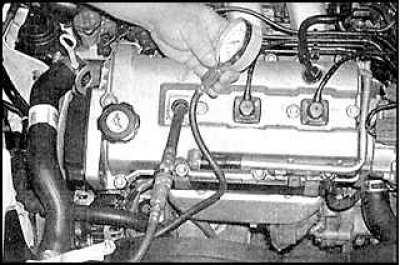
The gauge hose is connected to the adapter, and the adapter is screwed into the spark plug hole.
Open the throttle valve fully and crank the engine crankshaft with the starter. After one or two revolutions, the compression pressure should rise to the maximum mark and then stabilize. Write down the result obtained.
[The full text is on the website: MAZbook.ru]
Carry out a similar check with the remaining cylinders and record the readings obtained.
The pressure in all cylinders should be the same. A difference of more than 2 bar between any two cylinders indicates a malfunction. In a healthy engine, pressure should build up quickly. Low pressure in the first stroke, gradually increasing in subsequent strokes, indicates that the piston rings are worn out. Low first stroke pressure that does not increase with subsequent strokes indicates a valve leak or a blown head gasket. Deposits on the bottom of the valves can also cause low compression.
If you have any doubts during the inspection, please contact experienced specialists.
If the pressure in any cylinder is too low, perform the following check to determine the cause. Pour a teaspoon of clean motor oil into the cylinder through the spark plug hole and repeat the pressure check.
If the compression pressure increases after adding oil, this means that the piston or cylinder is worn out. If the pressure does not increase, then the cause is worn or burnt valves or a blown cylinder head gasket.
Low pressure in two adjacent cylinders almost always means that the head gasket between them is blown.
If one of the cylinders is approximately 20% lower in pressure than the others and the engine is not idling properly, this means that the cause may be a worn camshaft cam.
If the pressure is too high, then most likely the combustion chamber walls are covered with carbon deposits.
Once the check is complete, screw the spark plugs back into place and connect the ignition system.