MazBook.ru
English Русский
Български
Беларускі
Український
Српски
Hrvatski
Română
Polski
Slovenský
Magyar
• Bookmark • Sitemap • Contacts •   
Cars Opel Cars Ford Cars Volkswagen Cars Audi Cars Kia Cars Renault Cars Peugeot


Familia Capella Mazda3 Mazda6 CX-? Others Articles
Capella 3 (1982-1992, petrol) Capella 3 and 4 (1982-1992) Capella 4 (1987-1992) Capella 5 (1991-1997) Capella 6 (1997-2005, petrol)

Basic information about suspension and steering (Mazda Capella GF)

  • Home
  • Mazda Capella
  • Capella GF (1997-2005)
  • Chassis
  • Car suspension
  • Basic information about suspension and steering
0
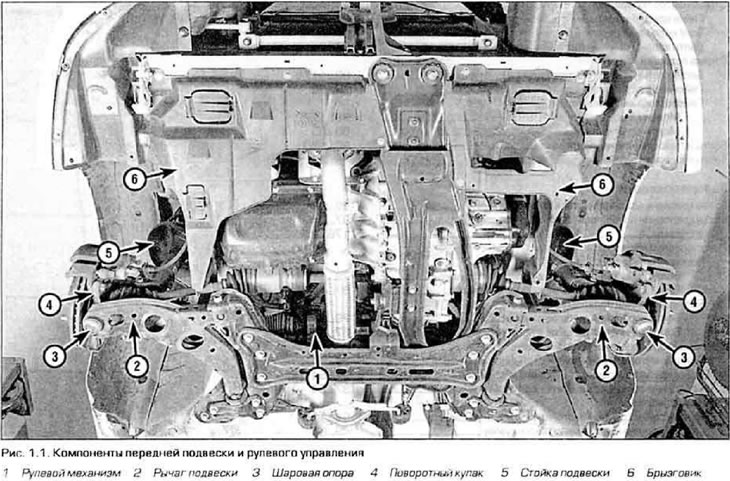
The front suspension (Fig. 1.1) is a MacPherson strut. The upper end of the strut is attached to the car body. The lower strut mount is attached to the steering knuckle. The steering knuckle is connected to the outer end of the suspension arm by means of a ball joint. The ball joint is made as a single unit with the suspension arm, so when it wears out, the support must be replaced along with the arm. To reduce the roll of the car, an anti-roll bar is installed, which is attached to the body using two clamps, and to the suspension arms using earrings.

The front suspension (Fig. 1.1) is a MacPherson strut. The upper end of the strut is attached to…


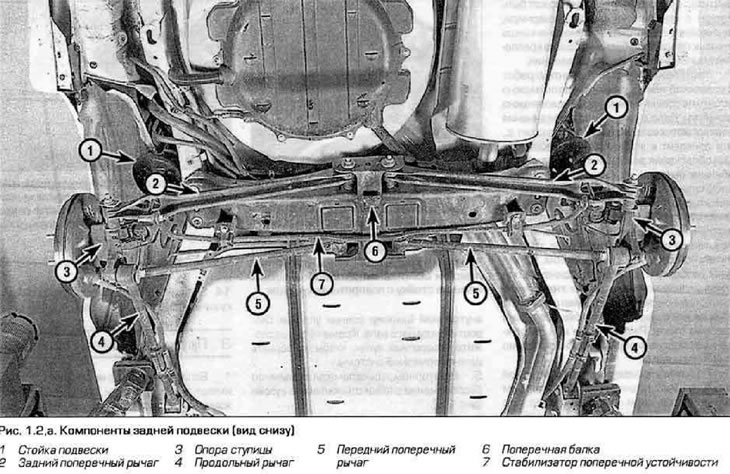
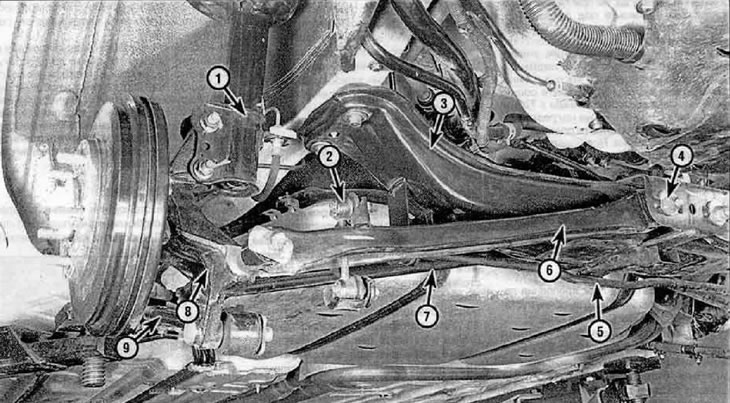
Rear suspension (figure 1.2.a) also consists of a MacPherson strut, four wishbones (two front and two rear) and two longitudinal levers. The upper end of the flock is attached to the car body. The lower end of the strut rests against the rear axle hub support. The outer ends of the wishbones are bolted to the lower parts of the hub supports. In the longitudinal direction, the hub supports are fixed using longitudinal levers. The anti-roll bar is attached to the body using two brackets and to the wishbones using earrings (figure 1.2,b).

Rear suspension (figure 1.2.a) also consists of a MacPherson strut, four wishbones (two front and…


Rear suspension (figure 1.2.a) also consists of a MacPherson strut, four wishbones (two front and…


The rack and pinion steering mechanism is located behind the engine, on the subframe. It is connected to the steering knuckles by means of steering rods. The inner ends of the rods are protected by rubber boots. It is necessary to periodically inspect these covers and check for any tears or grease leaks.


The power steering system consists of a hydraulic pump and a system of hoses and pipes. Periodically check the presence of oil in the booster pump reservoir (see chapter 1).

The steering wheel is mounted on a steering shaft, which is connected to the steering gear via a cardan joint. Increased play in the steering may be due to wear of the universal joint, rack and pinion, tie rod end joints, or loose steering component mounting bolts.

Often when performing repair work on the suspension or steering gear, you may encounter connections that cannot be loosened. The fact is that these connections are exposed to water, dirt, etc., which leads to the formation of rust. To make disassembling these connections easier, generously moisten them with liquid oil or a special liquid and let it soak in for some time, clean the nuts and bolts with a wire brush. As a last resort, you can try to loosen the connection by first tapping it with a hammer. It makes disassembling and heating the connection easier using a soldering iron, although in this case there is an obvious fire hazard. Sometimes, to loosen a nut, you first need to squeeze it. Any connections that are destroyed or damaged during assembly must be replaced with new ones.

The original article is posted on: MazBook

Because the procedures described in this chapter require raising the vehicle. You will need a pair of sturdy supports for the car. A hydraulic trolley jack is preferable as it allows you to lift and support various components during disassembly and assembly.

Caution! Never, under any circumstances, crawl under a vehicle that is supported only by a jack. If you remove any suspension or steering fastener, inspect it carefully and, if necessary, replace it with new ones of the same type, size and quality. Tighten the connections to torque. given in Technical data. Never heat or straighten suspension or steering components. Replace all damaged and deformed parts with new ones.
This article is available at: russian, bulgarian, belarusian, ukrainian, serbian, croatian, romanian, polish, slovak, hungarian
This text was checked by: German Vorobyov
Share with friends on social networks:

Previous
Capella 6 » Car suspension
Next

Suspension and steering technical data
Front suspension strut — removal, inspection and installation
Strut spring — replacement
Steering knuckle — removal and installation
Front Hub and Bearing Assembly — removal and installation
Front anti-roll bar — removal and installation
More articles on repairing other Mazda models
Basic special tool Mazda Familia 5 (1985-1989)
Power steering — general information Mazda3 BK (2003-2009)
General information about car suspension Mazda6 GG (2002-2008)
Vehicle Technical Information — General Overview Mazda CX-5KE (2012-2017)
Coolant — Basic Information Mazda 121 (3) (1996-2003)
Link in different formats to this article
Comments and feedback from visitors
No comments yet


How much will 34 + 45 ?


Capella 6 (1997-2005, petrol) 
  • General information
  • Introduction to guide
  • User manual
  • Troubleshooting
  • Maintenance
  • Power unit
  • 4-cylinder engines
  • 6-cylinder engines
  • Engine overhaul
  • Cooling and ventilation
  • Power and exhaust systems
  • Engine electrics
  • Control system
  • Transmission
  • Mechanical gearbox
  • Automatic gearbox
  • Clutch and drive shafts
  • Chassis
  • Brake system
  • Car suspension
  • Steering
  • Body
  • Exterior (external elements)
  • Interior (internal elements)
  • Doors, windows and locks
  • Electrical equipment
  • Equipment and devices
  • Electrical circuits
Capella 5 (1991-1997) 
  • General information
  • User manual
  • Maintenance
  • Helpful hints
  • Power unit
  • Petrol engines 1.6 and 1.8
  • Petrol engines 2.0
  • 2.5 petrol engines
  • Overhaul engines 1.6 and 1.8
  • Overhaul engines 2.0 and 2.5
  • Diesel engine 2.0
  • Engine electrics
  • Cooling system
  • Air conditioner
  • Carburetor Nikki 30/34
  • Power system (1.6 and 1.8)
  • Power system (2.0 and 2.5)
  • Control system
  • Transmission
  • Mechanical gearbox
  • Automatic gearbox
  • Clutch and axles
  • Chassis
  • Brake system
  • Suspension and wheels
  • Steering
  • Body
  • Exterior (external elements)
  • Interior (internal elements)
  • Doors and windows
  • Electrical equipment
  • Equipment and devices
  • Electrical circuits
Capella 4 (1987-1992) 
  • General information
  • Introduction to manual
  • Vehicle specifications
  • Power unit
  • Engine repair
  • Lubrication system
  • Cooling system
  • Fuel system (carburetor)
  • Fuel injection (FE)
  • Fuel injection (DOHC)
  • Fuel system (diesel)
  • Ignition system
  • Transmission
  • Clutch
  • Gearbox
  • Drive shafts
  • Chassis
  • Front suspension
  • Rear suspension
  • Steering system
  • Brake system
  • Electrical equipment
  • Equipment and devices
  • Electrical circuits
Capella 3 and 4 (1982-1992) 
  • General information
  • User manual
  • Maintenance
  • Power unit
  • Gasoline engine
  • Engine overhaul (gasoline)
  • Diesel engine
  • Cooling and heating
  • Supply system
  • Ignition system
  • Emission reduction
  • Transmission
  • Clutch
  • Mechanical gearbox
  • Automatic gearbox
  • Drive shafts
  • Chassis
  • Brake system
  • Suspension and wheels
  • Steering
  • Body
  • Exterior (external elements)
  • Interior (internal elements)
  • Electrical equipment
  • Equipment and devices
  • Power devices
  • Electrical circuits
Capella 3 (1982-1992, petrol) 
  • General information
  • User manual
  • Maintenance
  • Troubleshooting
  • Late models
  • Power unit
  • Engine in car
  • Engine overhaul
  • Cooling and heating system
  • Fuel and exhaust system
  • Engine electrical system
  • Emission control system
  • Transmission
  • Mechanical gearbox
  • Automatic gearbox
  • Clutch and drive shafts
  • Chassis
  • Brake system
  • Suspension and wheels
  • Steering
  • Body
  • Exterior (external elements)
  • Interior (internal elements)
  • Electrical equipment
  • Equipment and devices
  • Lighting and lamps
  • Electrical circuits
MazBook.ru © 2018–2026 · Mobile version · Articles and news · Sitemap: EN BG BY UA RS HR RO PL SK HU · Feedback · Site search · Add to bookmarks Familia 5 (BF) · Familia 6 (BG) · Capella 3 (GC) · Capella 3 and 4 (GC) · Capella 4 (GD) · Capella 5 (GE) · Capella 6 (GF) · Mazda3 BK · Mazda6 GG · CX-5KE · Mazda 121 (3) · Mazda BT-50 (1) ·
By continuing to use the site, you agree to the use of cookies 🔐